

How a Classified Defense Organization Cut Days of Engineering Work to Minutes with Leo AI During Wartime
Background
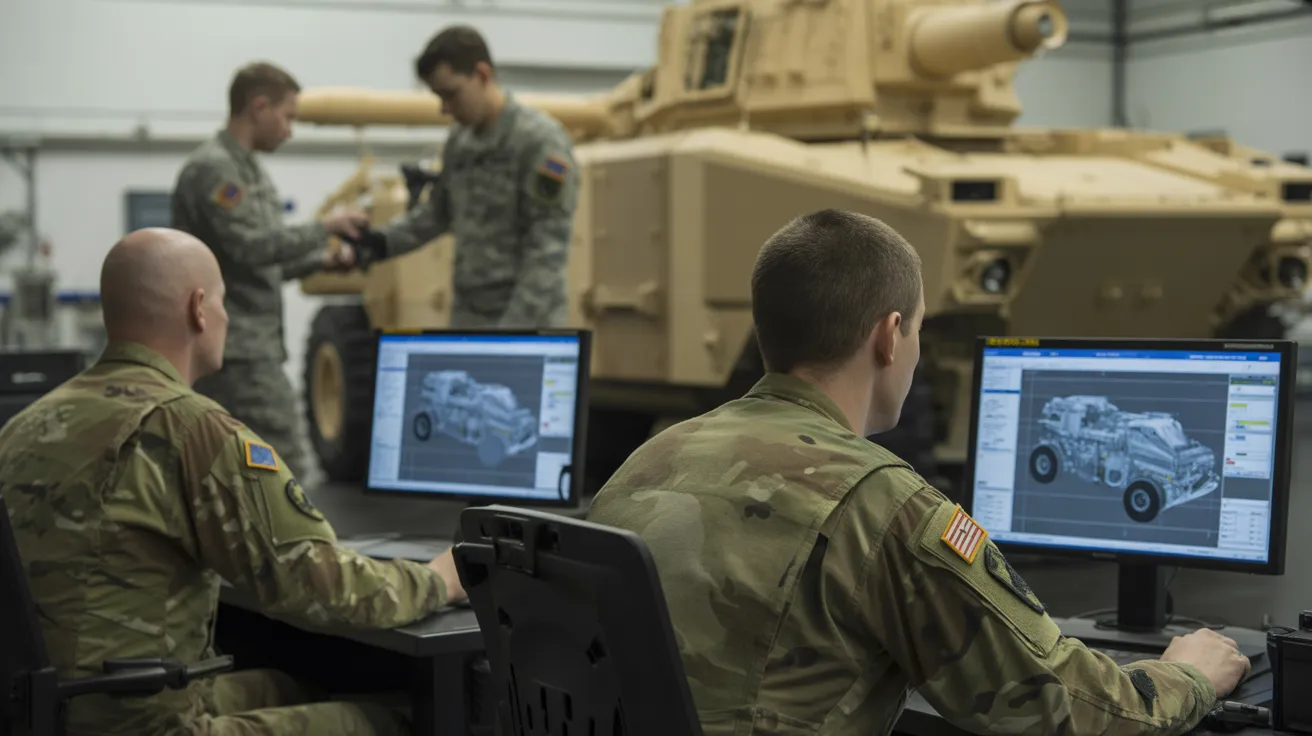
This engineering division is responsible for the design, manufacturing, and maintenance of infantry fighting vehicles for a major defense organization. The team includes commissioned officers with advanced engineering degrees, working on complex mechanical and structural problems under operational conditions that leave no room for error.
The unit completed their Leo AI implementation just weeks before a major regional conflict escalated into active operations. The timing is not a footnote. It is central to the story.
When conflict operations intensified, engineering workloads spiked immediately. The team was simultaneously managing vehicle maintenance demands, urgent design tasks, and operational support, all under the kind of pressure where cutting corners is not a choice but an inevitability when time runs out. The engineers had seen what happens when time pressure forces systems into the field without full calculation and validation. They had experienced failures, in the past, on systems that moved to manufacturing without the time to properly verify the design. Those failures carry consequences that go well beyond cost overruns.
Leo was not a nice-to-have in this context. It became the tool that allowed critical engineering work to get done at all.
The Security Problem That Made Everything Else Impossible
Before addressing what Leo solved technically, it is worth addressing what it solved operationally.
Engineers in this unit work with sensitive technical data. Vehicle designs, system specifications, structural parameters. When they tried using general-purpose tools like Gemini or ChatGPT, they ran into an immediate and serious constraint: every query required manually scrubbing and rewording the inputs to remove any sensitive or classified reference before it could be submitted. That meant using personal or external machines, disconnected from their secure environment, and carefully reframing every technical question to avoid exposure. The result was a tool that was both unreliable and operationally unusable at any meaningful scale.
Leo is SOC 2 Type 2 certified, with enterprise-grade security architecture that meets the data handling requirements of a defense environment. The Leo team configured and delivered dedicated hardware directly to the unit, handling setup from end to end. Engineers access Leo on those machines, inside their secure environment, without needing to scrub, reword, or proxy a single input. The security barrier that made other AI tools effectively unusable was removed entirely.
That is what made everything below possible.
The Challenge
Defense engineering teams face a version of the same problem that affects every mature engineering organization, made significantly worse by operational tempo and resource constraints.
When a problem falls outside a single engineer's specialty, or when a critical reference cannot be found fast enough, the options are limited: spend days searching through manuals and standards, wait for a senior expert to become available, or escalate outside the organization entirely. In an active conflict environment, none of those timelines are acceptable. And the consequence of not doing the analysis is not a delayed project. It is a system that enters the field under-validated.
The team had already tried general-purpose AI tools. The conclusion was consistent: too generic, unable to reason through specific engineering parameters, and with no grounding in verified technical sources. In a defense engineering context, an answer you cannot trace to a trusted source is an answer you cannot use.
What Changed
USE CASE 1
Hydraulic System Failure Analysis
Sr. Engr. E., Senior Mechanical Engineer and Engineering Officer
Time saved: 3+ days reduced to under 1 hour. Estimated risk reduction: significant, previously unresolvable under operational timeline.
“I was developing a hydraulic system for one of our vehicles and running into serious execution problems that I could not get to the bottom of. We’re talking about flow rates, pressure drop across components, actuator sizing, trying to reconcile what the theoretical model said the system should do with what we were actually seeing in hardware. I spent over three days working through it manually. Textbooks. Standards. Hand calculations. Nothing was resolving the discrepancy. I tried Gemini. It could not reason through the specific parameters of my system at all. It gave me generic hydraulics information with zero ability to identify where my assumptions were breaking down or what was actually causing the behavior I was seeing. It was not useful.
Then I remembered that I had access to Leo. I uploaded a photograph of the system and started a technical conversation. Leo asked the right diagnostic questions. It walked through the system parameters with me, identified the specific assumptions in my pressure and flow calculations that were incorrect, and gave me concrete corrective recommendations, each one grounded in hydraulic engineering principles from verified sources I could actually cite. I applied those recommendations directly to the system. I saw measurable improvement in system behavior immediately.
What I want to be clear about is the context. We were already in an extremely high-pressure operational period. This was not a routine design task. If Leo had not resolved this in the time it did, that system would have moved forward with an unresolved hydraulic issue. We did not have three more days. Leo gave me the answer in under an hour. I genuinely regret not starting with Leo at the beginning of the project. I would have saved the entire three days and avoided the risk entirely.”
USE CASE 2
CNC Machine Programming, Zero Prior Expertise
Sr. Engr. E., Senior Mechanical Engineer and Engineering Officer
Outcome: Complete functional program generated in seconds for a domain outside the engineer's training.
“I was assigned a CNC machine programming task with no background in CNC. The requirement was to define the complete machining sequence for a specific part geometry: tool paths, cutting operations, feed rates, the full program. Without Leo, I would have had to find a CNC specialist and wait, or attempt to teach myself from scratch under time pressure, neither of which was realistic given the operational situation we were in.
I provided Leo with the CAD model and the manufacturing drawings. I described the output I needed. In seconds, I had a structured CNC program. I read through the code. It was not flawless at the line level, but the program architecture, the sequencing logic, and the machining approach were exactly correct. For someone without CNC expertise, that is the entire delta between being stuck and being able to move forward. I could review and validate the logic rather than generate it from zero. We got the task done.”
USE CASE 3
Work Tool Design from Photograph
Lt. T.M., Lieutenant, Vehicle Systems Engineering
Time saved: Minimum 1 week reduced to 30 minutes. Estimated labor savings per occurrence: 35 to 40 engineering hours.
“We needed a specific work tool and we needed it fast. I had a photograph of the physical part we needed to replicate or adapt. I gave Leo the photograph and described what I needed. Leo generated a complete 3D CAD model from that image. The whole process took thirty minutes from the moment I started the conversation to a usable CAD output.
Without Leo, that task would have gone through our standard design cycle: hand sketches, dimensioning, full CAD modeling, revision cycles. Minimum one week. Probably closer to two given the workload we were carrying. What Leo compressed into thirty minutes would have consumed somewhere between thirty-five and forty engineering hours under normal conditions. And those are hours we did not have.”
USE CASE 4
Conical Connector Force and Stress Analysis
Lt. T.M., Lieutenant, Vehicle Systems Engineering
Time saved: Multi-week external academic engagement reduced to 30 minutes. Problem class: previously unsolvable within operational timeline.
“This is the use case I keep coming back to because it is the one that most clearly shows what Leo can do that nothing else can.
We had a complex structural problem involving the tightening force analysis of a conical connector on a vehicle system. To do this correctly, you need to calculate the clamping force generated by the tapered interface under a specified torque, accounting for the cone half-angle, the friction coefficient at the contact surface, the resulting contact stress distribution, and the margin against both yielding and self-loosening under operational vibration and load cycling. This is not something you solve with a handbook formula. It requires a full analytical derivation, and the answer has to be right because the consequences of getting it wrong on a vehicle system are not abstract.
Our assessment before we tried Leo was that we would need to engage with an outside academic institution to get this done properly. That process, submitting the problem, coordinating, waiting for analysis, reviewing the output, takes weeks. We were not going to get that answer in time.
Leo solved it in thirty minutes. Full derivation. Analytical calculation of clamping force, contact stress, and safety margins. Every step sourced from verified engineering references, with the source citations visible so I could confirm we were not working from forum posts or unverified content. No hallucinations. No Reddit. The output was at the level of quality I would expect from a senior analyst or an academic collaborator, delivered in a fraction of the time. We used the results. We trusted them.”
USE CASE 5
CAD Generation from Catalog Reference and Photo
Lt. T.M., Lieutenant, Vehicle Systems Engineering
Outcome: Direct CAD model generation from 2D reference, STP output compatible with existing engineering environment.
“We tested Leo’s CAD generation capability by providing a catalog page and a photograph of a part and asking it to generate a working CAD model. It produced a clean STP file that worked directly in our environment. That is a capability that opens a real path to digitizing legacy components and catalog parts without running a full manual modeling effort for each one. For a unit that maintains a fleet of older vehicle platforms with limited digital design records, that matters.”
USE CASE 6
Calculations and Standards Lookup
Lt. I., Lieutenant, Vehicle Systems Engineering
Outcome: Trusted, source-cited technical outputs replacing unreliable general search.
“The calculations work. That is what matters most to me in an environment like this. Leo pulls from verified engineering sources and shows you where the answer came from. I tested it on coatings specifications, looking for dimensional tolerances referenced in a specific standard. It returned accurate dimensional data with the source citation from the relevant internal standard. The CAD output format is STP, which integrates directly with our workflow. The calculations I needed worked correctly and I trusted the output enough to act on it. That bar, trusted output from a verified source, is the only bar that matters when you are working on systems that go into the field.”
Leadership Perspective
Maj. N.V., Commanding Officer, Vehicle Engineering Division
“I came into this partnership as a commander, not as an engineer running Leo myself. What changed my view was sitting in the room and hearing directly from my engineers about the specific problems Leo had solved for them. Not general impressions. Specific problems they had been stuck on, with specific numbers. A hydraulic analysis that would have taken three days resolved in under an hour. A structural calculation that would have required outside academic engagement done in thirty minutes with sourced, trustworthy output. I was not expecting that. When an engineering team operating under the kind of pressure we are carrying right now tells me that a tool is making real problems solvable, that is not a small thing.”
Results at a Glance
Problem
Previous Approach
With Leo
Time Saved
Hydraulic system failure analysis
3+ days manual calculation, unresolved
Under 1 hour, resolved
~95%
CNC programming outside expertise
Specialist required, days of wait
Seconds
Entirely new capability unlocked
Work tool CAD from photograph
Full design cycle, 1 to 2 weeks
30 minutes
~95%
Conical connector force and stress analysis
External academic engagement, weeks
30 minutes, sourced derivation
Weeks to minutes
CAD from catalog page and photo
Full manual modeling effort
Automated STP output
Significant
Standards and coatings lookup
Manual search, unverified sources
Instant, source-cited output
Hours to minutes
The Partnership Model
One dimension of this deployment that stood out beyond the technical performance was the commitment Leo brought to making the team operational under genuinely difficult circumstances.
A Defense Technology Integration Specialist from the Department of Defense Partnership Program described it directly:
“What stands out about Leo is not just the product. It is the level of commitment they bring to making their customers successful. This team is operating in an active conflict environment with constrained resources and extreme time pressure. Leo did not hand over licenses and step back. They provided dedicated hardware, configured it from end to end, handled all the security requirements so the engineers could work in their actual environment without compromise, and stayed engaged through every adoption challenge. When you are working with an engineering team under those conditions, that kind of partnership is not a nice-to-have. It is the reason the tool got used at all. And the results speak for themselves.”
What Comes Next
The expansion criteria the unit’s leadership identified are specific and outcome-driven. If Leo can accelerate the onboarding of newly assigned engineers, compressing months of institutional knowledge transfer into a tool that a new lieutenant can start using productively on day one, that is the primary trigger for broader deployment.
The secondary trigger is consistent, documented ROI: time savings on calculations, reduction in the risk of under-validated systems entering the field, and quality improvements that show up in engineering output. In an environment where the cost of a missed calculation is not a rework cycle but a vehicle system in the field, that ROI calculation is not theoretical.
STOP LOSING ENGINEERING KNOWLEDGE
Every resignation email is a knowledge transfer you are not ready for.
Leo AI makes the institutional knowledge already in your CAD vault searchable by every engineer on your team, before the next senior engineer walks out the door.
Schedule a Demo →

#1 New AI Software Globally - G2 2026

Enterprise-grade security

Trusted by world-class engineering teams