
AI for Engineering Knowledge Management
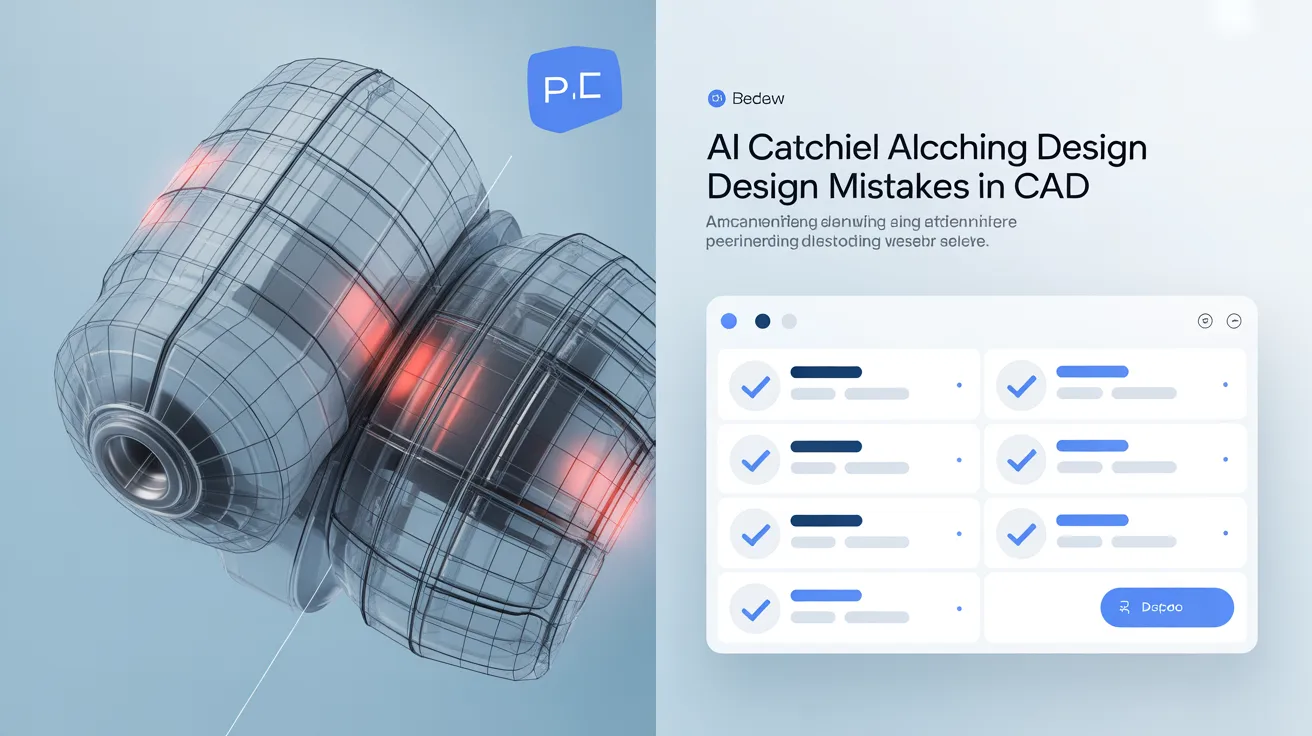
AI-powered CAD design review tools catch manufacturing errors, tolerance issues, and design mistakes before they reach production. Here's what actually works in 2026.
·
⏱
10 min read

Michelle Ben-David
Michelle Ben-David is a mechanical engineer and Technion graduate. She served in an IDF elite technology and intelligence unit, where she developed multidisciplinary systems integrating mechanics, electronics, and advanced algorithms. Her engineering background spans robotics, medical devices, and automotive systems.
BOTTOM LINE
AI-powered CAD design review is not about replacing experienced engineers. It is about giving every engineer access to the collective knowledge and systematic checking capability that only the most senior, most experienced team members can provide today. The technology catches the errors that manual reviews consistently miss: tolerance stack-ups across assemblies, process-specific manufacturability issues, drawing inconsistencies, and repeat mistakes from past programs.
The implementations that succeed are the ones that integrate into existing workflows, run as a pre-check rather than a replacement, and are tuned to the company's specific standards and manufacturing capabilities. The ROI is measurable in reduced ECOs, shorter review cycles, and fewer manufacturing surprises.
If your team's design reviews still depend on having the right people in the room and hoping they catch everything, automated review tools are worth a serious look. The right people will not always be in the room. The AI system is always there, and it never gets tired on drawing number fifteen.
Design reviews are one of those things every engineering team does, nobody loves, and almost everyone admits could be better. The typical process looks like this: an engineer finishes a design, schedules a review meeting, prints out drawings or projects a CAD model on a conference room screen, and a group of colleagues spends 30 to 60 minutes scanning for issues. Some problems get caught. Many do not. The ones that slip through show up weeks or months later as manufacturing defects, assembly problems, or field failures.
The dirty secret of manual design reviews is that they are heavily dependent on who is in the room. A senior engineer with 20 years of tooling experience will catch a draft angle problem instantly. A structural analyst will spot an under-constrained load path. But no single person, and no realistically sized review team, has expertise across every discipline that affects whether a part will be manufactured correctly, assemble properly, and survive its service life. Things fall through the cracks not because people are careless, but because the scope of what needs checking exceeds what human attention can reliably cover.
AI-powered CAD design review tools are changing this equation. Not by replacing the human review process, but by adding an automated layer that systematically checks for the errors that experienced engineers know to look for but that manual reviews inconsistently catch. The best implementations work like a tireless junior engineer who has memorized every design standard, every manufacturing constraint, and every lesson learned from past production issues, and who checks every single feature on every single part, every single time.
What Manual Design Reviews Actually Miss
To understand what AI design review adds, you need to understand the failure modes of manual reviews. They are not random. They follow predictable patterns.
Attention fatigue is the biggest factor. Studies in cognitive psychology have consistently shown that human ability to detect errors in visual inspection tasks degrades after about 20 to 30 minutes. By the time a review team is looking at the fifteenth drawing in a package, the detection rate for subtle issues drops significantly. This is not a character flaw; it is just how human visual processing works. Complex assemblies with hundreds of parts simply overwhelm the capacity of a manual review session.
Domain blindness is the second factor. Mechanical designers catch mechanical design issues. Manufacturing engineers catch manufacturing issues. Quality engineers catch tolerance stack-up problems. But in most organizations, not all these disciplines are present at every review. And even when they are, cross-domain issues (where a design decision in one area creates a problem that manifests in another) are systematically under-detected. The designer who chose a tight tolerance to ensure fit may not realize it requires a grinding operation that triples the machining cost.
Institutional knowledge gaps grow over time. When the engineer who spent six months debugging a press-fit interference issue on a previous program retires, that hard-won knowledge leaves with them. The next designer makes the same mistake, and it gets caught in production instead of in review. This is the tribal knowledge problem applied specifically to design review, and it is pervasive in manufacturing companies with any turnover at all.
Standard compliance checking is tedious and inconsistent. GD&T rules, material callout conventions, drawing format standards, and company-specific design rules are well-defined on paper but inconsistently applied in practice. Checking every dimension, every callout, and every note on a drawing against the applicable standard is exactly the kind of repetitive, detail-oriented work that humans are worst at and automated systems excel at.
The cost of missed errors escalates rapidly through the product development process. The rule of ten, a widely cited principle in quality engineering, states that the cost to fix an error increases by roughly 10x at each stage: $1 to fix in design, $10 in prototyping, $100 in production tooling, $1,000 in production. An error that an automated review catches at the design stage and that a manual review would have missed until first article inspection represents a 100x cost avoidance.
IN PRACTICE
Unlike general AI, Leo uses a Large Mechanical Model trained on 1M+ technical sources.
Dorian G.
How AI-Powered Design Review Works
AI CAD design review tools operate on multiple levels, from geometric analysis of 3D models to semantic understanding of engineering drawings to contextual evaluation against design history and manufacturing knowledge bases.
At the geometric level, AI tools analyze the 3D CAD model for features that are known to cause manufacturing or assembly problems. This includes wall thicknesses below minimum machinable or moldable values, draft angles that are insufficient for the specified manufacturing process, undercuts that require side actions or secondary operations, fillet radii that are too small for the specified tool sizes, sharp internal corners that create stress concentrations, and features that violate minimum spacing rules for the given process (hole-to-edge distances, boss spacing, rib placement).
These geometric checks are not new in concept. Traditional DFM (design for manufacturability) checkers have been doing rule-based geometric analysis for years. What AI adds is the ability to learn from actual manufacturing outcomes. Instead of applying generic rules (minimum wall thickness for injection molding is 1mm), an AI system trained on your company's actual production data can apply learned rules (this resin, on this machine, with this mold maker's process, fails below 0.8mm in flow-restricted areas but works fine at 0.6mm in gate-adjacent regions). The rules become specific to your manufacturing reality, not textbook generalities.
At the drawing level, AI tools can now read and interpret 2D engineering drawings with remarkable accuracy. This includes parsing GD&T callouts, verifying that datum references are consistent and complete, checking that dimensions are properly formatted and non-conflicting, validating material and finish callouts against standards databases, and flagging ambiguous or missing information that would cause questions on the shop floor.
The contextual layer is where AI design review gets genuinely powerful. By connecting to PLM and PDM systems, an AI tool can compare a new design against the company's entire design history. Has a similar geometry caused a manufacturing issue before? Is the specified tolerance achievable with the process and equipment available in-house? Was a particular material-surface treatment combination tried and rejected on a previous program? This is the institutional memory that manual reviews depend on having the right person in the room to provide.
What AI Design Review Catches That Humans Consistently Miss
Based on published case studies and industry reports, certain categories of errors are disproportionately caught by automated systems compared to manual reviews.
Tolerance stack-up issues across assemblies are the number one category. When individual part tolerances are each reasonable in isolation but accumulate to create interference or excessive clearance in the assembly, manual review rarely catches it without explicit stack-up analysis. AI tools that analyze the full assembly tolerance chain flag these issues automatically.
Process-specific manufacturability problems for secondary operations are frequently missed. A designer may specify a surface finish that requires grinding, but the part geometry makes fixturing for grinding impractical. Or a hole pattern requires a specific machining sequence that conflicts with how the part will be set up on the mill. These are issues that experienced manufacturing engineers catch, but only if they are looking at the specific part and mentally simulating the machining sequence.
Drawing completeness and consistency errors are caught far more reliably by automated tools than by human reviewers. Missing dimensions, conflicting tolerances between views, datum references that do not match across the drawing set, and notes that reference obsolete standards are exactly the kind of detail-level errors that humans skim over after the first few drawings in a review session.
Material and process compatibility issues are another category. Specifying a heat treatment that is incompatible with the chosen alloy, calling out a coating that does not adhere to the base material, or selecting a fastener material that creates a galvanic corrosion couple with the mating part are errors that require cross-referencing multiple databases. AI tools that have access to materials data and process compatibility matrices catch these systematically.
Repeat errors from past programs are perhaps the most valuable catch. When an AI system has access to corrective action reports, NCRs (non-conformance reports), and engineering change order histories, it can flag design features that have caused problems before. This is the automated equivalent of having every experienced engineer in the company looking over the designer's shoulder, which is obviously impossible in a manual review.
Implementing AI Design Review Without Disrupting Existing Workflows
The practical challenge with any new design review tool is adoption. Engineers are skeptical of tools that generate noise (false positives), slow down their workflow, or require them to change how they work. The implementations that succeed share several characteristics.
First, they integrate into the existing CAD and PLM environment rather than requiring a separate application. If an engineer has to export a model, upload it to a web portal, wait for results, and then cross-reference back to the original CAD session, adoption will be low regardless of how good the checks are. The tools that work in practice sit inside or alongside the CAD environment and present results in context: this feature, on this part, has this specific issue, with this recommendation.
Second, they are tunable. Every company has different design standards, manufacturing capabilities, and risk tolerances. An AI design review tool that applies generic rules will generate too many false positives for some companies and miss important issues for others. The ability to customize rules, adjust sensitivity, and teach the system about company-specific standards and processes is what separates useful tools from academic demos.
Third, they do not try to replace the human review. The most effective implementations position AI review as a pre-check that runs before the formal design review meeting. The automated system catches the routine, checkable errors so that the human review can focus on the harder questions: Is this the right architecture? Does this design approach make sense for the application? Are we solving the right problem? Those are judgment calls that AI is not equipped to make, and they are where senior engineering expertise adds the most value.
Leo AI takes this approach by working as an intelligence layer on top of existing PLM and PDM systems. Instead of requiring a separate tool or workflow change, it integrates with platforms like SolidWorks PDM, Autodesk Vault, PTC Windchill, Siemens Teamcenter, and Arena PLM, giving engineers access to design history, past issues, and institutional knowledge directly in their working context. The platform is SOC-2 certified and GDPR compliant, and it does not train its AI models on customer data, which matters for companies concerned about proprietary design information.
For teams starting with AI-assisted design review, the recommended approach is to begin with a pilot on a single product line or project. Run the AI review in parallel with the existing manual process for several review cycles. Compare what each catches. Use the results to tune the system's rules and sensitivity. Then gradually expand as confidence builds.
Keep Reading: DFM Analysis in 2026: The Best Tools for Getting Instant Manufacturing Feedback · The Engineer's Guide to AI-Powered Design Review: Catch Errors Before Manufacturing · Engineering Change Orders and AI: How to Cut Rework and Speed Up ECOs in 2026 · AI for Mechanical Engineers: The Complete Guide for 2026
The Real Impact on Engineering Teams
The measurable impacts of AI-powered design review fall into three categories: error reduction, time savings, and knowledge retention.
On error reduction, teams implementing automated design review consistently report 30% to 50% fewer engineering change orders reaching the prototyping and production stages. Those ECOs represent real costs in rework, schedule delays, and scrap. One study by the Lifecycle Insights research firm found that companies using AI-assisted design checks reduced late-stage design changes by 40% over a 12-month period.
The time savings are twofold. First, automated pre-checks reduce the duration of formal review meetings because the routine issues have already been identified and addressed. Reviews that previously took 60 minutes now take 30 because the team is not spending time spotting missing fillets or incorrect surface finish callouts. Second, the time engineers spend responding to manufacturing questions ("what does this dimension mean?" "is this tolerance achievable?") drops because the automated review catches ambiguities before they reach the shop floor.
Knowledge retention may be the most strategically valuable impact. When design review knowledge is embedded in an AI system, it does not leave when people leave. The lessons from past manufacturing issues, the tribal knowledge about what works and what does not in your specific production environment, the accumulated judgment of experienced engineers: all of it is preserved in the system's rules and patterns. New engineers benefit from institutional knowledge from day one instead of spending years building their own experience base through trial and error.
One engineer described the value of having traceable, source-backed answers: "Unlike general AI, Leo uses a Large Mechanical Model trained on 1M+ technical sources." That specificity matters when you are making design decisions that affect manufacturing outcomes.
FAQ
Catch Design Errors Before They Ship
AI-powered review with your full design history.
Leo AI connects to your PLM and gives your team instant access to past design issues, manufacturing lessons, and company standards. Stop catching errors in production.
Schedule a Demo →

#1 New AI Software Globally - G2 2026

Enterprise-grade security

Trusted by world-class engineering teams