AI for Engineering Knowledge Management
Learn how AI design review tools help mechanical engineers catch costly errors before parts reach the shop floor, reducing scrap rates and accelerating time to market.
·
⏱
5 min read

Michelle Ben-David
Michelle Ben-David is a mechanical engineer and Technion graduate. She served in an IDF elite technology and intelligence unit, where she developed multidisciplinary systems integrating mechanics, electronics, and advanced algorithms. Her engineering background spans robotics, medical devices, and automotive systems.
BOTTOM LINE
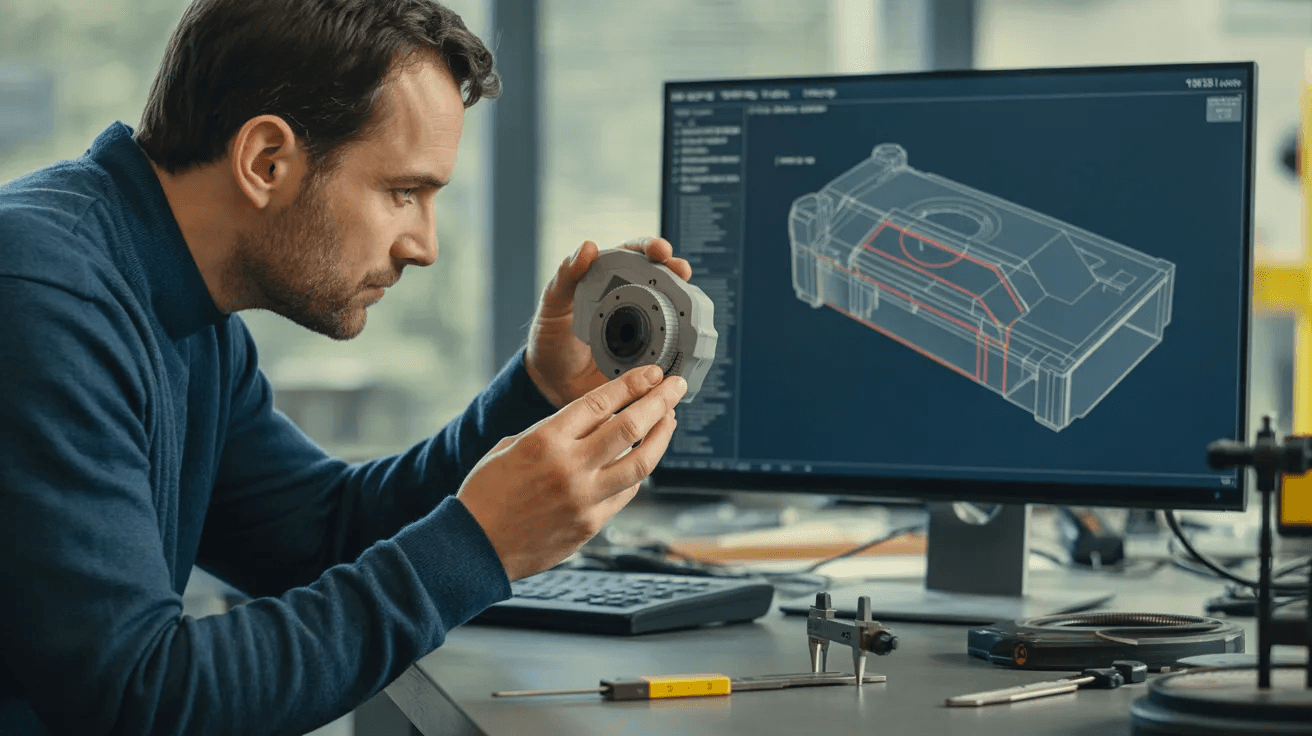
Design errors that reach the shop floor are among the most expensive problems in mechanical engineering, and the traditional review process was never designed to catch them all. AI-powered design review gives your team a systematic way to check every design against manufacturing constraints, company standards, and institutional knowledge before a single part is made.
It does not replace experienced engineers. It makes sure their knowledge is applied consistently, even when they are not in the room. If your team is still relying solely on manual reviews and tribal knowledge, it is time to close that gap.
Every mechanical engineer has a story about the design error that made it all the way to the shop floor. Maybe it was a wall thickness that looked fine in the CAD model but couldn't survive the injection molding process. Maybe it was an interference fit that only showed up when someone tried to assemble the prototype. Or maybe it was a tolerance stack-up that seemed reasonable on paper but turned into a nightmare at scale.
These mistakes are expensive. Industry research suggests that catching an error during the design phase costs a fraction of what it costs to fix after tooling has been cut or parts have shipped. And yet, traditional design review processes still rely heavily on manual checklists, tribal knowledge locked in senior engineers' heads, and review meetings that happen too late in the cycle to make meaningful changes without blowing the schedule.
That is starting to change. AI-powered design review tools are giving engineering teams a way to systematically check designs against manufacturing constraints, company standards, and lessons learned from past projects, all before a single part is made. Here is what that looks like in practice and why it matters for your team.
The standard design review process at most engineering organizations follows a familiar pattern. An engineer finishes a design, schedules a review meeting, presents the model to a group of peers and senior engineers, and collects feedback. The problem is not that this process is useless. It is that it is slow, inconsistent, and dependent on whoever happens to be in the room.
If your best DFM expert is out sick the day your design review happens, critical feedback gets missed. If your company has 15 years of injection molding lessons learned sitting in a shared drive somewhere, nobody is pulling those up during the review. And if the review happens three weeks into a four-week timeline, the pressure to push forward usually wins over the pressure to go back and fix things.
Manual checklists help, but they have limits. They capture general rules but rarely capture the organization-specific knowledge that separates good designs from great ones. They also cannot adapt. A checklist written for machined aluminum parts does not help when you are suddenly designing for sheet metal or additive manufacturing.
The result is predictable: errors slip through, prototypes fail, tooling gets reworked, and schedules stretch. Not because engineers are careless, but because the review process was never built to handle the volume and complexity of modern product development.
IN PRACTICE
"It's the only AI for Mechanical Engineers that actually understands CAD, PLM, and the realities of enterprise design work. With Leo, our team improves design quality, reduces mistakes, and shortens time-to-market. Instead of wasting hours on repetitive searches and calculations, we focus on making better products and leading our category." — Uriel B., Field Warfare and Survivability Specialist
AI-powered design review works differently because it does not rely on who is available or what someone remembers. Instead, it draws from the full scope of an organization's engineering knowledge, past design decisions, industry standards, supplier feedback, and manufacturing constraints, and applies that knowledge consistently to every design that passes through the system.
In practical terms, that means an engineer can get feedback on a design at 11pm on a Tuesday, not just during a scheduled review meeting. It means the same manufacturing constraints that tripped up a project two years ago get flagged automatically on a new design today. And it means junior engineers get access to the kind of institutional knowledge that used to take years of experience to accumulate.
The technology behind this varies, but the most effective tools combine large-scale technical knowledge bases (covering standards like ASME, ISO, and material specifications) with the ability to index an organization's own data: PDM vaults, PLM records, past ECOs, supplier quality reports, and design guidelines that live in documents most people have forgotten about.
This is not about replacing the design review meeting. It is about making sure that by the time a design reaches that meeting, the obvious issues have already been caught and resolved. The human reviewers can then focus on the higher-level questions: Is this the right approach? Are there better alternatives? Does this align with the product strategy?
The errors that cost the most money are usually not exotic failures. They are common, repeatable mistakes that fall into a handful of categories.
Manufacturability violations are the most straightforward. Wall thicknesses that are too thin for the process, draft angles that will cause parts to stick in the mold, undercuts that require side actions nobody budgeted for. AI tools trained on manufacturing data can flag these based on the specific process and material selected, not just generic rules of thumb.
Tolerance and fit issues are harder to catch manually because they require analyzing the full assembly context. A shaft-to-bore fit that works fine in isolation might create problems when thermal expansion is factored in, or when the tolerance stack-up across five mating parts is calculated end to end. AI can run these analyses systematically rather than relying on an engineer to spot-check critical dimensions.
Standards compliance gaps show up when designs reference outdated specifications or fail to meet industry requirements. An AI tool connected to current standards databases can verify that material callouts, surface finishes, and testing requirements align with the latest revisions of ASME, ISO, or customer-specific specs.
Reuse opportunities are the errors you never see because they are errors of omission. When an engineer designs a custom bracket that is functionally identical to one that already exists in the company's vault, that is wasted effort and added cost. AI-powered part search can surface existing designs that match or nearly match what is needed, eliminating redundant custom work.
Lessons-learned violations are the most organization-specific category. Every company has a history of failures, near-misses, and hard-won design rules that came from expensive field returns or manufacturing scrap. An AI system that indexes these lessons and applies them to new designs acts as an institutional memory that never forgets and never retires.
Not every tool that slaps "AI" on its marketing page actually delivers meaningful design review capabilities. Here is what separates the useful ones from the hype.
First, it needs to connect to your actual data. If the tool can only reference generic engineering knowledge but cannot access your PDM vault, your company design standards, or your past project files, it is essentially a search engine with a chat interface. The real value comes from organization-specific knowledge: your supplier constraints, your process capabilities, your failure history.
Second, it needs to cite its sources. An AI that tells you "this wall thickness is too thin" without telling you where that rule comes from is not helpful in an engineering context. Engineers need to verify, to trace the recommendation back to a standard, a past failure report, or a company guideline. Tools that provide transparent reasoning and traceable citations build trust. Tools that give unsourced opinions get ignored.
Third, it should work within your existing workflow. If engineers have to export their model, upload it to a separate platform, wait for results, and then manually cross-reference back to their CAD environment, adoption will be low. The best tools integrate with the systems engineers already use: SolidWorks, CATIA, NX, and the PDM/PLM platforms behind them.
Fourth, look for accuracy on technical content. General-purpose AI models frequently get engineering math wrong, hallucinate material properties, or cite standards that do not exist. Tools built specifically for engineering, trained on verified technical sources, consistently outperform generic chatbots on the questions that actually matter during design review.
Keep Reading: DFM Analysis in 2026: The Best Tools for Getting Instant Manufacturing Feedback · AI CAD Design Review: Automated Error Checking That Catches What Engineers Miss · Engineering Change Orders and AI: How to Cut Rework and Speed Up ECOs in 2026 · AI for Mechanical Engineers: The Complete Guide for 2026
Rolling out AI design review does not require ripping up your existing process. The most successful teams start by layering AI checks onto their current workflow rather than replacing it.
A practical starting point is to use AI as a pre-review filter. Before a design goes to the formal review meeting, run it through an AI check to flag manufacturability issues, standards compliance gaps, and potential reuse opportunities. This catches the low-hanging fruit early and frees up review meeting time for the discussions that actually need human judgment.
The next step is connecting the tool to your organization's knowledge base. This is where platforms like Leo AI become particularly valuable, because they can index your PDM vault, your PLM records, and your internal documentation to surface organization-specific insights rather than just generic engineering rules. When an engineer asks "has anyone designed something like this before?" or "what tolerance did we use on the last project with this supplier?", the AI can pull answers from your own data instead of guessing.
Over time, teams that use AI design review consistently report two things: fewer errors making it to manufacturing, and faster design cycles because engineers spend less time searching for information and more time actually engineering. The math is simple. If a design review catches one fewer error per project that would have cost tooling rework or prototype respins, the tool pays for itself quickly.
FAQ
Review Designs Smarter
Catch manufacturing errors before they cost you time and money.
Leo AI checks your designs against your organization's full knowledge base, standards, and past lessons learned, so nothing slips through the cracks.
Schedule a Demo →

#1 New AI Software Globally - G2 2026

Enterprise-grade security

Trusted by world-class engineering teams