
AI for Engineering Knowledge Management
AI-generated CAD models look impressive in demos but fail in production. Here's why mesh output, missing tolerances, and no design history create real problems, and what engineering teams should do instead.
·
⏱
9 min read

Dr. Maor Farid
Maor Farid is the Co-Founder and CEO of Leo AI, the first AI platform purpose-built for mechanical engineers. He holds a PhD in Mechanical Engineering and completed postdoctoral research at MIT as a Fulbright fellow. A Forbes 30 Under 30 honoree and former AI researcher and Mechanical Engineer in an elite military intelligence, Maor leads Leo AI's mission to transform how engineering teams design better products faster.
BOTTOM LINE
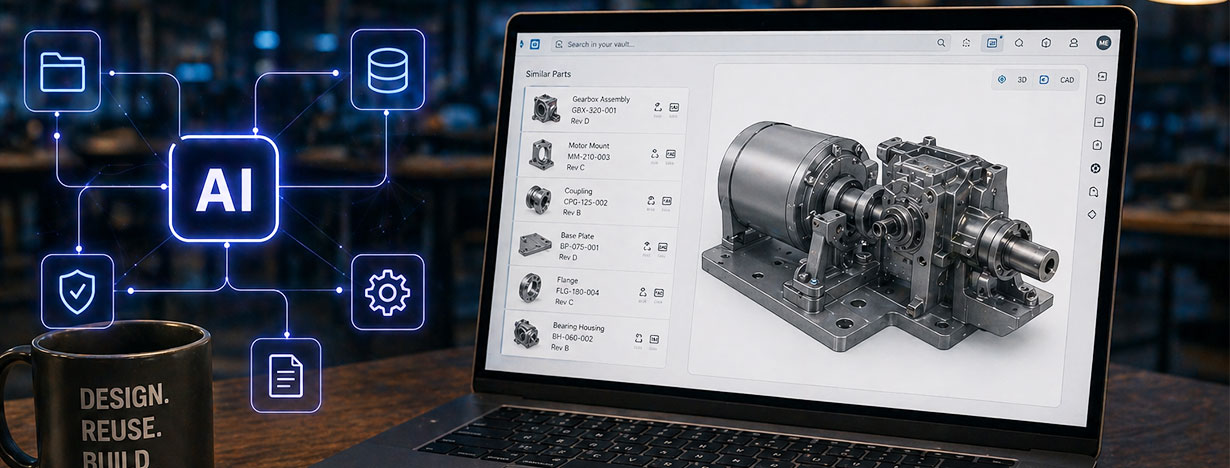
AI-generated CAD models in 2026 are fundamentally mesh output: non-parametric geometry missing tolerances, material data, revision history, and manufacturing metadata. The conversion and validation effort needed to make this output production-ready often exceeds the time saved by automated generation. For most engineering teams, the higher-impact approach is AI-powered retrieval of existing validated parts rather than AI generation of new unvalidated geometry. Leo AI searches your PDM vault with natural language and finds production-ready parts with full metadata intact.
Every few weeks, a new AI tool releases a demo showing geometry appearing on screen from a text prompt. The part looks clean, the rendering is beautiful, and the comments section fills up with some version of "CAD engineers are done." Then an actual mechanical engineer downloads the output, opens it in SolidWorks or Creo, and discovers what the demo carefully avoided showing.
The model is a mesh. There are no features to edit. The dimensions are approximate. There is no way to apply GD&T. The wall thickness varies randomly. And the file is completely disconnected from any BOM, revision history, or drawing package. It is, for all practical purposes, a 3D screenshot of a part. Useful for visualization. Useless for manufacturing.
This is not a temporary limitation that will be fixed with the next software update. The gap between AI-generated CAD geometry and production-ready engineering data is structural, and understanding why it exists is the first step toward building workflows that actually work.
The Mesh Problem: Why AI Output Cannot Be Edited Like Real CAD
The fundamental issue with AI-generated CAD models is representation. Virtually every text-to-CAD and generative design tool in 2026 outputs mesh geometry: triangulated surfaces stored as STL, OBJ, or similar formats. A mesh describes the outer skin of a part as thousands of tiny triangles. It looks like a solid, but it contains none of the intelligence that makes parametric CAD useful.
In a parametric model, a hole is not just a cylindrical void. It is a feature with a defined diameter, depth, position, and relationship to other features. You can change the diameter from 6mm to 8mm and the entire model updates. In mesh output, that same hole is just a collection of triangles that happen to form a roughly cylindrical shape. Changing the diameter means deleting triangles and rebuilding the surface, which is error-prone and time-consuming.
This distinction matters because manufacturing requires editability. Tolerances change. Design reviews produce modifications. Suppliers suggest alternative dimensions. If your model is a frozen mesh, every change means going back to the AI tool and regenerating, hoping the output is close enough to your previous version.
Some tools claim to convert mesh output to BREP solids automatically. The reality in 2026 is that this conversion works acceptably for simple prismatic geometry (blocks, plates, basic extrusions) and fails badly for anything with complex curves, fillets, or organic shapes. The resulting "parametric" model often has dozens of surface patches instead of clean features, making it harder to edit than starting from scratch.
IN PRACTICE
Unlike general AI, Leo uses a Large Mechanical Model trained on 1M+ technical sources - standards, textbooks, datasheets. It also provides citations, so we don't have to guess whether a material property or tolerance is correct.
"Unlike general AI, Leo uses a Large Mechanical Model trained on 1M+ technical sources - standards, textbooks, datasheets. It also provides citations, so we don't have to guess whether a material property or tolerance is correct."
- Dorian G., AI Engineer
Missing Metadata: The Invisible Requirements
A production-ready CAD model is not just geometry. It is geometry plus everything that makes that geometry manufacturable and traceable. AI-generated models are missing almost all of this supporting data.
No GD&T. Geometric dimensioning and tolerancing defines how much a feature can deviate from its nominal position, size, and form. Without GD&T, a part cannot be properly inspected. AI-generated models have no tolerance information whatsoever.
No material properties. The AI might generate geometry that looks like aluminum, but the file contains no material assignment. No density, no yield strength, no thermal expansion coefficient. Any simulation you try to run on the raw output will fail.
No revision history. Production parts live in a PDM or PLM system with check-in and check-out workflows, revision tracking, and approval states. AI-generated geometry exists outside this ecosystem entirely. Dropping it into your vault means starting a revision history from zero, with no traceability to design intent.
No drawing association. Most machine shops still work from 2D drawings, and even shops that accept 3D models need PMI (Product Manufacturing Information) annotations. AI-generated geometry has none of this, so an engineer has to manually create drawings from the mesh or converted model.
No BOM linkage. In an assembly, every part connects to procurement, costing, and supplier data. AI-generated parts have no part numbers, no approved vendors, no cost history.
The Validation Gap: Trust Without Evidence
When an experienced engineer designs a part, decades of accumulated judgment go into every decision. Wall thickness is not arbitrary; it is based on structural requirements, manufacturing feasibility, and material properties. Fillet radii are chosen to reduce stress concentrations. Draft angles enable ejection from molds. These decisions are intentional and traceable.
AI-generated geometry has no such provenance. The tool produces a shape that satisfies the prompt, but there is no engineering rationale behind specific dimensions or features. A wall might be 2.3mm thick because the training data happened to include parts in that range, not because 2.3mm meets a load-bearing requirement.
This creates a validation burden. Every AI-generated part needs the same level of analysis you would apply to a part designed by someone with no context about your product. You need to verify structural adequacy, check manufacturing feasibility, confirm that tolerances are achievable, and validate fit within the assembly. For simple parts, this overhead might be acceptable. For anything safety-critical or dimensionally complex, the validation effort can exceed the time saved by automated generation.
What Actually Works: Combining AI With Proven Data
The path forward is not abandoning AI in mechanical engineering. It is using AI capabilities where they genuinely add value while maintaining the engineering rigor that production demands.
Generative design works well for early-stage concept exploration. Let the tool explore the design space, show you structural possibilities you might not have considered, and give you a starting point. Then rebuild the promising concepts in your native CAD tool as proper parametric models with full feature trees, tolerances, and material assignments.
AI-assisted calculations and analysis add real value. Tools that help with stress calculations, material selection, tolerance stack-ups, and standard compliance accelerate engineering work without introducing the mesh-to-production gap.
And the highest-impact AI application for most mechanical engineering teams is not generation at all. It is retrieval. Finding existing, validated, production-proven parts from your own vault using intelligent search eliminates the entire mesh conversion and validation problem. The part already has GD&T. It already has a material assignment. It already has revision history, approved suppliers, and cost data. You just need to find it.
Keep Reading: Text-to-CAD Accuracy: Can AI Match the Precision Engineers Need for Production? · Best Text-to-CAD AI Tools in 2026: What Engineers Actually Need · Generative Design Constraints: Setting Up Manufacturing Methods That Actually Work · AI for Mechanical Engineers: The Complete Guide for 2026
How Leo AI Addresses the Production-Readiness Problem
Leo AI was built around the insight that the biggest bottleneck for most engineering teams is not creating new geometry. It is finding and reusing the geometry they already have. Leo AI is trained on over one million pages of industry standards, textbooks, and technical references, and connects directly to your organization's PDM or PLM vault.
Describe the part you need in natural language, and Leo searches your existing design history. It finds parametric parts with full feature trees, complete metadata, revision tracking, and associated drawings. Leo holds 3 US patents for reading CAD geometry natively, understanding B-rep data, feature trees, and assembly relationships. The search works text-to-text, text-to-CAD, and even CAD-to-CAD by uploading a reference model.
Leo offers integrations with leading PDM and PLM platforms including SolidWorks PDM, Autodesk Vault, PTC Windchill, Siemens Teamcenter, and Arena PLM. Everything it finds is already in your system, already parametric, already editable, and already connected to your BOM and procurement workflows.
For engineering teams frustrated by the gap between AI-generated demos and production reality, this approach skips the problem entirely. You do not need to convert mesh to BREP, add missing tolerances, create drawings from scratch, or validate geometry with no engineering provenance. You find a proven part, modify it as needed, and move forward.
FAQ
Skip the Mesh. Find Real Parts.
Search your vault in natural language
Stop converting AI-generated meshes into production models. Leo AI searches your PDM vault to find proven parametric parts with full metadata, revision history, and manufacturing data already attached.
Schedule a Demo →

#1 New AI Software Globally - G2 2026

Enterprise-grade security

Trusted by world-class engineering teams