
AI for Engineering Knowledge Management
Learn how AI-powered part discovery helps engineering teams find and reuse existing components from PLM and PDM systems, cutting costs and accelerating design cycles.
·
⏱
5 min read

Michelle Ben-David
Michelle Ben-David is a mechanical engineer and Technion graduate. She served in an IDF elite technology and intelligence unit, where she developed multidisciplinary systems integrating mechanics, electronics, and advanced algorithms. Her engineering background spans robotics, medical devices, and automotive systems.
BOTTOM LINE
Most engineering organizations are sitting on a goldmine of reusable parts and do not even know it. The problem was never a lack of parts. It was a lack of findability.
AI-powered part discovery finally solves the search problem that PDM systems were never built to handle, letting engineers find existing components by describing what they need in plain language or uploading a geometry. When reuse becomes easier than redesigning from scratch, everything downstream gets simpler: shorter design cycles, leaner BOMs, lower procurement costs, and fewer quality surprises.
The parts are already in your vault. You just need a way to find them.
Every mechanical engineer has lived through the same frustrating experience. You spend two days designing a custom bracket, send it to procurement, and then someone on the team says: "We already have something that does exactly that. It's in the vault somewhere."
That "somewhere" is the problem. Most engineering organizations have thousands -- sometimes tens of thousands -- of validated, production-ready parts sitting in their PDM or PLM systems. Parts that have been tested, qualified, and manufactured before. Parts that could be reused tomorrow if anyone could actually find them. But traditional search tools require exact part numbers, precise file names, or navigating folder structures that only the engineer who originally created them understands.
The result? Teams keep designing from scratch. They create duplicate parts, inflate BOMs, slow down procurement, and introduce unnecessary risk into every new product. According to industry research, up to 60% of parts in a typical engineering organization are redundant or could be replaced by existing components. That is a staggering amount of wasted effort, and it has been the status quo for decades because the search problem was never properly solved.
The Real Cost of Not Reusing Parts
When an engineer designs a custom part that already exists somewhere in the system, the cost goes far beyond the hours spent at the CAD workstation. Every new part triggers a chain reaction across the entire product development lifecycle.
First, there is the design time itself. A custom bracket, housing, or fixture can take anywhere from a few hours to several days to model, depending on complexity. Then comes the documentation: engineering drawings, tolerance specs, material callouts, and revision tracking. Each new part number needs to be registered in the PDM system, assigned to a BOM, and routed through an approval workflow.
Then procurement gets involved. A new part means new supplier quotes, new tooling discussions, and new lead time calculations. If the part requires custom manufacturing, you are looking at minimum order quantities, setup charges, and qualification runs. Compare that to reusing a part that already has an approved supplier, known lead times, and established quality records.
On the manufacturing floor, every unique part adds complexity to assembly instructions, inventory management, and quality inspection protocols. Multiply this across hundreds of projects and thousands of engineers, and the hidden cost of poor part reuse runs into millions of dollars annually for mid-size and large engineering organizations.
IN PRACTICE
Customer Quote
"The geometry search has been invaluable -- helping me find standard parts instead of designing new ones, saving a huge amount of time and effort. The search system is smart and CAD-aware. It was made by people who truly understand the struggles of mechanical engineers."
-- Eytan S., R&D Engineer, Mid-Market
Why Traditional Search Falls Short
The irony is that most engineering teams know they should be reusing more parts. The intent is there. The problem is that the tools they rely on make it nearly impossible to actually find what they need.
PDM systems like SolidWorks PDM, PTC Windchill, and Siemens Teamcenter were built to manage files, revisions, and workflows. They were not designed to help engineers discover parts based on function, geometry, or engineering requirements. Their search capabilities typically rely on metadata: part numbers, file names, descriptions, and custom properties. If the original designer did not tag the part with the exact terminology you are searching for, you will never find it.
Think about it this way. You need a stainless steel mounting plate, roughly 150mm x 80mm, with four M6 through-holes on a bolt circle. In a traditional PDM search, you would type "mounting plate" and get back hundreds of results -- or none at all, because someone called it a "base plate" or "fixture panel" instead. There is no way to search by geometry, dimensions, or functional requirements.
The result is predictable. Engineers learn that searching is a waste of time. They stop trying. They open a blank sketch and start designing from scratch, even when a perfectly good part exists three folders away in the same vault. It is not laziness. It is a rational response to a broken system.
How AI Changes the Part Discovery Problem
AI-powered part discovery works fundamentally differently from traditional PDM search. Instead of relying on exact keyword matches against metadata, AI understands engineering context. It can interpret natural language queries, analyze geometric similarity, and surface relevant results even when naming conventions are inconsistent.
With an AI layer connected to your PDM or PLM system, an engineer can describe what they need in plain language: "stainless steel bracket for mounting a sensor, roughly 100mm tall, needs to handle 50N of load." The AI searches across part descriptions, drawing notes, material properties, dimensional data, and even CAD geometry to find candidates that match -- regardless of what the original designer named them.
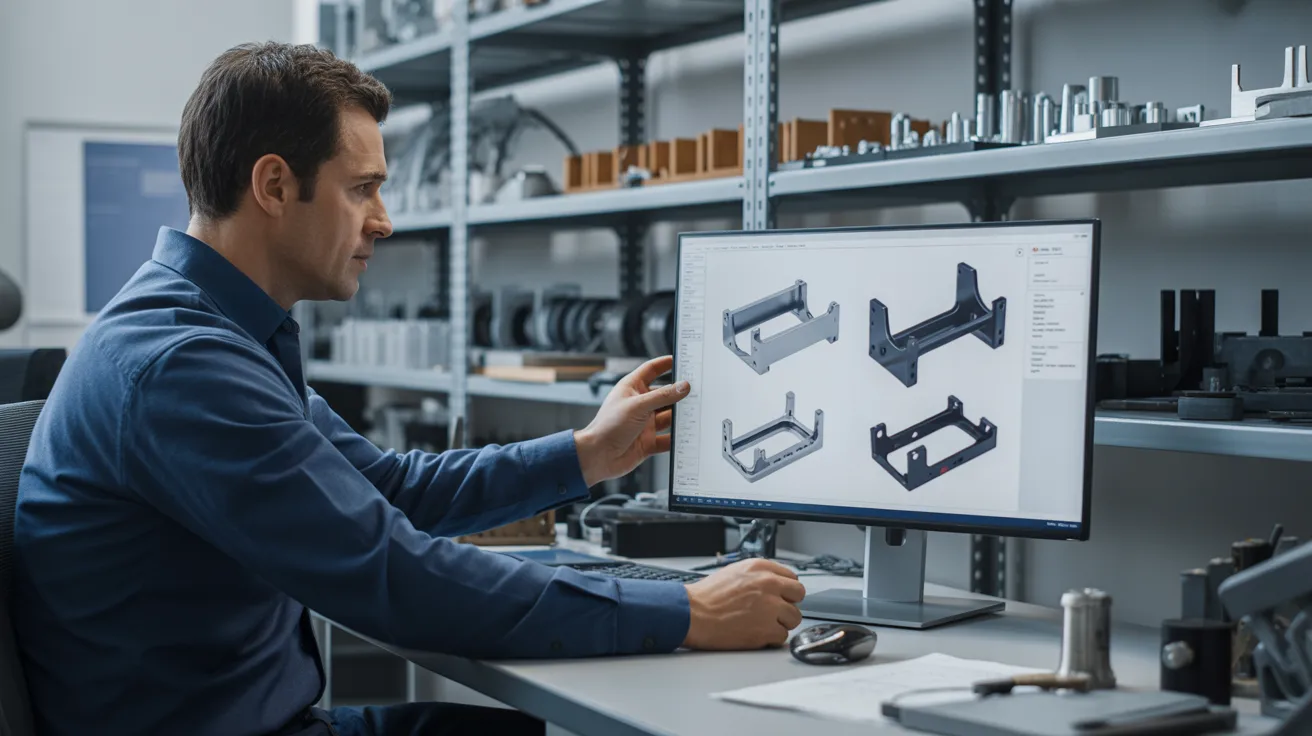
Some AI platforms also support geometry-based search: upload a 3D model or sketch, and the system finds geometrically similar parts in your vault. This is particularly powerful for organizations with decades of legacy data where documentation quality varies wildly across different teams and eras.
The shift is not just about better search results. It is about changing engineer behavior. When finding existing parts becomes faster than designing new ones, reuse becomes the default. Engineers stop treating the vault as an archive and start treating it as a parts library they actually want to use.
What Teams Actually Experience When Part Reuse Works
The impact of effective part reuse shows up everywhere, not just in the design phase. Teams that successfully implement AI-powered part discovery report shorter design cycles, simpler BOMs, lower procurement costs, and fewer quality issues downstream.
When engineers can find and reuse validated parts, they skip the entire qualification cycle for those components. No new supplier negotiations, no new tooling, no first-article inspections. The part already has a track record. It has been manufactured, assembled, and tested in the field. That level of confidence is something a freshly designed custom part simply cannot offer on day one.
BOM simplification is another major win. Fewer unique part numbers mean fewer SKUs to manage in inventory, fewer items to inspect during incoming quality checks, and simpler assembly instructions on the production floor. For organizations running lean manufacturing, reducing part count has a direct impact on operational efficiency.
There is also a knowledge transfer benefit that is easy to overlook. When an engineer discovers a part that was designed by someone else for a similar application, they are not just finding a component. They are finding a design decision. They can see what material was chosen, what tolerances were applied, and what trade-offs were made. That context is incredibly valuable, especially for newer engineers who are still building their judgment.
Getting Started Without Ripping Out Your Current Systems
One of the biggest misconceptions about AI-powered part reuse is that it requires a massive infrastructure overhaul. It does not. The best AI solutions work as an intelligence layer that sits on top of your existing PDM and PLM systems, connecting to SolidWorks PDM, PTC Windchill, Siemens Teamcenter, Autodesk Vault, Arena PLM, and others without requiring migration or platform changes.
The implementation path is straightforward. Connect the AI platform to your existing data sources. It indexes your parts library, drawing files, specifications, and engineering documents. Engineers start searching in natural language and immediately see results from their own vault, not a generic external database.
Security and IP protection are handled at the foundation level. With SOC-2 certification, GDPR compliance, and strict data isolation, your engineering data stays secure. No AI model is trained on your proprietary data, and your intellectual property is never shared with anyone outside your organization.
The real key is starting small. Pick a team or project with a known duplicate-parts problem. Let them try AI-powered search for a few weeks. The results tend to speak for themselves -- engineers find parts they did not know existed, reuse rates climb, and the team starts questioning why they ever accepted the old way of doing things.
FAQ
Find Parts You Already Have
Stop redesigning what your vault already holds.
Leo AI connects to your PDM and PLM systems, letting engineers find reusable parts in seconds through natural language and geometry search. Start reducing duplicate parts today.
Schedule a Demo →

#1 New AI Software Globally - G2 2026

Enterprise-grade security

Trusted by world-class engineering teams