
AI for Engineering Knowledge Management
Compare the best text-to-CAD AI tools in 2026. See which tools generate real engineering assemblies vs simple shapes, and what matters for production.
·
⏱
7 min read

Dr. Maor Farid
Maor Farid is the Co-Founder and CEO of Leo AI, the first AI platform purpose-built for mechanical engineers. He holds a PhD in Mechanical Engineering and completed postdoctoral research at MIT as a Fulbright fellow. A Forbes 30 Under 30 honoree and former AI researcher and Mechanical Engineer in an elite military intelligence, Maor leads Leo AI's mission to transform how engineering teams design better products faster.
BOTTOM LINE
Text-to-CAD AI is real, but most tools in this space are built for simple, single-part geometry that serves hobbyists and 3D printing enthusiasts more than professional engineering teams. If you are evaluating text-to-CAD tools for production use, the capabilities that matter are assembly-level generation, existing part reuse, compliance checking, DFM awareness, and transparent engineering calculations.
Leo AI is the only text-to-CAD tool built for this level of engineering rigor. It connects to your PDM/PLM, prioritizes parts you already own, runs calculations before generating geometry, and outputs standards-compliant assemblies compatible with your CAD platform. For teams tired of AI demos that generate impressive shapes with zero engineering value, Leo is built for the work that actually ships.
You type a description. A 3D model appears. That is the promise every text-to-CAD AI tool is selling right now, and on the surface it sounds like a productivity breakthrough. But if you have spent any time in a real engineering environment, you know the gap between a visually convincing 3D shape and a production-ready part is enormous. Most text-to-CAD AI tools today generate geometry that looks impressive in a demo but falls apart the moment you try to add tolerances, run stress analysis, or send it to manufacturing. For mechanical engineers working on assemblies with hundreds of components, compliance requirements, and strict material constraints, the question is not whether AI can generate a CAD model. It is whether AI can generate one you would actually use.
What Text-to-CAD Actually Means for Mechanical Engineers
Text-to-CAD is a category of AI tools that convert natural language descriptions into 3D geometry. You describe a part or assembly in plain English, and the tool outputs a CAD file you can open in SolidWorks, CATIA, Inventor, or another modeling environment.
The concept has been gaining traction since 2024, with several startups and research labs releasing tools that generate STEP files, STL meshes, or native CAD formats from text prompts. Search volume for "text to CAD AI" has grown steadily, and engineering teams are genuinely evaluating these tools for their workflows.
But the category is broad. Some tools target hobbyists and 3D printing enthusiasts. Others aim at professional mechanical engineers working on multi-part assemblies for aerospace, automotive, defense, or medical devices. The difference between these two use cases is not incremental. It is fundamental. A tool that generates a bracket with a hole in it is solving a completely different problem than a tool that generates a standards-compliant assembly with proper material selection, vendor part prioritization, and design-for-manufacturability checks.
IN PRACTICE
What Engineers Are Saying
Leo found a nature-inspired solution, a concept we would not have thought of, that let us use standard, off-the-shelf parts. No custom manufacturing. No dedicated engineer. We saved around $400 per system.
Chen, Team Lead at ZutaCore
Where Most Text-to-CAD Tools Fall Short
The majority of text-to-CAD tools on the market today share the same limitation: they generate single, simple geometries. A cylinder with a slot. A housing with mounting holes. A bracket with fillets. These outputs look clean in a rendering, but they are not engineering artifacts. They lack feature trees, parametric constraints, material assignments, and any connection to your existing design ecosystem.
Here is what that means in practice. When you generate a part with most text-to-CAD AI tools, you get a dead-end file. It is not parametric, so you cannot adjust dimensions without rebuilding from scratch. It has no design history, so no one on your team can understand the intent behind the geometry. It does not reference your organization's existing parts, so you may be generating a custom component when a standard off-the-shelf part would work better and cost 60% less. And it has no awareness of manufacturing constraints, so the geometry it produces may not be manufacturable with your available processes.
For teams managing vaults with 10,000 to 50,000 parts, generating new geometry without first searching existing inventory is a direct path to BOM bloat, redundant tooling, and procurement waste. The engineering value of text-to-CAD is not in creating new shapes. It is in creating the right shapes, informed by everything your organization already knows.
What to Look for in a Text-to-CAD Tool Built for Real Engineering
If your team is evaluating text-to-CAD AI tools for professional use, here are the capabilities that separate engineering-grade tools from demo-ready prototypes.
Assembly-level output, not just single parts. Real products are assemblies. A tool that can only generate individual parts ignores the core challenge of mechanical design: how components fit together, interact under load, and satisfy system-level requirements. Look for tools that output full part trees and feature trees compatible with your CAD platform.
Part reuse prioritization. Before generating any new geometry, an engineering-grade text-to-CAD tool should search your existing PDM/PLM vault for parts that already meet the requirement. Reusing a validated, production-proven part is always better than designing a new one. This alone can reduce BOM costs by 15-30% on complex programs.
Compliance and standards awareness. Depending on your industry, designs must comply with MIL-STD, ISO, FDA, or other regulatory frameworks. A text-to-CAD tool that ignores compliance is generating rework, not productivity. The tool should check generated designs against relevant standards and flag violations before the engineer ever sees the output.
DFM integration. The geometry a tool generates must be manufacturable with your available processes. If your shop runs 3-axis CNC and the AI outputs a topology-optimized lattice that requires 5-axis or additive manufacturing, the output is useless. Manufacturing feasibility should be a constraint in the generation process, not an afterthought.
Transparent calculations and sources. When the tool selects a material, recommends a wall thickness, or chooses a fastener size, engineers need to see the reasoning. Traceable sources, visible calculation logic, and cited engineering standards build trust. A black-box recommendation that says "use 6061-T6 aluminum" with no justification is not actionable in a professional context.
How Leo AI Approaches Text-to-CAD Differently
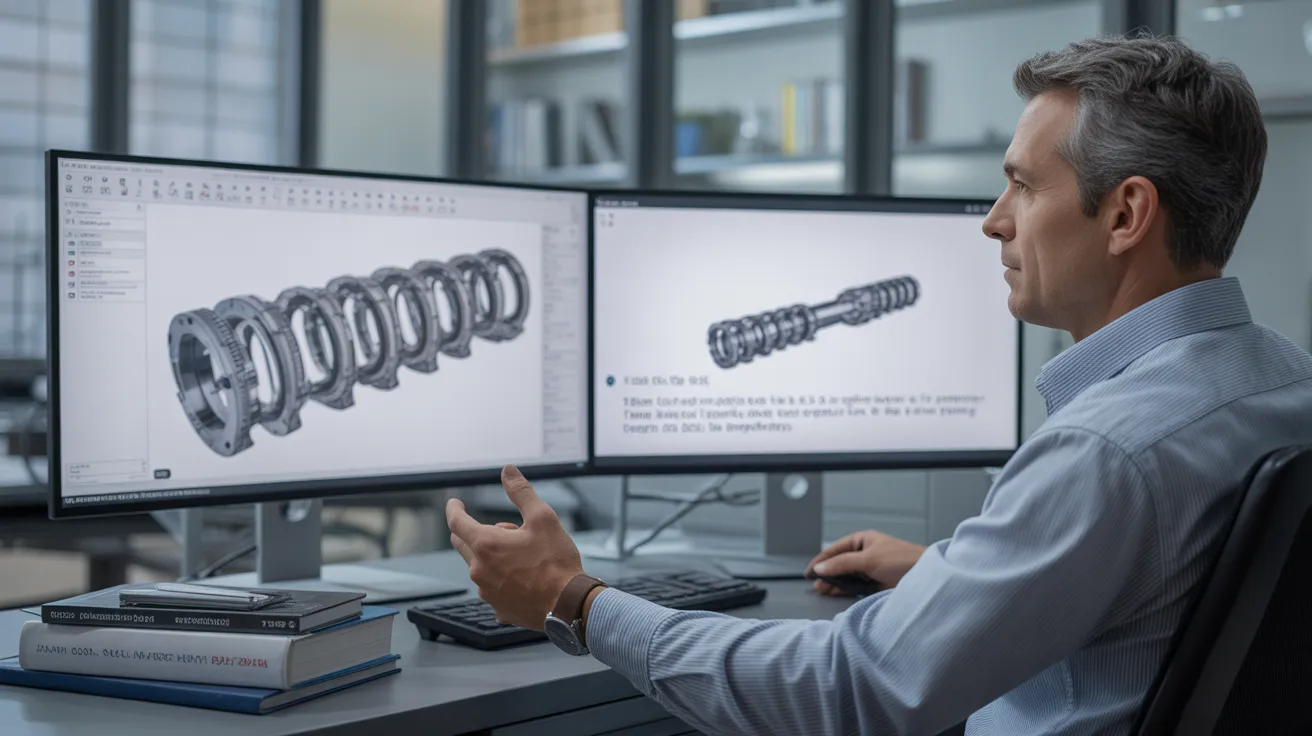
Leo AI is the first text-to-CAD AI tool built specifically for the way mechanical engineers actually work. When you describe an assembly to Leo, it does not immediately generate geometry. Instead, it follows the same process a senior mechanical engineer would.
First, Leo asks clarifying questions. If you request a pipe adjustment assembly, Leo asks about operating pressure, temperature range, flow requirements, connection types, and space constraints. These are the questions you might not know you need to answer, the kind of domain knowledge that typically lives in a senior engineer's head.
Second, Leo searches your organization's existing knowledge base. It queries your PDM/PLM system for parts that match or nearly match the requirement. Leo offers integrations with leading PDM and PLM platforms, including SolidWorks PDM, Autodesk Vault, PTC Windchill, Siemens Teamcenter, and Arena PLM. Before creating anything new, Leo identifies what you already have.
Third, Leo runs engineering calculations. Material selection is not a guess. It is computed based on load conditions, environmental factors, cost targets, and available supply. Fastener sizing follows published standards. Wall thicknesses are derived from stress analysis, not defaults.
Fourth, Leo generates the assembly. The output is a complete, editable 3D assembly with a full part tree and feature tree, compatible with SolidWorks, CATIA, Onshape, and Inventor. Each part includes parametric constraints, material assignments, and manufacturing notes. The assembly is not a visual mock-up. It is a production-ready starting point that an engineer can refine, not rebuild.
Finally, Leo runs a design inspection against your project's compliance requirements. Whether your industry demands MIL-STD, ISO 13485, or FDA 21 CFR, Leo checks the generated design against the applicable framework and flags any issues before the design reaches review.
Enterprise organizations including HP, NVIDIA, Intel, Scania, Elbit Systems, and Rafael Advanced Defense Systems already use Leo AI in their engineering workflows. The platform is SOC-2 certified, GDPR compliant, and customer data is never used to train AI models.
Keep Reading: Best AI CAD Generation Tools for Manufacturing Teams · Sketch-to-CAD with AI: Converting Hand Drawings to 3D Models in Minutes · Generative Design ROI: Real Cost Savings From Engineering Teams That Actually Use It · AI for Mechanical Engineers: The Complete Guide for 2026
Text-to-CAD for Assemblies: Why Single-Part Generation Is Not Enough
The gap between single-part generation and assembly generation is where most text-to-CAD AI tools lose their value for professional engineering teams.
Generating a single bracket is a parlor trick. Generating a 47-part pneumatic actuator assembly with proper tolerances, fastener specifications, seal selections, and material compatibility across components is engineering. The distinction matters because it determines whether the tool saves time or creates more work.
When a text-to-CAD tool generates a single part without context, someone on your team still needs to figure out how it connects to adjacent components, verify material compatibility, check clearances, validate against standards, and integrate it into the existing assembly. That "time saved" in generation is consumed three times over in integration work.
Leo AI generates assemblies, not parts. It prioritizes components your team has already designed or purchased. It understands how parts relate to each other in the context of a system. And it maximizes part reuse, which has a direct, measurable impact on procurement costs and manufacturing lead times. For organizations managing large vaults of legacy parts, this approach to text-to-CAD is not a convenience. It is a competitive advantage.
FAQ
See Real Text-to-CAD for Engineers
Book a demo — see Leo AI generate a production-ready assembly in minutes.
Leo AI searches your vault, runs engineering calculations, and outputs complete parametric assemblies. Book a demo to see a text brief become a manufacturing-ready assembly.
Schedule a Demo →

#1 New AI Software Globally - G2 2026

Enterprise-grade security

Trusted by world-class engineering teams