
AI for CAD Tools
Claude can now create 3D models in Autodesk Fusion via MCP. We tested it on real engineering tasks. Here's what works, what breaks, and what's missing.
·
⏱
7 min

Michelle Ben-David
Michelle Ben-David is a mechanical engineer and Technion graduate. She served in an IDF elite technology and intelligence unit, where she developed multidisciplinary systems integrating mechanics, electronics, and advanced algorithms. Her engineering background spans robotics, medical devices, and automotive systems.
BOTTOM LINE
Claude's Fusion MCP integration creates basic 3D geometry from text descriptions through API commands. It works for simple shapes and quick concept mockups. But it cannot read existing models, understand assemblies, validate manufacturability, or work with any CAD platform besides Fusion. Complex geometry is hit-or-miss, and there is no connection to PDM systems or engineering knowledge bases. For engineers who need AI that understands their actual designs, reads native CAD files, and integrates with real engineering infrastructure, purpose-built tools like Leo AI deliver where general-purpose connectors fall short.
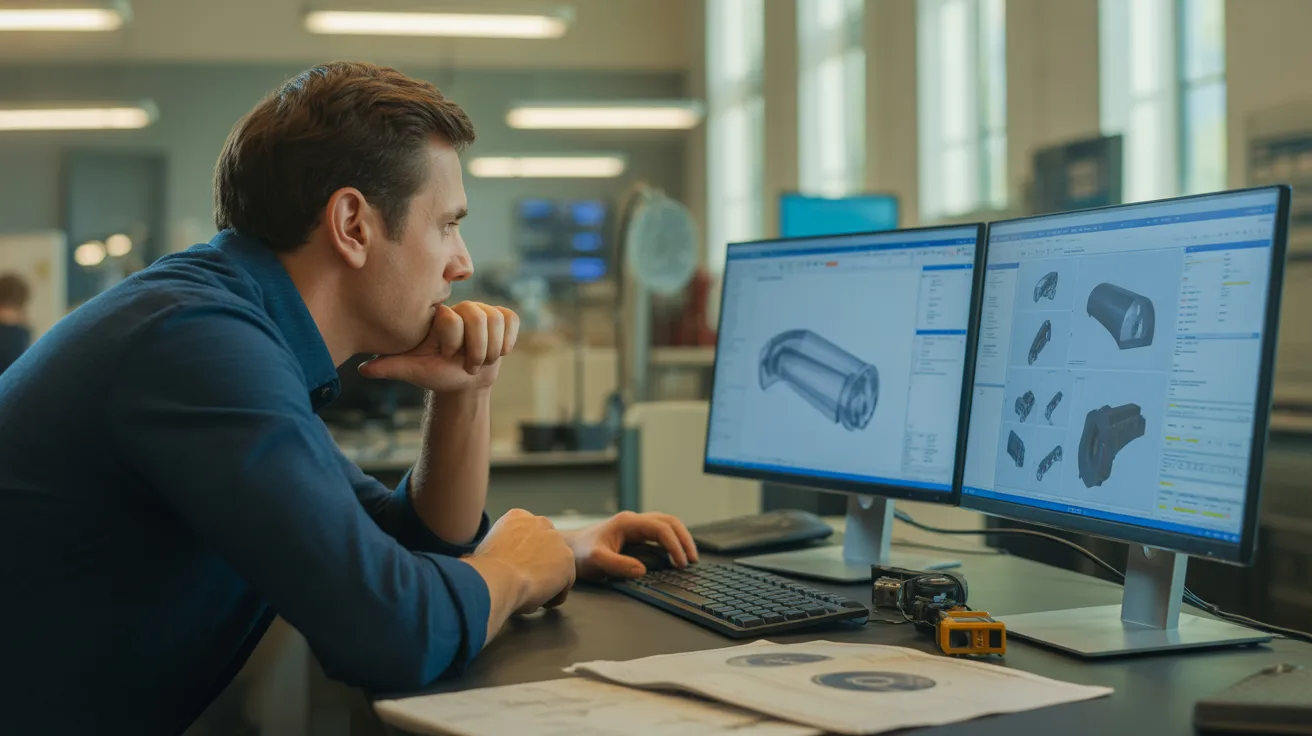
The engineering internet lit up when Anthropic's Claude got the ability to create 3D models in Autodesk Fusion. The clips are all over social media - someone types "make a phone case with rounded corners" and watches a 3D model materialize in Fusion. It is genuinely cool to watch.
But here is the thing. I am a mechanical engineer. I have spent years in CAD tools designing actual products that go to manufacturing. When I see "AI can now do CAD," my first question is not "how cool does the demo look?" It is "can this survive contact with real engineering work?"
So I dug into what Claude's Fusion integration actually does, where it falls apart, and what it means for engineers who design products for a living. The answer is more nuanced than the headlines suggest.
How Claude's Fusion MCP Integration Works
The technical setup is straightforward. MCP - Model Context Protocol - is an open standard that lets AI models interact with external software through API calls. A community-built Fusion MCP server exposes Autodesk Fusion's programming interface to Claude, so Claude can send commands like "create sketch," "extrude profile," and "add fillet" through natural language.
You type a description. Claude translates it into a sequence of Fusion API calls. Fusion executes them. A 3D model appears on screen.
For basic geometry, this works reliably. Rectangular enclosures, cylindrical housings, simple brackets - things you can describe in a sentence or two come out clean. Claude understands dimensions, can apply features in logical order, and generally produces geometry that matches the description.
The experience feels like having a fast intern who knows Fusion's API by heart. Tell them exactly what to model, and they will click through the commands faster than you could. That is legitimately useful for prototyping simple shapes.
IN PRACTICE
Leo feels like having an expert always by my side. It lets me ask engineering questions, check ideas, and move forward with confidence instead of getting stuck.
Harel O., Studio Manager & Industrial Designer
Where It Breaks Down - Complex Geometry
The problems start when geometry gets even moderately complex. And in professional mechanical design, things get complex fast.
Multi-feature interactions are the first wall. When you ask Claude to create a part with a boss that intersects a rib that touches a shell wall, the sequencing gets tricky. Claude does not see the intermediate geometry - it plans a sequence of API calls and hopes they work. If an extrusion fails because it intersects unexpected geometry from a previous operation, Claude does not always recover gracefully.
Surface modeling is essentially a non-starter. Organic shapes, complex fillets that blend into freeform surfaces, lofted profiles with guide curves - the kind of geometry that shows up constantly in consumer products, medical devices, and automotive parts - Claude cannot produce reliably. It struggles to describe complex surface transitions in API call format because these operations require visual feedback that Claude does not have.
Sketch constraints cause trouble too. Professional parametric modeling relies heavily on fully constrained sketches with geometric and dimensional relationships. Claude tends to create geometry by absolute coordinates rather than building properly constrained sketch profiles. The result is geometry that looks right but is brittle - change one dimension and the whole sketch can break because nothing is properly referenced.
I tried asking Claude to model a simple injection-molded housing with snap fits, boss features, and draft angles. After several attempts, the geometry had overlapping features, missing drafts on internal walls, and snap fit geometry that would never work in practice. A first-year design engineer would do better.
The One-Way Street Problem
Here is the fundamental issue that most coverage misses entirely. Claude's connection to Fusion is essentially one-directional.
Claude can send commands to Fusion. It tells Fusion what to create. But it cannot read back what already exists in a model. If you have an assembly with 200 components and you want Claude to add a bracket that fits in a specific gap, Claude cannot see the assembly. It does not know what is there, what the clearances are, or what other components it needs to avoid.
This means Claude always starts from zero. Every model is a blank canvas. It cannot modify an existing design, analyze what is already modeled, or understand context from previous work. In professional mechanical engineering, almost nothing starts from zero. You work with existing assemblies, modify existing parts, and reference existing designs. An AI that cannot read the current state of a model is fundamentally limited.
There is no assembly understanding. No interference checking. No ability to look at what you have and suggest what to change. Claude builds forward, blind to everything that already exists.
No Manufacturing Validation - The Dangerous Gap
Creating geometry without DFM feedback is how engineering teams burn money. And Claude's Fusion integration provides zero manufacturing awareness.
It does not check wall thicknesses against material guidelines. It does not flag draft angles that are too shallow for injection molding. It does not warn about undercuts that require side actions. It does not evaluate whether a feature can be machined with standard tooling. It does not consider how a part will be fixtured during manufacturing.
This matters because geometry that looks correct on screen can cost 3x more to manufacture than a slightly different version that accounts for process constraints. Young engineers learn this the hard way. An AI tool that creates geometry without manufacturing context risks teaching bad habits or producing parts that cannot be made economically.
When you compare this to engineering-specific AI, the gap is obvious. Leo AI, for example, was built with native CAD file reading - 3 US patents for processing B-rep geometry, feature trees, and assemblies. It integrates with SolidWorks PDM, Autodesk Vault, PTC Windchill, Siemens Teamcenter, and Arena PLM. Its Large Mechanical Model was trained on over 1 million vetted engineering sources. It can search for similar parts across your vault using CAD-to-CAD similarity at 96% accuracy, flag potential design issues, and provide answers with citations you can verify. It reads your designs rather than just building new ones blind.
What This Means for Engineering Teams
Claude's Fusion MCP integration is interesting technology. It proves that AI-to-CAD communication through open protocols is possible, and that natural language can drive parametric modeling operations. For quick concept generation, simple geometry, and prototyping ideas before committing to a full design, it saves time.
But it is not a replacement for engineering judgment, not a design validation tool, and not an AI that understands mechanical engineering the way purpose-built systems do. If you are an engineering leader evaluating AI tools for your team, here is what matters: can the AI read your existing designs? Does it connect to your PDM? Does it understand manufacturing constraints? Can it search across your company's engineering knowledge?
Claude's Fusion connector answers "no" to all of these. The flashy demo creates geometry. The real work happens after that - in the analysis, the iteration, the manufacturing validation, and the institutional knowledge that separates a shape on screen from a product that ships.
FAQ
AI That Reads Your CAD Files
Not just geometry creation. Actual design understanding.
Leo AI reads native SolidWorks, CATIA, Creo, NX, and Inventor files with patented B-rep technology. Search your PDM vault, get DFM feedback, and ask engineering questions with cited answers.
Schedule a Demo →

#1 New AI Software Globally - G2 2026

Enterprise-grade security

Trusted by world-class engineering teams