
AI for CAD Tools
Claude's new Fusion MCP connector sends API commands to Autodesk Fusion. But sending commands is not the same as understanding CAD. Here's what it actually does.
·
⏱
8 min read

Michelle Ben-David
Michelle Ben-David is a mechanical engineer and Technion graduate. She served in an IDF elite technology and intelligence unit, where she developed multidisciplinary systems integrating mechanics, electronics, and advanced algorithms. Her engineering background spans robotics, medical devices, and automotive systems.
BOTTOM LINE
Claude's Fusion MCP connector is a scripting bridge, not a CAD intelligence system. It sends API commands to Autodesk Fusion to create geometry from text descriptions. It cannot read existing models, understand assemblies, search vaults, or evaluate manufacturability. It only works with Fusion - not SolidWorks, CATIA, Creo, NX, or Inventor. For engineers who need AI that actually understands 3D data, reads native CAD files, and integrates with the PDM platforms where real design work lives, purpose-built tools with native geometry comprehension are the only option that delivers today.
The headlines sound exciting. "Claude can now do CAD." Social media is buzzing. Engineers are sharing clips of Claude creating simple shapes in Autodesk Fusion through a new MCP (Model Context Protocol) connector. It looks impressive in a demo.
But if you are a mechanical engineer who actually designs products for a living, the question is not whether Claude can send a command to Fusion. The question is whether it understands what it is doing. And that is a very different conversation.
Let me be specific about what just happened, what it means, and what it does not mean. Because "doing CAD" has a definition in our profession, and what Claude's MCP connector delivers is not it.
What Claude's Fusion MCP Connector Actually Does
MCP - Model Context Protocol - is an open standard that lets AI models communicate with external software through API calls. Anthropic published the spec, and the community has built connectors for various tools, including Autodesk Fusion.
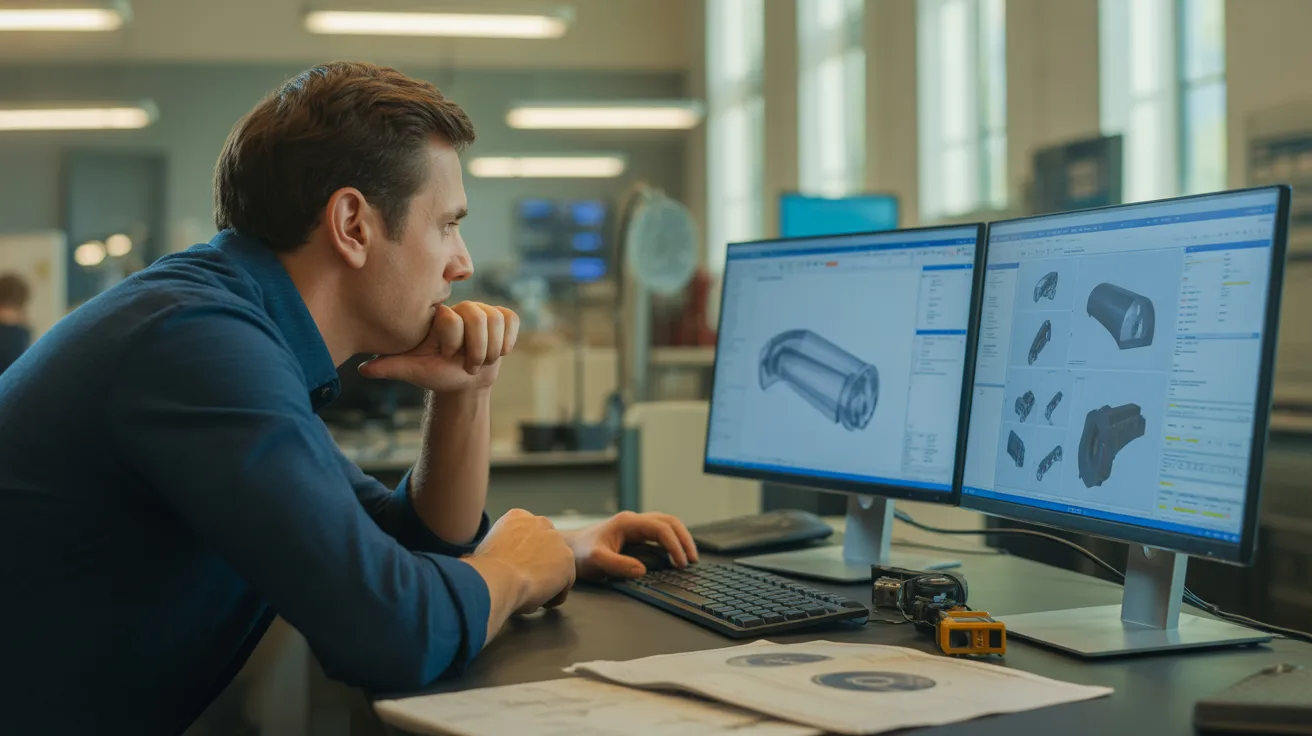
Through this connector, Claude can send parameterized commands to Fusion's API. That means it can tell Fusion to create a sketch, extrude a shape, add a fillet, or perform other operations that Fusion exposes through its programming interface. You describe what you want in natural language, Claude translates that into API calls, and Fusion executes them.
For simple geometry, this works. You can say "create a 50mm cube with 3mm fillets on all edges" and watch it happen. For a demo, it is compelling. For actual product design work, you run into the boundaries fast.
Claude is not reading geometry. It is not interpreting B-rep data. It is not understanding the design intent behind a feature. It is translating text into API calls. That is scripting, not engineering.
IN PRACTICE
The connection to our PDM and using that as a data source is legit the best thing ever. I found three viable bracket options fitting my exact envelope constraints - in minutes, not days.
eytan s., R&D
What "Doing CAD" Actually Means for Engineers
When a mechanical engineer says they are "doing CAD," they mean something specific. They mean modeling parts with complex surfaces and feature interactions. They mean building assemblies with hundreds of components that need to fit together. They mean running interference checks. They mean iterating on a design based on FEA results, manufacturing feedback, and tolerance analysis.
"Doing CAD" means understanding that the 2mm fillet you just added interacts with the draft angle on the adjacent face. It means knowing that a boss feature needs to be thick enough to accept an M4 thread but thin enough not to cause sink marks on the opposite surface. It means reading an existing assembly, understanding how components relate to each other, and modifying one part without breaking the rest.
Claude's MCP connector does none of this. It sends commands forward - "create this shape" - but it cannot read back. It does not parse the geometry that already exists in your model. It does not understand relationships between features. It cannot look at an assembly and tell you which parts interfere. It creates geometry by instruction, but it does not comprehend geometry by analysis.
This is the critical difference. A script that automates Fusion API calls is useful for repetitive modeling tasks. But it is not "doing CAD" in any meaningful engineering sense.
What the Connector Does Not Cover
Let's be specific about the gaps, because they matter.
No SolidWorks support. The MCP connector works with Autodesk Fusion. If your team runs SolidWorks - which is still the most widely used mechanical CAD platform in the industry - this does not apply to you. Same goes for CATIA, Creo (Pro/E), Siemens NX, and Inventor. The vast majority of professional mechanical engineers work in tools that have no MCP connection to Claude.
No geometry reading. Claude sends commands to create geometry, but it cannot read existing geometry. It does not process B-rep data, does not understand feature trees, and cannot analyze what is already in a model. If you ask Claude to "make the wall thicker on the left side," it has no idea what the left side looks like, how thick the wall currently is, or what features depend on it.
No assembly understanding. Real mechanical design work involves assemblies - sometimes with thousands of components. Claude's connector operates at the part level through API commands. It does not understand assembly constraints, mate relationships, or how changes to one component affect others.
No vault or PDM search. Claude cannot search your design vault. It cannot find a similar bracket your team designed last year. It cannot check whether a standard part already exists before creating a new one. Every "design" starts from scratch, which is the opposite of good engineering practice.
No DFM feedback. Creating geometry without understanding manufacturability is how you get parts that look great on screen and cost a fortune to make - or cannot be made at all. Claude creates shapes. It does not evaluate whether those shapes can be injection molded, cast, machined, or 3D printed within reasonable cost and quality constraints.
What Actually Constitutes AI for CAD
Real CAD intelligence requires the ability to read, understand, and reason about 3D geometry. Not just create it from text commands.
Leo AI approaches this differently. With 3 US patents for native CAD file reading, Leo processes B-rep geometry, feature trees, and full assembly structures. It does not just send commands to a CAD tool - it ingests and understands the actual 3D data.
That means Leo can do things that Claude's MCP connector fundamentally cannot: search for geometrically similar parts across your entire PDM vault, analyze existing assemblies for potential issues, flag DFM concerns on actual part geometry, and retrieve past design decisions tied to specific CAD files. Leo offers integrations with SolidWorks PDM, Autodesk Vault, PTC Windchill, Siemens Teamcenter, and Arena PLM - not just Fusion.
The difference is between an AI that can instruct a CAD tool and an AI that comprehends CAD data. One is a scripting assistant. The other is an engineering intelligence layer.
Where This Is Heading - and What to Watch For
Credit where it is due: the MCP approach is interesting from a technology standpoint. Giving AI models the ability to interact with professional software tools through standardized protocols opens real possibilities. Over time, these connectors will get more capable.
But the current state is far from what the headlines suggest. If you are an engineering manager reading "Claude can now do CAD" and thinking about how this changes your tool stack, here is the reality check. Claude can send simple modeling commands to one CAD platform. It cannot read geometry, understand assemblies, search vaults, or provide manufacturing feedback. It works for demos and basic geometry creation. It does not work for the complex, multi-constraint, standards-driven design work that mechanical engineers actually do every day.
The engineers who will benefit most from AI in the near term are not the ones waiting for general-purpose AI to slowly build CAD capabilities through API connectors. They are the ones using tools that were designed from day one to understand mechanical engineering data - CAD files, PDM systems, engineering standards, and manufacturing constraints.
FAQ
AI That Actually Reads CAD
Not scripts. Not API calls. Real geometry understanding.
Leo AI reads B-rep geometry, feature trees, and assemblies natively across every major CAD format. Search your vault, analyze your designs, and get cited answers. Try it free.
Schedule a Demo →

#1 New AI Software Globally - G2 2026

Enterprise-grade security

Trusted by world-class engineering teams