
AI for Engineering Knowledge Management
How conformal cooling channels designed with generative algorithms cut injection molding cycle times by 20-40%. Manufacturing constraints, real results, and implementation guide.
·
⏱
11 min read

Michelle Ben-David
Michelle Ben-David is a mechanical engineer and Technion graduate. She served in an IDF elite technology and intelligence unit, where she developed multidisciplinary systems integrating mechanics, electronics, and advanced algorithms. Her engineering background spans robotics, medical devices, and automotive systems.
BOTTOM LINE
Conformal cooling with generative design is one of the most commercially proven applications of additive manufacturing in tooling. The cycle time reductions are real, repeatable, and well-documented across thousands of production molds worldwide. The quality improvements in warpage, sink marks, and dimensional consistency address problems that injection molders have lived with for decades because conventional cooling could not solve them.
The technology is not without constraints. AM mold inserts cost more, the design process requires thermal simulation expertise, and the manufacturing and QA workflows are different from conventional tool making. But for high-volume production parts where cooling limits cycle time, the business case is strong and getting stronger as AM costs come down and design tools improve.
If cooling time is your cycle bottleneck and you have not evaluated conformal cooling, you are leaving money on the table.
If you have spent any time on an injection molding floor, you know the drill: cycle time is money. Every second you shave off the cooling phase translates directly to throughput, part cost, and competitive advantage. And cooling is almost always the bottleneck. It accounts for 60% to 80% of total cycle time in most injection molding operations. Yet for decades, the cooling channels in most molds have been limited to straight-line drilled holes that follow the machining constraints of the tool, not the thermal needs of the part.
Conformal cooling changes that equation. By routing cooling channels that follow the contours of the part geometry, you remove heat more uniformly and more quickly. The concept has been around since the early 2000s, but it was an academic curiosity until metal additive manufacturing matured enough to actually produce these channels reliably. Now add generative design to the mix, and you get cooling channel layouts that are optimized not just to follow the part surface but to actively manage thermal gradients, minimize warpage, and hit cycle time targets that straight-drilled channels cannot touch.
This is not theoretical. Mold makers and injection molding shops are shipping conformal-cooled tools today and seeing 20% to 40% reductions in cycle time on real production parts. But the technology has practical constraints that matter, and understanding those constraints is the difference between a successful implementation and an expensive experiment.
The Cooling Problem in Injection Molding
The physics is straightforward. Molten plastic enters the mold cavity at temperatures between 200C and 350C depending on the resin. The part cannot be ejected until it cools below the heat deflection temperature of the material, which for most commodity resins is between 60C and 100C. The rate at which heat is extracted from the part is governed by the distance from the cooling channels to the mold surface, the flow rate and temperature of the coolant, and the thermal conductivity of the mold material.
With conventional straight-drilled cooling channels, the distance from the channel to the mold surface varies across the part geometry. In areas where the channel runs close to the surface, cooling is efficient. In areas where the channel is far away (which happens at every contour, curve, and feature that the straight drill cannot follow), cooling is slow. These hot spots control the cycle time because you cannot eject the part until the slowest-cooling region reaches ejection temperature.
Hot spots also cause quality problems. Differential cooling creates internal stresses that lead to warpage, sink marks, and dimensional variation. Every injection molder has dealt with parts that warp after ejection because one side cooled faster than the other. The standard countermeasure is to slow the cycle down (extending cooling time until the hot spots catch up), but that is just trading quality for throughput. Neither problem is actually solved.
The thermal simulation tools have been good enough to diagnose this problem for years. Moldflow, Moldex3D, and similar packages can show you exactly where the hot spots are and how much they are costing you in cycle time and part quality. The problem was always on the solution side: even when you knew exactly where you needed cooling, you could not get a channel there with a drill bit.
IN PRACTICE
The geometry search has been invaluable, helping me find standard parts instead of designing new ones.
eytan s.
How Conformal Cooling Channels Work
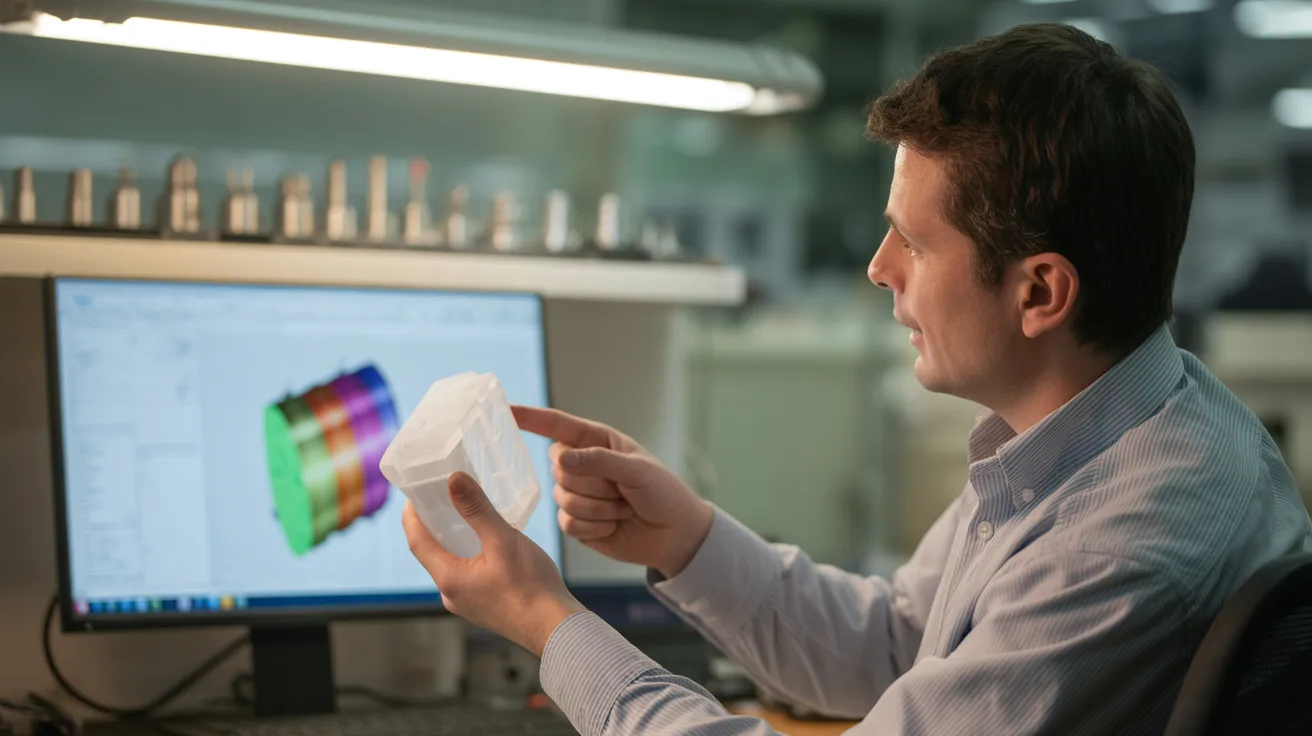
Conformal cooling channels follow the contour of the part surface at a controlled, relatively uniform distance. Instead of straight holes drilled from the outside of the mold block, conformal channels curve, branch, and wrap around features to maintain consistent cooling across the entire part geometry.
The result is dramatically more uniform heat extraction. Hot spots shrink or disappear. The part cools to ejection temperature faster because the slowest-cooling region is no longer bottlenecked by a channel that is 30mm away instead of 10mm away. And because cooling is more uniform, differential shrinkage decreases, which means less warpage, fewer sink marks, and tighter dimensional control.
The thermal improvement is well-documented. Peer-reviewed studies and industry case studies consistently report 20% to 40% reduction in cooling time with conformal channels compared to conventional drilled channels on the same part geometry. On some geometries, particularly deep-draw parts, complex contours, and parts with thick-to-thin transitions, the improvement can exceed 50%.
But designing conformal cooling channels by hand is surprisingly difficult. You need to balance channel diameter (too small and you get insufficient flow and clogging risk; too large and you weaken the mold structure), channel spacing (closer gives better cooling but higher stress concentrations in the steel), distance from the mold surface (closer is better for cooling but risks breakthrough and reduced mold life), and the overall channel routing that avoids ejector pins, slides, lifters, and other mold components.
This is where generative design transforms the equation. Instead of a mold designer manually routing channels and iterating through thermal simulations, a generative algorithm can explore thousands of channel configurations, optimizing for cooling uniformity, cycle time, pressure drop through the coolant circuit, and structural integrity of the mold simultaneously. The algorithm does not get tired, does not miss constraints, and can evaluate far more alternatives than a human designer working in CAD.
Generative Design for Cooling Channel Optimization
The best generative approaches for conformal cooling work by defining the design space (the mold volume excluding the cavity, ejector pins, and other fixed components), the objective function (minimize cooling time or maximize cooling uniformity), and the constraints (minimum wall thickness, maximum coolant pressure drop, structural load requirements, manufacturing constraints).
The algorithm then generates cooling channel layouts that may include branching networks that distribute coolant to high-heat regions, variable cross-section channels that balance flow distribution with structural requirements, spiral or helical paths around cylindrical features, and interconnected multi-circuit layouts that can be independently controlled for different zones of the mold.
Several commercial and research tools are available for this optimization. Autodesk Moldflow includes conformal cooling design guidance. Specialized tools from companies like Additive Innovation, Next Chapter Manufacturing, and various academic research groups offer more advanced generative optimization. nTopology provides general-purpose lattice and channel design tools that can be applied to conformal cooling.
The key advancement in recent years is the integration of thermal simulation directly into the generative loop. Early approaches generated channel geometries and then ran separate thermal simulations to evaluate them. Current tools embed thermal FEA within the optimization, so each candidate design is evaluated against the actual injection molding thermal cycle, including fill, pack, and cool phases. This produces channel layouts that are optimized for the real process, not an idealized steady-state thermal condition.
One important practical point: generative algorithms for conformal cooling need good boundary conditions. That means accurate material properties for the resin and mold steel, realistic coolant flow conditions (temperature, flow rate, turbulence regime), and correct cycle parameters (injection time, packing pressure profile, mold open time). Garbage in, garbage out applies just as much to generative cooling design as to any other simulation.
Manufacturing Conformal-Cooled Molds
Conformal cooling channels require additive manufacturing for the mold insert, and this introduces its own set of considerations that mold designers need to plan for.
Direct metal laser sintering (DMLS) and selective laser melting (SLM) in maraging steel (MS1), H13 tool steel, and stainless steels are the primary manufacturing processes. Maraging steel is the most common choice because it can be age-hardened to 50+ HRC after printing, giving it tool steel-level hardness for the molding surface while being relatively easy to print. H13 tool steel is more challenging to print due to its carbon content and tendency to crack, but several material suppliers now offer process parameters that produce reliable results.
The typical workflow is: print the mold insert with conformal channels, heat treat (stress relief followed by age hardening or quench and temper), machine the molding surfaces to final dimensions and surface finish, EDM any features that require it, and polish. The as-built surface roughness from LPBF (5 to 15 microns Ra) is fine for the internal cooling channels (some roughness actually improves turbulent heat transfer), but the molding surfaces need to be machined and polished to the required specification, just like a conventionally manufactured mold.
Channel design for manufacturability matters. Minimum channel diameter is typically 2 to 3mm for LPBF (smaller channels risk clogging with powder or coolant deposits). Self-supporting geometries are preferred: circular cross-sections transition to diamond or teardrop shapes for channels in overhanging orientations to avoid the need for internal supports. Support structures inside cooling channels are a nightmare because they are essentially impossible to remove.
Pressure testing is mandatory. Every conformal-cooled mold insert must be pressure-tested before going into production to verify that channels are fully open, that there are no leaks between channels and the mold surface, and that the circuit can handle the coolant pressure without deformation.
Cost is the elephant in the room. A conformal-cooled mold insert costs 2x to 5x more than a conventionally machined equivalent, depending on size, complexity, and material. The business case depends entirely on whether the cycle time savings and quality improvements pay back that premium over the production run. For high-volume parts (100,000+ shots per year), the math usually works comfortably. For low-volume tooling, the payback period may exceed the useful life of the tool.
Keep Reading: Best AI CAD Generation Tools for Manufacturing Teams · Generative Design for Heat Exchangers: Thermal-Optimized Geometries That Actually Work · Generative Design Constraints: Setting Up Manufacturing Methods That Actually Work · AI for Mechanical Engineers: The Complete Guide for 2026
Making the Business Case and Getting Started
The ROI calculation for conformal cooling is actually one of the more straightforward analyses in manufacturing engineering because the variables are well-defined.
Start with your current cycle time and identify the cooling-limited portion. If cooling accounts for 15 seconds out of a 25-second cycle, and conformal cooling can reduce that by 30%, you save 4.5 seconds per shot. On a 4-cavity mold running 24/7, that translates to roughly 15,000 additional parts per month. At even a modest per-part margin, the additional revenue or cost savings can pay back the tooling premium in weeks.
Quality improvements are harder to quantify but often equally valuable. If warpage rejection rates drop from 3% to 0.5%, the material savings and avoided scrap costs add up. Reduced dimensional variation can eliminate secondary operations like fixture-straightening or selective assembly. And more uniform cooling can sometimes allow a switch to a lower-cost resin that would warp with conventional cooling but is dimensionally stable with conformal.
For engineering teams evaluating conformal cooling, the practical starting point is to identify your highest-volume, most thermally challenging molds. Parts with deep draws, thick-to-thin transitions, complex contours, and high cosmetic requirements are the best candidates. Run a thermal simulation on the current conventional cooling layout, identify the hot spots and cooling-limited regions, and quantify the potential cycle time improvement.
When it comes to designing the optimized conformal channels, leveraging your organization's accumulated tooling knowledge makes a real difference. How did similar parts perform with conventional cooling? What coolant temperatures and flow rates work best for this resin family? What mold maintenance issues have been seen with previous conformal-cooled tools? AI-powered engineering platforms like Leo AI let teams search across their complete design and manufacturing history to find relevant precedents. Leo offers integrations with leading PDM and PLM platforms, so mold engineering teams can pull data from their existing systems without changing workflows.
If you are new to conformal cooling, partner with a mold maker that has AM experience. The design-for-AM rules for cooling channels are different from structural AM parts, and the post-processing and QA requirements are specific to tooling. Do not try to learn AM mold making on your highest-volume production tool. Pick a medium-criticality mold where the risk is manageable and the learning is transferable.
FAQ
Cut Mold Design Time in Half
Search past tooling designs and lessons learned.
Leo AI connects to your PLM and PDM so mold engineering teams can instantly find past cooling designs, material specs, and tooling performance data. Build better molds faster.
Schedule a Demo →

#1 New AI Software Globally - G2 2026

Enterprise-grade security

Trusted by world-class engineering teams