
AI for Engineering Knowledge Management
Leo AI for SOLIDWORKS: Stop Context Switching, Save 6.5 Hours/Week
Leo AI for SOLIDWORKS: Stop Context Switching, Save 6.5 Hours/Week
Leo AI for SOLIDWORKS: Stop Context Switching, Save 6.5 Hours/Week
Enterprise SOLIDWORKS teams use Leo AI to preserve tribal knowledge and prevent design mistakes. HP, Intel, and Philips save $1.3M annually. Request your custom demo.
·
⏱
11 min read

Michelle Ben-David
Product Specialist, Leo AI
Product Specialist, Leo AI
Mechanical Engineer, B.Sc. · Ex-Officer, Elite Tech Unit · Aerospace & Defence · Medical Devices
Mechanical Engineer, B.Sc. · Ex-Officer, Elite Tech Unit · Aerospace & Defence · Medical Devices
Michelle Ben-David is a mechanical engineer and Technion graduate. She served in an IDF elite technology and intelligence unit, where she developed multidisciplinary systems integrating mechanics, electronics, and advanced algorithms. Her engineering background spans robotics, medical devices, and automotive systems.
Contents
BOTTOM LINE
SolidWorks teams that integrate AI into their workflow stop losing institutional knowledge every time an engineer leaves, and stop wasting senior engineer time on questions that have already been answered. The productivity gains compound quickly.
The integration doesn't require replacing your existing stack — it works alongside SolidWorks PDM and PLM to surface the knowledge your team already has, when engineers need it most.
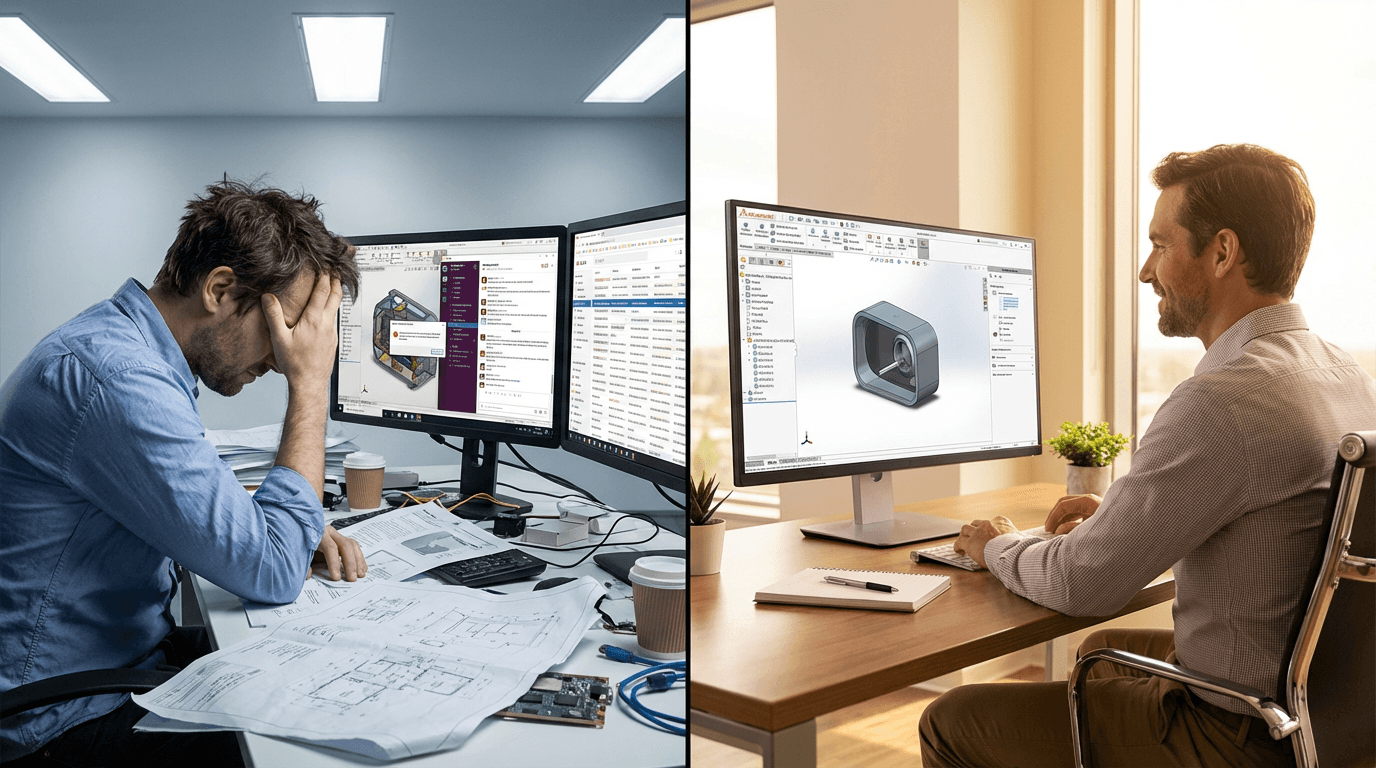
Your best SOLIDWORKS engineer just gave notice. He's been with the company for 12 years. He knows why certain assemblies are designed the way they are. He remembers the material supplier issue from 2019 that cost you $200K. He can solve configuration problems in his sleep.
When he leaves, all of that walks out the door with him.
This isn't just an inconvenience. According to research from the University of California, Irvine, engineers spend 6-8 hours per week searching for answers. Every time they switch between SOLIDWORKS and Slack, email, SharePoint, or calling a colleague, they lose 23 minutes of deep work time. McKinsey research shows the average hardware company loses 15-20% of its engineering knowledge every year to turnover.
For companies like HP, Intel, and Philips, lost knowledge means repeated mistakes, longer design cycles, and millions in preventable errors.
Leo AI is an artificial intelligence assistant specifically designed for SOLIDWORKS users. Unlike generic AI chatbots, Leo AI integrates directly into the SOLIDWORKS Computer-Aided Design (CAD) environment and learns from your company's specific design history, Product Data Management (PDM) data, and engineering decisions. No context switching. No hunting through old files. No waiting for the one person who knows the answer.
The Hidden Costs of Context Switching in SOLIDWORKS Environments
The average engineer switches tasks 13 times per hour. Each switch costs 23 minutes to regain full focus. For SOLIDWORKS work specifically, interruptions mean losing track of design intent, constraints, and relationships between hundreds of components.
A 50-person engineering team loses 2,400 hours per year just searching for information. At $85/hour average loaded cost, that's $204,000 annually in search time alone.
Key Takeaway: Enterprise teams lose $200K+ annually just on information search time, before counting the cost of repeated design mistakes.
When you're working on a complex assembly with 500+ parts, every interruption means losing your mental model of the design, re-establishing what you were trying to solve, and double-checking constraints you already verified.
The Tribal Knowledge Crisis
Tribal knowledge isn't the stuff in your CAD files or PDFs. It's the why behind decisions. Why this tolerance is tighter than standard. Which supplier to avoid for this material. What workaround fixes a specific mating issue. Why a certain approach failed three years ago.
Real examples: "We don't use that fastener type anymore because it failed vibration testing in 2020." "This assembly sequence is the only one that works on the production line." "When you get error X, it actually means problem Y."
According to Pew Research, 10,000 baby boomers retire every day in the US. The average engineer stays at a company 4.2 years. It takes 6-12 months for a new engineer to become productive in complex CAD environments.
One hardware company redesigned a component, not knowing it had already been tried and failed. Six months of work, $400K spent, same failure mode. The engineer who knew why it wouldn't work had retired 18 months earlier.
The Hidden Costs of Context Switching in SOLIDWORKS Environments
The average engineer switches tasks 13 times per hour. Each switch costs 23 minutes to regain full focus. For SOLIDWORKS work specifically, interruptions mean losing track of design intent, constraints, and relationships between hundreds of components.
A 50-person engineering team loses 2,400 hours per year just searching for information. At $85/hour average loaded cost, that's $204,000 annually in search time alone.
Key Takeaway: Enterprise teams lose $200K+ annually just on information search time, before counting the cost of repeated design mistakes.
When you're working on a complex assembly with 500+ parts, every interruption means losing your mental model of the design, re-establishing what you were trying to solve, and double-checking constraints you already verified.
The Tribal Knowledge Crisis
Tribal knowledge isn't the stuff in your CAD files or PDFs. It's the why behind decisions. Why this tolerance is tighter than standard. Which supplier to avoid for this material. What workaround fixes a specific mating issue. Why a certain approach failed three years ago.
Real examples: "We don't use that fastener type anymore because it failed vibration testing in 2020." "This assembly sequence is the only one that works on the production line." "When you get error X, it actually means problem Y."
According to Pew Research, 10,000 baby boomers retire every day in the US. The average engineer stays at a company 4.2 years. It takes 6-12 months for a new engineer to become productive in complex CAD environments.
One hardware company redesigned a component, not knowing it had already been tried and failed. Six months of work, $400K spent, same failure mode. The engineer who knew why it wouldn't work had retired 18 months earlier.
IN PRACTICE
What Engineers Are Saying
"The parts search across our PDM system has been a game changer — engineers find components much faster instead of pinging each other constantly. The technical Q&A feature pulls from real engineering standards with source citations, giving engineers confidence they're getting accurate, relevant answers."
— Verified User, Mechanical Engineering, Mid-Market
The Real Cost of Replacing a Retiring Engineer: A Timeline Comparison
When your veteran engineer gives his two-week notice, you have options. Here's what productivity actually looks like across different scenarios.
Capability | Junior Engineer (No Leo) | Senior Engineer (No Leo) | Junior Engineer + Leo AI | Senior Engineer + Leo AI |
Profile | Fresh grad, CAD basics from school | 8+ years, highly relevant industry experience | Fresh grad, CAD basics from school | 8+ years, highly relevant industry experience |
Basic SOLIDWORKS proficiency | 2-3 months | Already proficient | 3-4 weeks | Already proficient |
Technical drawing standards | 3-4 months | 2-3 weeks (your standards) | 4-6 weeks | 1-2 weeks |
Learning your PLM system | 4-6 months | 6-8 weeks | 6-8 weeks | 3-4 weeks |
Understanding product line history | 8-12 months | 4-6 months | 2-3 months | 6-8 weeks |
Learning past design decisions & rationale | 12-18 months (partial) | 6-9 months | 3-4 months | 2-3 months |
Recognizing proven workflows | 12+ months | 3-4 months | 2-3 months | 4-6 weeks |
Knowing "why we don't do X" | 18+ months (if ever) | 6-12 months | 3-5 months | 6-10 weeks |
Understanding vendor relationships | 18-24 months | 6-9 months | 4-6 months | 2-3 months |
Spotting repeat mistakes before they happen | 24+ months | 9-12 months | 4-6 months | 2-4 months |
Time to independent productivity | 18-24 months | 9-12 months | 6-9 months | 3-4 months |
Fully replaces retiring engineer's expertise | Never (60-70%) | 12-18 months (85%) | 9-12 months (80-85%) | 4-6 months (90-95%) |
What This Table Reveals
Even your best hire faces a knowledge gap. That stellar senior engineer with perfect experience? He still needs 9-12 months to become truly productive in your environment. He doesn't know why Design Team A stopped using that specific fastener in 2019. He wasn't in the room when Engineering decided to change that assembly sequence.
Junior engineers without Leo never fully catch up. After two years, they're still missing 30-40% of the institutional knowledge. They'll make mistakes that the retiring engineer would have prevented.
Leo levels the playing field faster. A junior engineer with Leo AI reaches productivity in 6-9 months instead of 18-24 months. That's a 12-18 month time savings. He retains 80-85% of the retiring engineer's expertise instead of 60-70%.
Leo supercharges your best hires. That expensive senior engineer you recruited? With Leo AI, he's independently productive in 3-4 months instead of 9-12 months. He retains 90-95% of institutional knowledge instead of 85%.
Real Scenario: A precision manufacturing company hired a senior mechanical engineer with 12 years of experience in similar products. With Leo AI, he was solving complex assembly problems independently by month 3, because Leo gave him instant access to 15 years of design rationale and past decisions.
The math that matters:
Junior engineer salary: ~$75K
Senior engineer salary: ~$140K
Cost of 12 months at partial productivity: $50K-$90K in lost output
Cost of one repeated design mistake: $200K-$500K
Leo AI pays for itself in the first prevented mistake or the first accelerated hire.
Why Even Great Hires Need Leo AI
Your senior engineer brings skills, but not your company's memory:
✅ He knows SOLIDWORKS cold
✅ He understands engineering principles
✅ He has industry best practices
❌ He doesn't know YOUR product line
❌ He doesn't know YOUR past failures
❌ He doesn't know YOUR vendor issues
❌ He doesn't know YOUR workflow quirks
Leo AI fills that gap on day one.
The Real Cost of Replacing a Retiring Engineer: A Timeline Comparison
When your veteran engineer gives his two-week notice, you have options. Here's what productivity actually looks like across different scenarios.
Capability | Junior Engineer (No Leo) | Senior Engineer (No Leo) | Junior Engineer + Leo AI | Senior Engineer + Leo AI |
Profile | Fresh grad, CAD basics from school | 8+ years, highly relevant industry experience | Fresh grad, CAD basics from school | 8+ years, highly relevant industry experience |
Basic SOLIDWORKS proficiency | 2-3 months | Already proficient | 3-4 weeks | Already proficient |
Technical drawing standards | 3-4 months | 2-3 weeks (your standards) | 4-6 weeks | 1-2 weeks |
Learning your PLM system | 4-6 months | 6-8 weeks | 6-8 weeks | 3-4 weeks |
Understanding product line history | 8-12 months | 4-6 months | 2-3 months | 6-8 weeks |
Learning past design decisions & rationale | 12-18 months (partial) | 6-9 months | 3-4 months | 2-3 months |
Recognizing proven workflows | 12+ months | 3-4 months | 2-3 months | 4-6 weeks |
Knowing "why we don't do X" | 18+ months (if ever) | 6-12 months | 3-5 months | 6-10 weeks |
Understanding vendor relationships | 18-24 months | 6-9 months | 4-6 months | 2-3 months |
Spotting repeat mistakes before they happen | 24+ months | 9-12 months | 4-6 months | 2-4 months |
Time to independent productivity | 18-24 months | 9-12 months | 6-9 months | 3-4 months |
Fully replaces retiring engineer's expertise | Never (60-70%) | 12-18 months (85%) | 9-12 months (80-85%) | 4-6 months (90-95%) |
What This Table Reveals
Even your best hire faces a knowledge gap. That stellar senior engineer with perfect experience? He still needs 9-12 months to become truly productive in your environment. He doesn't know why Design Team A stopped using that specific fastener in 2019. He wasn't in the room when Engineering decided to change that assembly sequence.
Junior engineers without Leo never fully catch up. After two years, they're still missing 30-40% of the institutional knowledge. They'll make mistakes that the retiring engineer would have prevented.
Leo levels the playing field faster. A junior engineer with Leo AI reaches productivity in 6-9 months instead of 18-24 months. That's a 12-18 month time savings. He retains 80-85% of the retiring engineer's expertise instead of 60-70%.
Leo supercharges your best hires. That expensive senior engineer you recruited? With Leo AI, he's independently productive in 3-4 months instead of 9-12 months. He retains 90-95% of institutional knowledge instead of 85%.
Real Scenario: A precision manufacturing company hired a senior mechanical engineer with 12 years of experience in similar products. With Leo AI, he was solving complex assembly problems independently by month 3, because Leo gave him instant access to 15 years of design rationale and past decisions.
The math that matters:
Junior engineer salary: ~$75K
Senior engineer salary: ~$140K
Cost of 12 months at partial productivity: $50K-$90K in lost output
Cost of one repeated design mistake: $200K-$500K
Leo AI pays for itself in the first prevented mistake or the first accelerated hire.
Why Even Great Hires Need Leo AI
Your senior engineer brings skills, but not your company's memory:
✅ He knows SOLIDWORKS cold
✅ He understands engineering principles
✅ He has industry best practices
❌ He doesn't know YOUR product line
❌ He doesn't know YOUR past failures
❌ He doesn't know YOUR vendor issues
❌ He doesn't know YOUR workflow quirks
Leo AI fills that gap on day one.
Why Traditional Solutions Fall Short for SOLIDWORKS Teams
SharePoint and Confluence are built for general business content, not CAD workflows. Search doesn't understand engineering terminology. They exist outside your design environment.
To answer one SOLIDWORKS question, engineers search five different places: PDM vault comments, email archives, Slack or Teams, shared drives, and by asking colleagues directly. Each search uses different systems with different search logic.
Generic AI assistants like ChatGPT or Copilot don't know your company's specific design history. They can't access your CAD files or PDM data. They give general answers, not answers specific to your products.
Feature | Traditional Docs | SharePoint/Confluence | Generic AI | Leo AI |
SOLIDWORKS integration | ❌ | ❌ | ❌ | ✅ |
Understands CAD context | ❌ | ❌ | ❌ | ✅ |
Your design history | ❌ | Partial | ❌ | ✅ |
Automatic knowledge capture | ❌ | ❌ | ❌ | ✅ |
Answers in workflow | ❌ | ❌ | ❌ | ✅ |
Enterprise security | N/A | ✅ | ⚠️ | ✅ |
How Leo AI Transforms SOLIDWORKS Knowledge Access
Instant Answers Without Leaving Your Workflow
You're in SOLIDWORKS. You have a question. You ask Leo AI in natural language. You get an answer based on your company's actual design history. You keep working.
Instead of searching with keywords, you ask like you'd ask a colleague: "Why did we change the wall thickness on the XR-400 housing?" "What's the fastest way to fix a circular reference in this assembly?" "Which vendor did we use for die-cast aluminum on the last project?"
Leo AI integrates directly into your SOLIDWORKS environment. No switching to another application. No opening another browser tab. The answer appears where you're already working.
Capturing and Preserving Tribal Knowledge Automatically
Engineers don't have to document anything. Leo AI learns from design changes and revision notes, PDM vault data and check-in comments, email discussions about designs, meeting notes and decisions, and CAD file metadata and history.
How institutional memory builds:
Month 1: Leo AI indexes your current projects and active designs
Month 6: Leo AI identifies patterns across multiple projects
Year 1: Leo AI understands why certain approaches work and others don't
Year 3: Leo AI has captured knowledge from engineers who've since left
A new engineer asks: "How do I set up this type of weldment?" Without Leo AI, he asks around, hopes someone's done it before, maybe finds an old file, reverse engineers it, and possibly does it wrong. With Leo AI: "Here's how the team approached this on the HX-500 project. Here's the design table setup. Here are the common mistakes to avoid."
When a senior engineer retires, his CAD files stay (you already had those), but now his decisions, rationales, and expertise also stay. His problem-solving patterns become accessible to everyone.
Preventing Repeated Design Mistakes
Leo AI identifies when a current design approach is similar to something that failed before. Even if it's not identical, if the pattern matches, you get a heads up.
You're designing a cooling channel layout. Leo AI notices the flow pattern is similar to a design from 2021 that had heat distribution problems. It flags this before you finish the design.
Leo AI watches for constraint combinations that caused problems before, material and geometry pairings that failed testing, assembly sequences that don't work in manufacturing, and configurations that violate company standards.
Real Impact: One medical device company using SOLIDWORKS for surgical instrument design had a biocompatibility failure with a specific material and sterilization combination that cost them 8 months and $1.2M. Leo AI now flags any similar material choices immediately.
Most companies document successes. Failures get buried or forgotten. Leo AI treats failures as valuable data. What was tried, why it didn't work, what was done instead, and what to watch for next time.
Why Traditional Solutions Fall Short for SOLIDWORKS Teams
SharePoint and Confluence are built for general business content, not CAD workflows. Search doesn't understand engineering terminology. They exist outside your design environment.
To answer one SOLIDWORKS question, engineers search five different places: PDM vault comments, email archives, Slack or Teams, shared drives, and by asking colleagues directly. Each search uses different systems with different search logic.
Generic AI assistants like ChatGPT or Copilot don't know your company's specific design history. They can't access your CAD files or PDM data. They give general answers, not answers specific to your products.
Feature | Traditional Docs | SharePoint/Confluence | Generic AI | Leo AI |
SOLIDWORKS integration | ❌ | ❌ | ❌ | ✅ |
Understands CAD context | ❌ | ❌ | ❌ | ✅ |
Your design history | ❌ | Partial | ❌ | ✅ |
Automatic knowledge capture | ❌ | ❌ | ❌ | ✅ |
Answers in workflow | ❌ | ❌ | ❌ | ✅ |
Enterprise security | N/A | ✅ | ⚠️ | ✅ |
How Leo AI Transforms SOLIDWORKS Knowledge Access
Instant Answers Without Leaving Your Workflow
You're in SOLIDWORKS. You have a question. You ask Leo AI in natural language. You get an answer based on your company's actual design history. You keep working.
Instead of searching with keywords, you ask like you'd ask a colleague: "Why did we change the wall thickness on the XR-400 housing?" "What's the fastest way to fix a circular reference in this assembly?" "Which vendor did we use for die-cast aluminum on the last project?"
Leo AI integrates directly into your SOLIDWORKS environment. No switching to another application. No opening another browser tab. The answer appears where you're already working.
Capturing and Preserving Tribal Knowledge Automatically
Engineers don't have to document anything. Leo AI learns from design changes and revision notes, PDM vault data and check-in comments, email discussions about designs, meeting notes and decisions, and CAD file metadata and history.
How institutional memory builds:
Month 1: Leo AI indexes your current projects and active designs
Month 6: Leo AI identifies patterns across multiple projects
Year 1: Leo AI understands why certain approaches work and others don't
Year 3: Leo AI has captured knowledge from engineers who've since left
A new engineer asks: "How do I set up this type of weldment?" Without Leo AI, he asks around, hopes someone's done it before, maybe finds an old file, reverse engineers it, and possibly does it wrong. With Leo AI: "Here's how the team approached this on the HX-500 project. Here's the design table setup. Here are the common mistakes to avoid."
When a senior engineer retires, his CAD files stay (you already had those), but now his decisions, rationales, and expertise also stay. His problem-solving patterns become accessible to everyone.
Preventing Repeated Design Mistakes
Leo AI identifies when a current design approach is similar to something that failed before. Even if it's not identical, if the pattern matches, you get a heads up.
You're designing a cooling channel layout. Leo AI notices the flow pattern is similar to a design from 2021 that had heat distribution problems. It flags this before you finish the design.
Leo AI watches for constraint combinations that caused problems before, material and geometry pairings that failed testing, assembly sequences that don't work in manufacturing, and configurations that violate company standards.
Real Impact: One medical device company using SOLIDWORKS for surgical instrument design had a biocompatibility failure with a specific material and sterilization combination that cost them 8 months and $1.2M. Leo AI now flags any similar material choices immediately.
Most companies document successes. Failures get buried or forgotten. Leo AI treats failures as valuable data. What was tried, why it didn't work, what was done instead, and what to watch for next time.
Measurable Results
One aerospace manufacturer case study with 200+ SOLIDWORKS seats faced a senior engineer retirement wave. It normally took 9 months to get new engineers productive on their complex assemblies. With Leo AI, that dropped to 3.5 months.
Design iteration cycles improve dramatically. Before Leo AI: design approach based on best guess, build prototype, discover it won't work in manufacturing, redesign. 12-16 week cycle. With Leo AI: design approach informed by past projects, manufacturing constraints caught during design, first prototype works. 6-8 week cycle.
Measurable ROI for Engineering Leadership
Time savings add up fast. Engineers recover 6.5 hours per week from searching. That's a 40% reduction in time spent on repetitive questions and 25% faster resolution of technical blockers.
Calculate for your team: 50 engineers × 6.5 hours per week × 48 weeks × $85/hour = $1,326,000 annual value.
Error reduction drives additional savings. Teams see 35% fewer design revisions due to repeated mistakes, 60% reduction in "we tried that before" redesigns, and 45% fewer late-stage design changes.
Productivity improvements by role:
Junior engineers: 55% faster to productivity
Mid-level engineers: 30% more efficient
Senior engineers: 25% less time answering questions, more time on complex work
Year 1 brings immediate time savings and error reduction. Year 2: accumulated knowledge starts preventing new mistakes. Year 3: new engineers are productive faster than ever before. Year 5: your institutional knowledge is a competitive advantage.
Implementation and Integration for Enterprise SOLIDWORKS Environments
Security and Compliance
Your CAD files are your intellectual property. Your design decisions are trade secrets. Security isn't negotiable for companies like HP, Intel, and Philips.
Leo AI offers on-premise installation, private cloud with your encryption keys, or hybrid deployment. Your data is never used to train models for other companies. Complete audit logs track who accessed what information. Role-based access control matches your existing PDM permissions.
Leo AI meets compliance requirements including ITAR for defense contractors, ISO 27001 for information security, SOC 2 Type II certification, and GDPR for European operations. Learn more about Leo AI's enterprise security features.
Seamless Integration
Leo AI connects to SOLIDWORKS PDM Professional and Standard, Windchill, Teamcenter, Enovia, Arena PLM, and custom Product Lifecycle Management (PLM) systems via API. View our complete integration documentation for technical details.
Authentication integrates with Single Sign-On, Active Directory, Okta, Azure AD, and other enterprise auth systems. Permissions mirror your existing SOLIDWORKS and PDM setup.
Implementation Timeline:
Week 1: Connect to your PDM system and begin indexing existing design data
Week 2-4: Leo AI learns your design history and terminology
Week 4: Start pilot program with core engineering team
Week 8-12: Roll out to full engineering organization with training
Measurable Results
One aerospace manufacturer case study with 200+ SOLIDWORKS seats faced a senior engineer retirement wave. It normally took 9 months to get new engineers productive on their complex assemblies. With Leo AI, that dropped to 3.5 months.
Design iteration cycles improve dramatically. Before Leo AI: design approach based on best guess, build prototype, discover it won't work in manufacturing, redesign. 12-16 week cycle. With Leo AI: design approach informed by past projects, manufacturing constraints caught during design, first prototype works. 6-8 week cycle.
Measurable ROI for Engineering Leadership
Time savings add up fast. Engineers recover 6.5 hours per week from searching. That's a 40% reduction in time spent on repetitive questions and 25% faster resolution of technical blockers.
Calculate for your team: 50 engineers × 6.5 hours per week × 48 weeks × $85/hour = $1,326,000 annual value.
Error reduction drives additional savings. Teams see 35% fewer design revisions due to repeated mistakes, 60% reduction in "we tried that before" redesigns, and 45% fewer late-stage design changes.
Productivity improvements by role:
Junior engineers: 55% faster to productivity
Mid-level engineers: 30% more efficient
Senior engineers: 25% less time answering questions, more time on complex work
Year 1 brings immediate time savings and error reduction. Year 2: accumulated knowledge starts preventing new mistakes. Year 3: new engineers are productive faster than ever before. Year 5: your institutional knowledge is a competitive advantage.
Implementation and Integration for Enterprise SOLIDWORKS Environments
Security and Compliance
Your CAD files are your intellectual property. Your design decisions are trade secrets. Security isn't negotiable for companies like HP, Intel, and Philips.
Leo AI offers on-premise installation, private cloud with your encryption keys, or hybrid deployment. Your data is never used to train models for other companies. Complete audit logs track who accessed what information. Role-based access control matches your existing PDM permissions.
Leo AI meets compliance requirements including ITAR for defense contractors, ISO 27001 for information security, SOC 2 Type II certification, and GDPR for European operations. Learn more about Leo AI's enterprise security features.
Seamless Integration
Leo AI connects to SOLIDWORKS PDM Professional and Standard, Windchill, Teamcenter, Enovia, Arena PLM, and custom Product Lifecycle Management (PLM) systems via API. View our complete integration documentation for technical details.
Authentication integrates with Single Sign-On, Active Directory, Okta, Azure AD, and other enterprise auth systems. Permissions mirror your existing SOLIDWORKS and PDM setup.
Implementation Timeline:
Week 1: Connect to your PDM system and begin indexing existing design data
Week 2-4: Leo AI learns your design history and terminology
Week 4: Start pilot program with core engineering team
Week 8-12: Roll out to full engineering organization with training
FAQ
Stop Wasting Hours on Manual CAD Search
Leo AI turns your existing vault into a searchable knowledge base.
Leo AI connects to your PDM and makes every part findable by description in under 10 seconds. <a href="/onboarding">Try Leo Today</a>

#1 New AI Software Globally - G2 2026

Enterprise-grade security

Trusted by world-class engineering teams
Recommended

Subscribe to our engineering newsletter
Be the first to know about Leo's newest capabilities and get practical tips to boost your engineering.
Need help? Join the Leo AI Community
Connect with other engineers, get answers from our team, and request features.


#1 New Software
Globally
All Industries
#12 AI Tool
Worldwide
G2 2026


© 2026 Leo AI, Inc.
Be the first to know about Leo's newest capabilities and get practical tips to boost your engineering.
Connect with other engineers, get answers from our team, and request features.
#1 New Software
Globally
All Industries
#12 AI Tool
Worldwide
G2 2026
© 2026 Leo AI, Inc.
Subscribe to our engineering newsletter
Be the first to know about Leo's newest capabilities and get practical tips to boost your engineering.
Need help? Join the Leo AI Community
Connect with other engineers, get answers from our team, and request features.
#1 New Software
Globally
All Industries
#12 AI Tool
Worldwide
G2 2026
© 2026 Leo AI, Inc.
Subscribe to our engineering newsletter
Be the first to know about Leo's newest capabilities and get practical tips to boost your engineering.
Need help? Join the Leo AI Community
Connect with other engineers, get answers from our team, and request features.
#1 New Software
Globally
All Industries
#12 AI Tool
Worldwide
G2 2026
© 2026 Leo AI, Inc.