
AI for Engineering Knowledge Management
Natural language CAD lets engineers type design intent instead of navigating menus. Learn why text-based engineering workflows are faster and more intuitive.
·
⏱
9 min read

Dr. Maor Farid
Maor Farid is the Co-Founder and CEO of Leo AI, the first AI platform purpose-built for mechanical engineers. He holds a PhD in Mechanical Engineering and completed postdoctoral research at MIT as a Fulbright fellow. A Forbes 30 Under 30 honoree and former AI researcher and Mechanical Engineer in an elite military intelligence, Maor leads Leo AI's mission to transform how engineering teams design better products faster.
BOTTOM LINE
The CAD interface has barely changed in 30 years. Engineers still navigate the same menu structures, manage the same feature trees, and spend the same disproportionate amount of time operating the software instead of doing engineering. Natural language does not replace parametric modeling, but it removes a massive amount of friction from the tasks that surround it.
Leo AI brings natural language access to your engineering knowledge base, PDM system, and technical standards. Ask questions in plain English, get cited answers in seconds, and find parts across your design history without memorizing folder structures or part numbers. It is an intelligence layer on top of the tools you already use, not a replacement for them.
Your engineering expertise deserves an interface that keeps up with how fast you think.
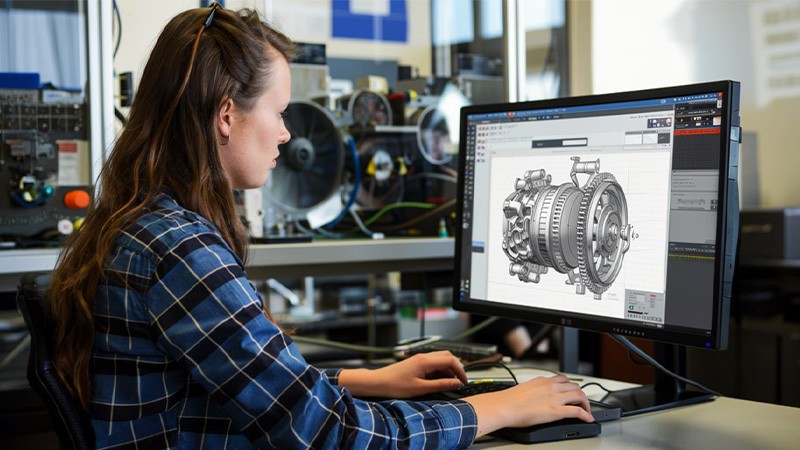
Every mechanical engineer has experienced this moment: you know exactly what you want the part to look like, you can describe it in a sentence, but translating that description into a sequence of CAD operations takes 45 minutes of menu navigation, feature tree management, and constraint definition. The mental model is clear. The software just makes you work for it.
CAD tools were designed around a paradigm of direct geometric manipulation. You sketch a profile, extrude it, add fillets, cut pockets, pattern features. Each operation is explicit, visual, and precise. That precision is the strength of traditional CAD. It is also the bottleneck. Because the interface forces engineers to think in terms of software operations rather than design intent, there is a constant translation overhead between what the engineer wants and how the software expects them to ask for it.
Natural language CAD is the emerging idea that engineers should be able to describe what they want in plain English (or any language) and have the system translate that intent into geometry. Not as a replacement for parametric modeling, but as a faster entry point into the design process. The interface shifts from clicking to communicating, and for a surprising number of engineering tasks, that shift saves real time.
The Translation Tax: How CAD Interfaces Slow Engineers Down
The dirty secret of modern CAD software is that a significant chunk of an engineer's time is spent operating the tool rather than solving engineering problems. Studies consistently show that engineers spend 30% or more of their working hours on information retrieval and tool manipulation rather than actual design and analysis work.
This translation tax hits hardest during the early stages of design, when concepts are still fluid and the engineer needs to explore multiple directions quickly. Sketching a rough concept on a whiteboard takes 30 seconds. Turning that concept into even a simplified CAD model takes an hour or more. That asymmetry discourages exploration.
The problem compounds for engineers who work across multiple CAD platforms. The command to chamfer an edge is different in SOLIDWORKS than in CATIA than in Creo. An engineer who is fluent in one platform stumbles in another, not because they lack the engineering knowledge but because they lack the muscle memory for that specific interface.
Experienced engineers develop workarounds. They memorize keyboard shortcuts, build custom macros, and develop template libraries to reduce repetitive interactions. But all of that effort is invested in becoming faster at operating the software, not at engineering.
IN PRACTICE
It opens our minds to new thinking -- new directions for us and for our users. We come up with better, more creative, and more efficient solutions than we did before.
"It opens our minds to new thinking -- new directions for us and for our users. We come up with better, more creative, and more efficient solutions than we did before."
- Harel Oberman, CEO, Oberman Industrial Designs
What Natural Language CAD Actually Looks Like Today
Let us be clear about what natural language CAD can and cannot do in its current state. Nobody is typing "design me a gearbox" and getting a production-ready assembly. That is science fiction, at least for now. What is real and practically useful today falls into several categories.
The first is natural language search and retrieval. Engineers describe a component they need, by function, geometry, or specification, and the system finds matching parts from internal libraries, past designs, or standards databases. This works today and it works well.
The second category is natural language engineering calculations. Rather than setting up a spreadsheet or searching for the right formula, an engineer types a question and gets the answer with the calculation logic shown.
The third category is natural language CAD operations, where the engineer describes a modification in words and the system executes it as a feature operation. This is the most nascent category, and the capabilities vary significantly across different tools.
The fourth is standards and specification lookup. These questions have definitive answers buried in standards documents that many engineers have on a shelf but rarely open. Natural language access to that information collapses the lookup time from minutes to seconds.
Why Text-Based Workflows Are Faster for Specific Tasks
The efficiency argument for natural language CAD is not that typing is always faster than clicking. It is that for certain categories of tasks, the gap is enormous, and those tasks happen to consume a disproportionate amount of engineering time.
Information retrieval is the clearest win. Finding a part in a PDM system, looking up a material property, checking a standard specification. These are tasks where the engineer knows what they want but the system makes them work to find it. Natural language interfaces collapse the search problem.
Repetitive operations are another strong case. Adding annotations to engineering drawings, applying standard edge treatments across a model, creating bill of materials entries. These tasks follow patterns, and a natural language interface can batch them.
Design space exploration benefits from text-based interaction because it lowers the cost of asking "what if?" questions. With an AI-powered natural language interface connected to your engineering data, the answer can come back in seconds.
Cross-disciplinary communication is an underappreciated benefit. When a manufacturing engineer asks the design team about a specific design choice, a natural language query against the project's knowledge base can surface that context instantly, reducing back-and-forth that slows cross-functional collaboration.
The Limits of Natural Language in Engineering
Natural language CAD has real limitations that are worth being honest about. Ambiguity is the fundamental challenge. When an engineer says "make it stronger," that could mean increase wall thickness, change to a higher-grade material, add ribs, modify the geometry to reduce stress concentrations, or any combination. Human language is inherently imprecise, and engineering design requires precision.
The best natural language CAD tools handle this by asking clarifying questions rather than guessing. They also provide their reasoning transparently, showing the calculations and assumptions behind any recommendation so the engineer can verify whether the interpretation matches their intent.
Complex geometric operations remain difficult to specify through text alone. For these operations, direct manipulation in the CAD environment is still the more reliable approach.
Natural language also does not replace the need for parametric modeling discipline. A well-structured feature tree with meaningful parameter names and clear parent-child relationships is essential for downstream modifications, drawing generation, and manufacturing handoff.
Keep Reading: Best Text-to-CAD AI Tools in 2026: What Engineers Actually Need · Sketch-to-CAD with AI: Converting Hand Drawings to 3D Models in Minutes · SolidWorks AI & Automation Without Coding: What Is Actually Possible in 2026
How Engineering Teams Are Adopting Natural Language Workflows
Adoption typically starts with search and retrieval rather than CAD creation. This makes sense because the value is immediate, the risk is zero, and the learning curve is almost nonexistent. Engineers start by querying their PDM systems in natural language, finding parts, looking up specifications, and pulling past design data. The connection to PDM and PLM platforms, including SolidWorks PDM, Autodesk Vault, PTC Windchill, Siemens Teamcenter, and Arena PLM, means engineers can start using natural language queries without migrating data or changing existing systems.
The next phase is typically technical Q&A and calculations. Engineers discover that they can get accurate, cited answers to engineering questions faster than searching through textbooks or standards documents. Engineering-specific AI trained on over one million pages of industry standards, books, and articles provides answers that are grounded in real technical sources.
The shift toward using natural language for actual CAD operations is slower and more cautious, which is appropriate. But as trust builds through successful search and calculation experiences, teams gradually incorporate text-based commands for routine operations.
Security and IP protection matter throughout this adoption curve. Engineers need confidence that their queries, designs, and proprietary knowledge are handled securely. SOC-2 certification and GDPR compliance provide that baseline.
FAQ
Ask Your Data, Skip the Menus
Natural language access to your engineering knowledge.
Leo AI lets your team query PDM systems, look up standards, and run calculations in plain language. Cited answers, transparent logic, and zero workflow disruption. Connected to your existing tools.
Schedule a Demo →

#1 New AI Software Globally - G2 2026

Enterprise-grade security

Trusted by world-class engineering teams