Liran Silbermann, Marketing Leo AI
Feb 10, 2026
Your new SOLIDWORKS engineer has a master's degree and 3 years of experience at a similar company. His resume is perfect. So why will it take him 9-12 months to become productive on your team?
The answer isn't his skills or motivation. It's everything he doesn't know yet. Your product line history. Your design standards. Your PLM workflows. The vendor who always ships late. Why that assembly sequence is the only one that works. The material combination that failed testing in 2020.
According to research from the Society for Human Resource Management, the average cost of a bad hire is five times their annual salary. But slow onboarding of good hires costs almost as much. At $140K for a senior mechanical engineer, every month of partial productivity costs you $5,000-$10,000 in lost output, plus the senior engineer time spent answering questions.
For a 50-person engineering team with 20% annual turnover, slow onboarding costs you $500K-$900K per year.
This article shows you how enterprise engineering teams cut SOLIDWORKS onboarding time by 60%, using proven frameworks and AI-powered knowledge management tools.
The Real Cost of Traditional SOLIDWORKS Onboarding
Industry benchmarks paint a consistent picture. Junior engineers take 18-24 months to reach full productivity. Senior engineers with relevant experience take 9-12 months. Even rockstar hires with perfect backgrounds need 6-9 months.
Here's what takes so long:
Systems and Tools (2-4 weeks): Getting access to SOLIDWORKS, PDM, PLM, email, Slack, VPN, design libraries. Learning where everything lives. Understanding file naming conventions. This is the easy part.
Company-Specific Knowledge (3-6 months): Learning your product lines, understanding your design standards, recognizing your assembly patterns, knowing your vendor relationships, understanding your testing requirements. This requires exposure to actual projects.
Tribal Knowledge (6-18 months): Why certain design decisions were made. What approaches have failed before. Which workarounds solve recurring problems. Who to ask for specific expertise. This is never written down anywhere.
Independent Problem-Solving (9-24 months): Knowing enough to solve problems without escalation. Recognizing patterns from past projects. Making good decisions without constant supervision. This is what "fully productive" actually means.
Key Insight: The bottleneck isn't CAD skills. It's access to institutional knowledge that exists only in people's heads and scattered across disconnected systems.
A McKinsey study found that engineers spend 6-8 hours per week searching for information. For new engineers, that number doubles. That's 12-16 hours per week asking questions, searching files, and interrupting colleagues.
At $85/hour loaded cost, that's $52,000-$68,000 per year just in search time. For a single engineer.
Understanding the phases helps you identify where acceleration is possible.
Phase 1: Systems and Tools (Weeks 1-2)
What happens: Access provisioning, software installation, basic orientation to systems.
Traditional approach: IT tickets, manual walkthroughs, shadowing someone for a day.
Accelerated approach: Pre-provisioned accounts, automated onboarding checklist, self-service knowledge base with video tutorials, AI assistant that answers basic questions.
Time savings possible: 30-40% (from 2-3 weeks to 1-2 weeks)
Phase 2: Product Knowledge (Weeks 3-8)
What happens: Learning product lines, understanding design intent, recognizing component relationships, knowing assembly patterns.
Traditional approach: Reading old documentation (if it exists), reviewing past projects, asking senior engineers constant questions.
Accelerated approach: Structured product knowledge base, design pattern library, AI-powered search across all past projects, guided project reviews with specific learning objectives.
Time savings possible: 50-60% (from 8-12 weeks to 4-6 weeks)
Phase 3: Design Autonomy (Weeks 9-16)
What happens: Working on real designs with minimal supervision, making decisions independently, solving problems without escalation.
Traditional approach: Trial and error, frequent reviews, lots of rework, gradual confidence building.
Accelerated approach: AI assistant that provides instant answers to "how did we handle this before" questions, proactive alerting about potential mistakes, access to design rationales and past decisions, automated knowledge capture from senior engineers.
Time savings possible: 60-70% (from 12-16 weeks to 4-6 weeks)
Phase 4: Full Productivity (Weeks 17+)
What happens: Contributing at the level of experienced team members, mentoring newer engineers, improving processes.
Traditional approach: Happens gradually over 18-24 months as engineer builds tribal knowledge through experience.
Accelerated approach: Continuous access to institutional knowledge through AI systems, systematic lessons learned capture, cross-project knowledge sharing.
Time savings possible: 50-65% (from 18-24 months to 6-9 months)
The Hiring Choice: Junior vs. Senior Engineer + AI Impact
When your veteran engineer retires, you face a choice. Here's what productivity timelines actually look like.
Capability | Junior (No AI) | Senior (No AI) | Junior + AI | Senior + AI |
Profile | Fresh grad, CAD basics | 8+ years relevant experience | Fresh grad, CAD basics | 8+ years relevant experience |
Basic SOLIDWORKS | 2-3 months | Already proficient | 3-4 weeks | Already proficient |
Your drawing standards | 3-4 months | 2-3 weeks | 4-6 weeks | 1-2 weeks |
Your PLM system | 4-6 months | 6-8 weeks | 6-8 weeks | 3-4 weeks |
Product line history | 8-12 months | 4-6 months | 2-3 months | 6-8 weeks |
Design decisions & rationale | 12-18 months | 6-9 months | 3-4 months | 2-3 months |
Proven workflows | 12+ months | 3-4 months | 2-3 months | 4-6 weeks |
"Why we don't do X" | 18+ months | 6-12 months | 3-5 months | 6-10 weeks |
Vendor relationships | 18-24 months | 6-9 months | 4-6 months | 2-3 months |
Spot repeat mistakes | 24+ months | 9-12 months | 4-6 months | 2-4 months |
Independent productivity | 18-24 months | 9-12 months | 6-9 months | 3-4 months |
Replaces retiring engineer | Never (60-70%) | 12-18 months (85%) | 9-12 months (80-85%) | 4-6 months (90-95%) |
What this reveals:
Even your best hire faces a massive knowledge gap. That stellar senior engineer with perfect experience? He still needs 9-12 months to become truly productive in your environment. He doesn't know why Design Team A stopped using that specific fastener in 2019. He wasn't in the room when Engineering decided to change that assembly sequence.
Junior engineers without AI support never fully catch up. After two years, they're still missing 30-40% of institutional knowledge.
AI levels the playing field. A junior engineer with AI-powered knowledge management reaches productivity in 6-9 months instead of 18-24 months. That's a 12-18 month time savings at $75K salary, or $75K-$112K in recovered productivity.
AI supercharges your best hires. That expensive senior engineer you recruited? With AI, he's independently productive in 3-4 months instead of 9-12 months. He retains 90-95% of institutional knowledge instead of 85%. You get ROI on that six-figure salary much faster.
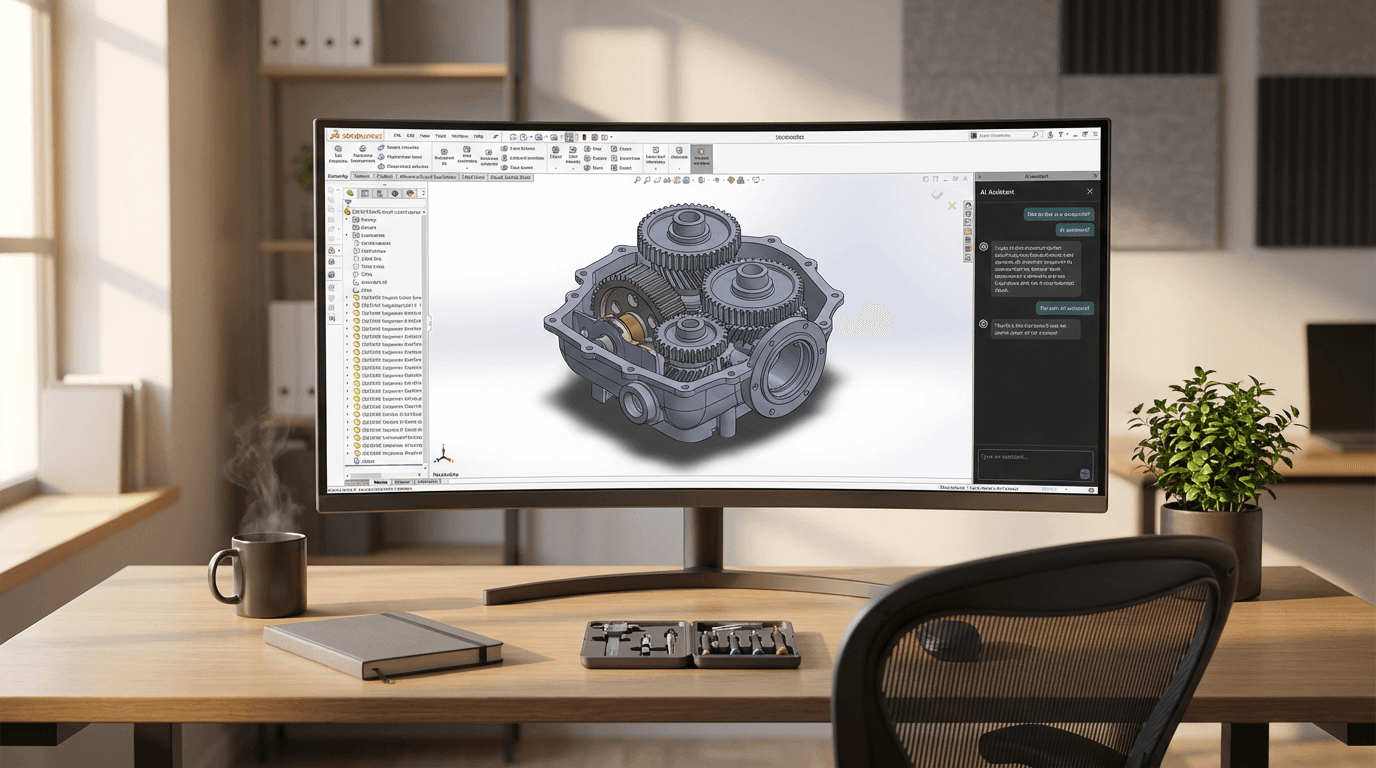
Real Example: A precision manufacturing company hired a senior mechanical engineer with 12 years of experience in similar products. With Leo AI providing instant access to 15 years of design rationale and past decisions, he was solving complex assembly problems independently by month 3 instead of the typical 9-month timeline.
Strategy 1: Build a Searchable Design Knowledge Base
Traditional documentation fails because engineers don't write it and don't read it. The solution isn't more documentation, it's better knowledge capture and retrieval.
What works:
Capture knowledge automatically from PDM check-in comments, email discussions, and design reviews
Make it searchable by design context, not just keywords
Embed answers in workflow (inside SOLIDWORKS, not a separate system)
Use AI to understand engineering terminology and product relationships
Implementation: Start with high-value knowledge domains like recurring design problems, vendor relationships, and common mistakes. Use AI-powered knowledge assistants that learn from existing PDM data and email archives.
Strategy 2: Create Progressive Complexity Assignments
Don't throw new engineers into complex projects immediately. Design a graduated path.
Week 1-2: Simple modifications to existing designs (change dimensions, swap components)
Week 3-6: Component-level designs with clear requirements and examples
Week 7-12: Sub-assembly designs with guidance from AI knowledge base
Week 13+: Full assembly ownership with decreasing supervision
Key principle: Each assignment should require learning one new thing while applying previously learned concepts. The AI assistant provides scaffolding that gradually reduces as competence increases.
Strategy 3: Implement "Office Hours" Instead of Constant Interruptions
Senior engineers lose 6-8 hours per week answering new hire questions. New engineers lose focus waiting for answers. Both problems are fixable.
What works:
Designated office hours for questions (2-3 scheduled blocks per week)
AI assistant answers 70-80% of questions instantly without human interruption
Questions that need human expertise get documented and added to knowledge base
Reduces context switching for senior engineers by 40-60%
Measurement: Track "questions asked per week" and "time to answer." As AI knowledge improves, questions decrease and answers get faster.
Strategy 4: Pair New Engineers with AI, Not Just People
The traditional buddy system pairs new engineers with experienced ones. This works but doesn't scale and creates bottlenecks.
Enhanced approach:
AI assistant is the primary resource for questions
Human buddy focuses on strategic guidance and relationship building
New engineer gets instant answers without interrupting colleagues
Human time is spent on high-value mentoring, not answering "where is the file" questions
Result: One experienced engineer can effectively support 5-6 new hires instead of 1-2.
Strategy 5: Measure and Optimize Continuously
You can't improve what you don't measure.
Key metrics to track:
Time to first independent design (target: 4-6 weeks with AI vs. 12-16 weeks traditional)
Questions asked per week (should decrease 60-70% by week 8)
Design revision rate (should match experienced engineers by month 6)
Knowledge base utilization (target: 80%+ of questions answered by AI)
Senior engineer time spent on onboarding support (should decrease 40-50%)
Quarterly review: Identify bottlenecks, update knowledge base, refine assignments, optimize AI training.
Tools and Technology That Accelerate Onboarding
Essential Foundation
SOLIDWORKS PDM Professional: Version control and design history
PLM System Integration: Product lifecycle context (integration guide)
Collaboration Platform: Slack or Teams for async communication
Accelerators
AI Knowledge Assistant: Leo AI provides instant answers from your design history without context switching
Video Knowledge Base: Screen recordings of complex workflows
Design Pattern Library: Proven approaches and templates
Automated Alerts: Flags potential mistakes based on past failures
Comparison: Traditional vs. AI-Assisted Onboarding
Aspect | Traditional Approach | AI-Assisted Approach |
Answer Time | 2-4 hours (wait for colleague) | Instant (AI responds in seconds) |
Knowledge Access | Fragmented across 5+ systems | Unified search across all sources |
Senior Engineer Burden | 6-8 hours/week per new hire | 2-3 hours/week per new hire |
Knowledge Retention | 60-70% after 12 months | 80-95% after 12 months |
Scalability | Limited (1 buddy per new hire) | High (AI supports unlimited users) |
Cost per New Hire | $50K-$90K in lost productivity | $15K-$30K in lost productivity |
Implementation Roadmap: 30-60-90 Days
Days 1-30: Foundation
Week 1:
Assess current onboarding process and pain points
Identify critical knowledge domains (what do new engineers ask most?)
Select AI knowledge management platform (evaluate options)
Week 2-3:
Connect AI system to PDM, email, and collaboration tools
Begin knowledge base indexing
Create progressive assignment framework
Week 4:
Pilot with next new hire
Track baseline metrics (questions asked, time to answer, senior engineer time)
Days 31-60: Optimization
Week 5-6:
Analyze pilot results and knowledge gaps
Enhance AI training with domain-specific content
Refine assignment progression based on actual performance
Week 7-8:
Expand to 2-3 concurrent new hires
Implement office hours structure
Create feedback loop for continuous knowledge base improvement
Days 61-90: Scaling
Week 9-10:
Roll out to all new hires
Train hiring managers on AI-assisted onboarding process
Establish quarterly optimization reviews
Week 11-12:
Measure results against traditional onboarding baseline
Calculate ROI (time saved, productivity gained, cost reduction)
Document best practices for company-wide adoption

Measuring Success: Key Performance Indicators
Track these metrics monthly to validate acceleration:
Time-based metrics:
Days to first independent design completion
Weeks to 80% productivity level
Months to full productivity equivalence
Quality metrics:
Design revision rate compared to experienced engineers
Number of repeated mistakes from knowledge gaps
Compliance with design standards
Efficiency metrics:
Questions asked per week (should decrease by 70% by week 8)
Senior engineer time spent on onboarding support
Knowledge base hit rate (% of questions answered by AI)
Business metrics:
Cost per new hire onboarding
Time-to-value for new engineering capacity
Knowledge retention after 6 and 12 months
ROI Calculation: Junior engineer at $75K takes 18 months to productivity traditionally. With AI-assisted onboarding, reaches productivity in 6 months. That's 12 months of accelerated value at partial productivity = $30K-$45K recovered per hire. For 10 hires per year: $300K-$450K annual value.
The Competitive Advantage of Faster Onboarding
Companies that master fast onboarding gain compounding advantages:
Talent acquisition: Offer new hires productivity and growth faster than competitors
Scaling capacity: Add engineering capacity 3x faster when business demands it
Knowledge resilience: Less vulnerable to turnover and retirements
Innovation velocity: Experienced engineers spend time innovating, not answering repetitive questions
Cost efficiency: Same team capacity at 40-60% lower onboarding cost
The engineering leaders who implement these systems first will build insurmountable knowledge advantages over the next 3-5 years.
Your Next Steps
Faster onboarding isn't about working harder. It's about giving new engineers instant access to the institutional knowledge that currently exists only in senior engineers' heads and scattered across disconnected systems.
Start here:
Calculate your current onboarding cost using your actual timelines and salaries
Identify your biggest knowledge bottlenecks (what do new engineers ask most?)
Pilot AI-assisted onboarding with your next hire
The technology exists today. The only question is whether you'll implement it before your competitors do.