
AI for Engineering Knowledge Management
Engineers lose 20% of their week to failed PDM searches. See the real cost of duplicated parts, buried knowledge, and how AI-powered search fixes it.
·
⏱
9 min read

Michelle Ben-David
Michelle Ben-David is a mechanical engineer and Technion graduate. She served in an IDF elite technology and intelligence unit, where she developed multidisciplinary systems integrating mechanics, electronics, and advanced algorithms. Her engineering background spans robotics, medical devices, and automotive systems.
BOTTOM LINE
PDM search problems are not a minor annoyance. They cost engineering organizations real money through duplicated parts, inflated BOMs, and buried institutional knowledge. The root cause is simple: traditional PDM search was designed for database queries, not for how engineers actually think and work. AI-powered search, like Leo AI, closes that gap by understanding natural language, geometry, and engineering context across your full knowledge base. No migration, no disruption, just a search experience that finally works the way it should.
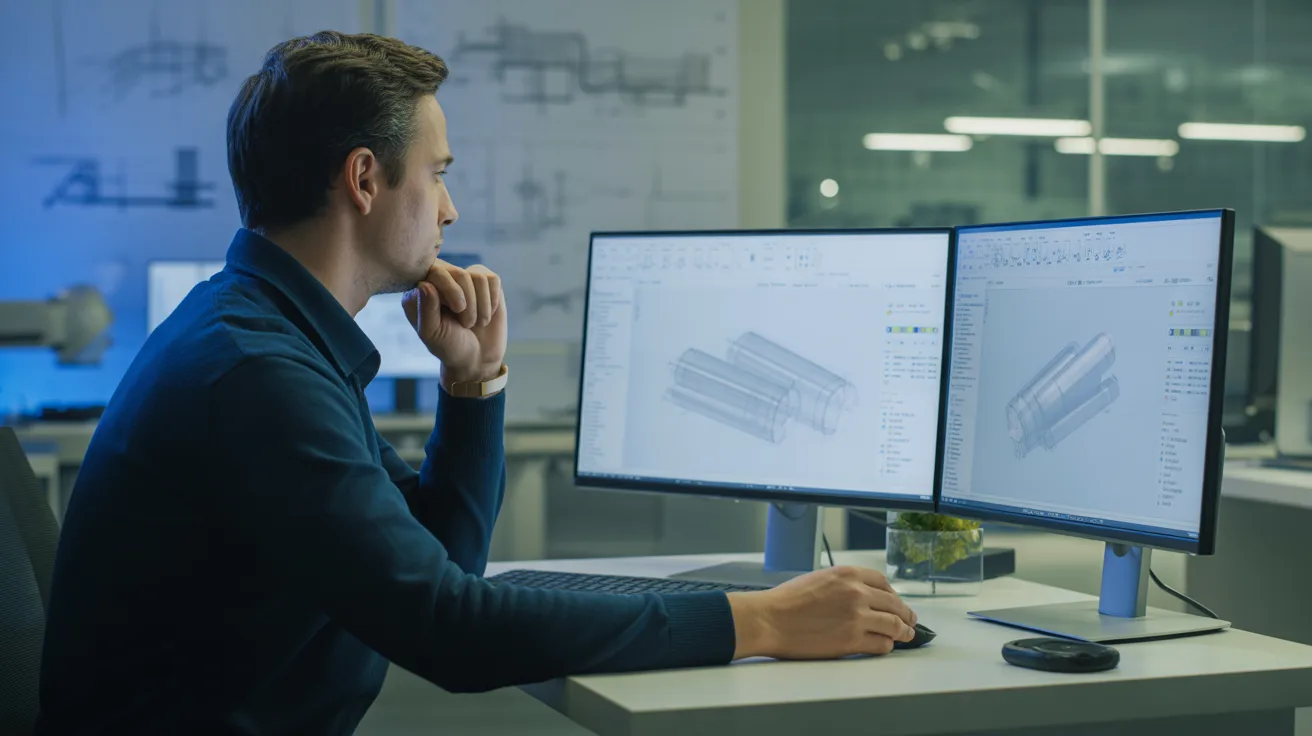
Let me paint you a picture you have probably lived through. It is 2 PM on a Tuesday. You need a mounting bracket that fits a specific envelope, and you are 90% sure your team designed one for a similar project last year. So you open your PDM, type in a few keywords, and get either nothing or 400 results sorted by date modified. You click through a dozen folders, open files that are clearly wrong, and after 45 minutes you give up and start modeling from scratch.
That bracket you just redesigned? It already existed. Three versions of it, actually, sitting in a subfolder two levels deeper than anyone would think to look, tagged with metadata that did not match the words you searched for. And now your company has a fourth version, with its own drawing package, its own BOM entry, and its own procurement cycle.
This is not an edge case. PDM search problems are one of the most common frustrations in mechanical engineering, and the costs go far beyond wasted time. Industry research by CIMdata and the Aberdeen Group has consistently shown that engineers spend 20 to 30 percent of their work week searching for information. That is roughly one full day per week lost to a search bar that does not work the way engineers think.
Why PDM Search Fails Engineers
The problem is structural, not cosmetic. Most PDM systems were built to manage files, not to help you find them. Their search engines are essentially database queries: they match exact strings against metadata fields. If you know the part number, the filename, or the precise value in a custom property, you will find your file. But that is almost never how real engineering work starts.
More often, you have a functional need. "I need a heat sink under 50 grams that fits in a 35 by 45mm footprint." Or you have a memory. "We used something like this on the defense project two years ago." Traditional PDM search cannot handle either of those. It does not understand geometry. It does not understand synonyms.
Metadata quality makes everything worse. In practice, engineers are under deadline pressure, naming conventions vary between teams, and nobody wants to spend 10 minutes filling out custom properties when there is a design review in an hour. The result is a vault full of CAD files with incomplete, inconsistent, or missing metadata.
And then there is the folder structure problem. Most PDM vaults are organized by project or by some legacy convention that made sense to whoever set it up years ago. If you were not on the original project team, you have no idea where to even start browsing.
IN PRACTICE
The search in Teamcenter has always been a weak point for us. If you don't know the exact part number or file name, you're basically not finding it. Leo changed that. I can describe a part geometrically or by function and it finds relevant parts from our own history.
Enterprise Defense User, G2 Review
Duplicated Parts and BOM Bloat
When engineers cannot find existing parts, they design new ones. This is not laziness. It is a rational response to a broken system. If searching takes longer than modeling, you model. But the downstream costs of that decision are enormous.
Every duplicated part creates a new drawing, a new BOM line item, new tooling requirements, and a new procurement cycle. Multiply it across hundreds of engineers working on dozens of projects over several years, and you end up with a parts catalog that is three or four times larger than it needs to be.
A study published by the Aberdeen Group found that companies with poor part reuse practices spent 10 to 15 percent more on direct materials than those with strong reuse programs. That is real money. It shows up in longer lead times, higher inventory carrying costs, more supplier negotiations, and more quality issues from untested new parts replacing proven ones.
There is also a compounding effect. Every unnecessary part you add to your catalog makes future searches harder. More results to wade through. More similarly named files. Bad search creates part duplication, and part duplication makes search worse. It is a feedback loop that accelerates over time.
Tribal Knowledge Gets Buried
Here is the part that does not show up on any cost spreadsheet. When a senior engineer retires, changes roles, or just takes a two-week vacation, their mental map of "where things are" goes with them. They knew that the titanium bracket from the 2019 project was filed under a client codename. They knew which revision of the spec had the updated tolerance callout.
None of that knowledge lives in the PDM. It lives in people's heads, in Slack threads, in meeting notes that nobody tagged or filed properly. And when those people are not around, the knowledge is effectively gone.
PDM search problems are not just about finding CAD files. They are about accessing the entire body of institutional knowledge that an engineering organization builds up over years of work. Design rationale, material trade-off decisions, lessons learned from manufacturing failures, supplier feedback on specific geometries.
The result is that every new project starts with less context than it should. Engineers repeat mistakes that were already solved. They make material choices without knowing that a colleague already tested and rejected that option two years ago. It is not just inefficiency. It is a loss of engineering intelligence.
What Good Engineering Search Looks Like
The search experience engineers actually need looks nothing like what most PDM systems offer. It needs to understand natural language. An engineer should be able to type "stainless steel mounting plate, M6 holes on 40mm spacing, used in outdoor enclosures" and get useful results.
Second, it needs to understand geometry. Text-to-CAD search, where you describe a part and the system finds matching 3D models, is the single most impactful capability for driving part reuse. CAD-to-CAD search, where you upload a model and find similar parts across the vault, is equally critical.
Third, it needs to search across systems, not just within one vault. Engineering knowledge is scattered across PDM vaults, PLM records, ERP data, shared drives, local folders, and specification documents.
Fourth, it needs to surface context, not just files. When an engineer finds a relevant part, they also need to know: why was it designed this way? What project was it for? Were there manufacturing issues? AI-powered search, built on large language models trained on engineering content, makes all of this possible today.
Keep Reading: Best PDM Software for Mechanical Engineers: A Full Comparison for 2026 · SolidWorks PDM Search Problem · Product Data Management Software: What Engineers Need in 2026 · Engineering Knowledge Management: The Workflow Problem Nobody Is Solving
How Leo AI Solves the PDM Search Problem
Leo AI is an AI-powered engineering assistant that sits on top of your existing systems as an intelligence layer. It does not replace your PDM. It makes your PDM searchable in the way it always should have been.
Leo offers integrations with leading PDM and PLM platforms including SolidWorks PDM, Autodesk Vault, PTC Windchill, Siemens Teamcenter, and Arena PLM. It also connects to local and network directories, ERP systems, and other data sources where engineering knowledge lives.
Leo is trained on over one million pages of industry standards, technical books, and engineering articles. When you ask it a question, it understands the difference between a press fit and a slip fit, between ASTM A36 and 304 stainless. It does not just match keywords. It understands what you are actually asking for.
Leo's part search capabilities include text-to-text, text-to-CAD, and CAD-to-CAD search. Setup typically takes days, not months, and requires no data migration. Leo AI is SOC-2 certified and GDPR compliant, and no AI model is ever trained on your data.
FAQ
CIMdata, "Engineering Efficiency and the Cost of Information Search," 2023
Aberdeen Group, "The Impact of Part Reuse on Product Development Costs," 2022
Stop Searching. Start Finding.
See how Leo AI transforms your PDM into a searchable knowledge base.
Leo connects to your existing PDM and PLM systems and lets engineers find parts, past designs, and tribal knowledge in seconds. No migration, no disruption.
Schedule a Demo →

#1 New AI Software Globally - G2 2026

Enterprise-grade security

Trusted by world-class engineering teams