General

Sheet Metal DFM: How AI Handles Bend Radius, K-Factor, and Manufacturing Cost Optimization

Sheet Metal DFM: How AI Handles Bend Radius, K-Factor, and Manufacturing Cost Optimization

Sheet Metal DFM: How AI Handles Bend Radius, K-Factor, and Manufacturing Cost Optimization

A mechanical engineer's guide to AI-powered sheet metal DFM, covering bend radius validation, k-factor accuracy, flat pattern generation, and cost optimization before parts go to fab.

·

5 min read

Michelle Ben-David

Mechanical Engineer · B.Sc. Technion

Ex-Officer, Elite Tech Unit · Aerospace & Defence · Medical Devices

Michelle Ben-David is a mechanical engineer and Technion graduate. She served in an IDF elite technology and intelligence unit, where she developed multidisciplinary systems integrating mechanics, electronics, and advanced algorithms. Her engineering background spans robotics, medical devices, and automotive systems.
BOTTOM LINE

AI-powered fastener selection cross-checks geometry, material, thread engagement, torque requirements, and your approved vendor list in seconds — eliminating the back-and-forth that adds days to assembly design cycles.

Sheet Metal DFM Is a Geometry Problem

Sheet metal fabrication failures are almost entirely geometry-based. The material and the process are well understood. The failure modes are documented. Minimum bend radius tables exist for every common alloy and temper. Hole-to-bend clearance rules are calculable. Flat pattern interference is a geometric fact that can be checked before the file goes to the laser.

The reason these failures still reach fabrication is not that engineers do not know the rules. It is that checking every feature on every part against every applicable rule, at the pace of a real design cycle, does not happen consistently without a tool that does it automatically.

The Sheet Metal DFM Checks That Matter

Bend Radius Validation

Minimum bend radius for sheet metal is a function of material, temper, thickness, and the bend direction relative to the grain of the sheet. Inside bend radius below the minimum for the specified material and thickness causes cracking at the outer surface of the bend. The minimums are published by material suppliers and covered in standards.

AI inspection reads the modeled inside radius on every bend feature and compares it against the minimum for the specified material and thickness. It flags violations with the specific radius, the minimum required, and the source standard or internal guideline cited.

This is straightforward to check manually on a part with three bends. It is not straightforward on a complex enclosure with 40 bend features across six faces.

K-Factor Accuracy

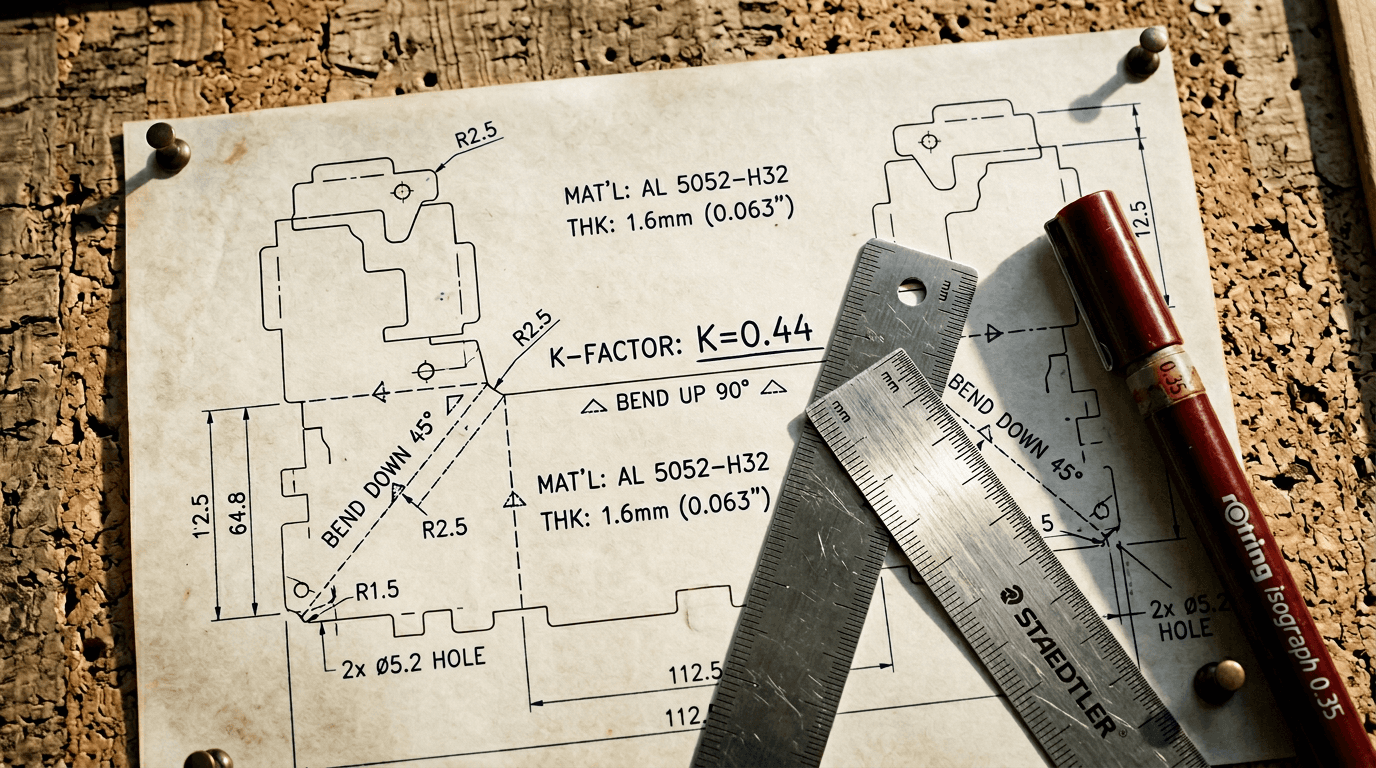
K-factor describes where the neutral axis sits within the material during bending, as a ratio of the neutral axis position to the material thickness. It directly affects flat pattern dimensions: use the wrong k-factor and your flat pattern is wrong, which means your part does not conform to the 3D model after forming.

The correct k-factor depends on material, thickness, bend radius, and your specific tooling setup. Most CAD tools use a default k-factor that is approximately correct for common mild steel at typical thicknesses. For aluminum, stainless, high-strength steel, or non-standard thicknesses, the default is often wrong.

AI tools connected to your fabricator's process data or your internal manufacturing guidelines can apply the correct k-factor for the specified material, flag when the CAD default is being used for a material where it is not accurate, and calculate the correct flat pattern length.

Hole-to-Bend Clearance

Holes too close to a bend distort during forming. The minimum clearance is typically expressed as a multiple of material thickness plus bend radius. A hole at 1.5 times material thickness from the bend tangent line in 3mm steel is going to distort. The rule is calculable. AI checks every hole on every part against the applicable clearance rule.

Flat Pattern Interference and Grain Direction

Flat pattern interference occurs when a feature in the flat pattern overlaps or conflicts with another feature, which only becomes visible when the 3D model is unfolded. AI tools that read the geometry can unfold the flat pattern computationally and check for interference before the file goes out.

Grain direction matters for bending performance in aluminum and some stainless alloys. AI inspection can flag bends oriented parallel to the rolling direction on materials where perpendicular orientation is required for crack-free bending.

Feature-Specific Checks

Relief cuts at bend terminations. Minimum flange lengths for press brake tooling access. Tab and slot alignment for welded assemblies. Countersink depth versus material thickness. Each of these is a geometric check that AI handles the same way: compare the modeled geometry against the rule, flag violations with citations.

The Sheet Metal DFM Checks That Matter

Bend Radius Validation

Minimum bend radius for sheet metal is a function of material, temper, thickness, and the bend direction relative to the grain of the sheet. Inside bend radius below the minimum for the specified material and thickness causes cracking at the outer surface of the bend. The minimums are published by material suppliers and covered in standards.

AI inspection reads the modeled inside radius on every bend feature and compares it against the minimum for the specified material and thickness. It flags violations with the specific radius, the minimum required, and the source standard or internal guideline cited.

This is straightforward to check manually on a part with three bends. It is not straightforward on a complex enclosure with 40 bend features across six faces.

K-Factor Accuracy

K-factor describes where the neutral axis sits within the material during bending, as a ratio of the neutral axis position to the material thickness. It directly affects flat pattern dimensions: use the wrong k-factor and your flat pattern is wrong, which means your part does not conform to the 3D model after forming.

The correct k-factor depends on material, thickness, bend radius, and your specific tooling setup. Most CAD tools use a default k-factor that is approximately correct for common mild steel at typical thicknesses. For aluminum, stainless, high-strength steel, or non-standard thicknesses, the default is often wrong.

AI tools connected to your fabricator's process data or your internal manufacturing guidelines can apply the correct k-factor for the specified material, flag when the CAD default is being used for a material where it is not accurate, and calculate the correct flat pattern length.

Hole-to-Bend Clearance

Holes too close to a bend distort during forming. The minimum clearance is typically expressed as a multiple of material thickness plus bend radius. A hole at 1.5 times material thickness from the bend tangent line in 3mm steel is going to distort. The rule is calculable. AI checks every hole on every part against the applicable clearance rule.

Flat Pattern Interference and Grain Direction

Flat pattern interference occurs when a feature in the flat pattern overlaps or conflicts with another feature, which only becomes visible when the 3D model is unfolded. AI tools that read the geometry can unfold the flat pattern computationally and check for interference before the file goes out.

Grain direction matters for bending performance in aluminum and some stainless alloys. AI inspection can flag bends oriented parallel to the rolling direction on materials where perpendicular orientation is required for crack-free bending.

Feature-Specific Checks

Relief cuts at bend terminations. Minimum flange lengths for press brake tooling access. Tab and slot alignment for welded assemblies. Countersink depth versus material thickness. Each of these is a geometric check that AI handles the same way: compare the modeled geometry against the rule, flag violations with citations.

IN PRACTICE · HP ENGINEERING TEAM

"We had a senior engineer leave after 11 years. Within two weeks, the team was querying his documentation through Leo like he was still there. That's when we knew this was different."

— Senior Mechanical Engineering Manager, HP Inc.

Manufacturing Cost Optimization

DFM inspection catches problems. Cost optimization identifies opportunities. For sheet metal, the main cost drivers are material utilization, setup time per part, number of bends and their sequencing, secondary operations (tapping, hardware insertion, welding), and tolerances tighter than the process requires.

AI tools that connect to your fabricator's pricing data or internal cost models can flag over-specified tolerances, suggest bend sequence reordering that reduces setup time, identify features requiring secondary operations that could be eliminated by design changes, and compare alternative material and thickness combinations against the functional requirements.

At ZutaCore, Leo's design suggestions identified a standardized approach to a recurring part type that eliminated custom design work per project and yielded $400 per unit in direct manufacturing cost savings. The mechanism was straightforward: AI identified that a standardized adjustable design using off-the-shelf parts solved the same functional requirement as a series of custom parts.


Manufacturing Cost Optimization

DFM inspection catches problems. Cost optimization identifies opportunities. For sheet metal, the main cost drivers are material utilization, setup time per part, number of bends and their sequencing, secondary operations (tapping, hardware insertion, welding), and tolerances tighter than the process requires.

AI tools that connect to your fabricator's pricing data or internal cost models can flag over-specified tolerances, suggest bend sequence reordering that reduces setup time, identify features requiring secondary operations that could be eliminated by design changes, and compare alternative material and thickness combinations against the functional requirements.

At ZutaCore, Leo's design suggestions identified a standardized approach to a recurring part type that eliminated custom design work per project and yielded $400 per unit in direct manufacturing cost savings. The mechanism was straightforward: AI identified that a standardized adjustable design using off-the-shelf parts solved the same functional requirement as a series of custom parts.


What This Looks Like in Practice

Scenario: Sheet metal enclosure for industrial electronics, prototype to production transition

Prototype parts were laser-cut and brake-formed in small quantities. Transitioning to production with a contract sheet metal fabricator. The fabricator's DFM review comes back with six issues: two bend radii below minimum for the specified aluminum alloy and temper, three holes within distortion distance of bend lines, and a tight tolerance on a formed feature that requires a secondary operation.

Three of those six issues are on features that an AI inspection would have caught in the design phase. The bend radius minimums for aluminum 5052-H32 are published. The hole-to-bend clearance rule is calculable from the part thickness. Catching them before the prototype build does not change the prototype outcome, but it eliminates the feedback loop iteration before production release.

With Leo AI in the pre-release workflow: engineer runs Leo Inspect on the enclosure before sending to prototype. Two bend radius violations flagged against the aluminum alloy minimum, citing the relevant material specification. Three hole proximity issues flagged with the applicable clearance calculation. Engineer addresses all five in the design phase. Prototype and production drawing are consistent. Fabricator's DFM review focuses on process optimization rather than geometry corrections.

What This Looks Like in Practice

Scenario: Sheet metal enclosure for industrial electronics, prototype to production transition

Prototype parts were laser-cut and brake-formed in small quantities. Transitioning to production with a contract sheet metal fabricator. The fabricator's DFM review comes back with six issues: two bend radii below minimum for the specified aluminum alloy and temper, three holes within distortion distance of bend lines, and a tight tolerance on a formed feature that requires a secondary operation.

Three of those six issues are on features that an AI inspection would have caught in the design phase. The bend radius minimums for aluminum 5052-H32 are published. The hole-to-bend clearance rule is calculable from the part thickness. Catching them before the prototype build does not change the prototype outcome, but it eliminates the feedback loop iteration before production release.

With Leo AI in the pre-release workflow: engineer runs Leo Inspect on the enclosure before sending to prototype. Two bend radius violations flagged against the aluminum alloy minimum, citing the relevant material specification. Three hole proximity issues flagged with the applicable clearance calculation. Engineer addresses all five in the design phase. Prototype and production drawing are consistent. Fabricator's DFM review focuses on process optimization rather than geometry corrections.

Run a Sheet Metal DFM Inspection on Your Parts

Bring a sheet metal part or enclosure to a Leo demo. The engineering team will run a live inspection against bend radius minimums, hole clearances, and your material specification.

Run a Sheet Metal DFM Inspection on Your Parts

Bring a sheet metal part or enclosure to a Leo demo. The engineering team will run a live inspection against bend radius minimums, hole clearances, and your material specification.

Can AI fastener selection handle custom or non-standard fasteners?

Does AI inspection replace a first-article inspection at the fabricator?

How does this handle proprietary or non-standard materials?

Glossary

  • DFM: Design for Manufacturability

  • K-factor: Ratio defining the neutral axis position during sheet metal bending, used to calculate flat pattern dimensions

  • PDM: Product Data Management

  • ECO: Engineering Change Order

  • LMM: Large Mechanical Model (Leo AI's patented AI architecture)

  • ASME: American Society of Mechanical Engineers

  • NCR: Non-Conformance Report

Glossary

  • DFM: Design for Manufacturability

  • K-factor: Ratio defining the neutral axis position during sheet metal bending, used to calculate flat pattern dimensions

  • PDM: Product Data Management

  • ECO: Engineering Change Order

  • LMM: Large Mechanical Model (Leo AI's patented AI architecture)

  • ASME: American Society of Mechanical Engineers

  • NCR: Non-Conformance Report

STOP LOSING ENGINEERING KNOWLEDGE

Every resignation email is a knowledge transfer you are not ready for.

Leo AI makes the institutional knowledge already in your CAD vault searchable by every engineer on your team - before the next senior engineer walks out the door.

Schedule a Demo →

★ #1 New AI Software Globally - G2 2026

🔒 Enterprise-grade security

Trusted by HP, NVIDIA, GE & 50k+ engineering teams

Subscribe to our engineering newsletter

Be the first to know about Leo's newest capabilities and get practical tips to boost your engineering.

Need help? Join the Leo AI Community

Connect with other engineers, get answers from our team, and request features.

#1 New Software

Globally

All Industries

#12 AI Tool

Worldwide

G2 2026

Contact us

160 Alewife Brook Pkwy #1095

Cambridge, MA 02138

United States

Subscribe to our newsletter

Be the first to know about Leo's newest capabilities and get practical tips to boost your engineering.

Need help? Join the Community

Connect with other engineers, get answers from our team, and request features.

#1 New Software

Globally

All Industries

#12 AI Tool

Worldwide

G2 2026

Contact us

160 Alewife Brook Pkwy #1095

Cambridge, MA 02138

United States

Subscribe to our engineering newsletter

Be the first to know about Leo's newest capabilities and get practical tips to boost your engineering.

Need help? Join the Leo AI Community

Connect with other engineers, get answers from our team, and request features.

#1 New Software

Globally

All Industries

#12 AI Tool

Worldwide

G2 2026

Contact us

160 Alewife Brook Pkwy #1095

Cambridge, MA 02138

United States

Subscribe to our engineering newsletter

Be the first to know about Leo's newest capabilities and get practical tips to boost your engineering.

Need help? Join the Leo AI Community

Connect with other engineers, get answers from our team, and request features.

#1 New Software

Globally

All Industries

#12 AI Tool

Worldwide

G2 2026

Contact us

160 Alewife Brook Pkwy #1095

Cambridge, MA 02138

United States