
AI for Engineering Knowledge Management
SolidWorks PDM stores thousands of parts but engineers still can't find what they need. Here is exactly why text search fails, and what AI-powered geometric search changes in 2026.
·
⏱
7 min read

Michelle Ben-David
Michelle Ben-David is a mechanical engineer and Technion graduate. She served in an IDF elite technology and intelligence unit, where she developed multidisciplinary systems integrating mechanics, electronics, and advanced algorithms. Her engineering background spans robotics, medical devices, and automotive systems.
BOTTOM LINE
SolidWorks PDM stores engineering history. The problem is never storage. It is retrieval.
Engineers fail to find existing parts not because the vault is disorganized, but because text-based search was designed for metadata that was never reliably filled out. The institutional knowledge layered on top of the geometry — why decisions were made, what alternatives were considered, what the constraints actually were — lives outside PDM entirely.
AI that reads native CAD geometry changes both problems at once. Geometric similarity search makes parts findable regardless of naming. An indexed knowledge base makes engineering rationale retrievable without tracking down the person who made the decision. The result is less duplication, faster decisions, and engineering context that survives team turnover.
An engineer needs a stainless flange nut with a specific head height. She checks SolidWorks PDM. Types "M8 stainless flange nut." Gets 847 results. Filters by project, by revision state, opens ten files. Nothing matches. Closes PDM, opens SolidWorks, and starts modeling the part from scratch.
The part she needed was result 23. The filename was "STD_HW_012_REV4." The description said "hardware item." PDM stored the part perfectly. It just could not surface it when it was needed.
This is not a rare edge case. In most engineering organizations running SolidWorks PDM, engineers fail to find existing parts several times per week. The workaround is always the same: design from scratch, add another duplicate to the vault, and repeat the cycle next quarter.
Why SolidWorks PDM Search Works the Way It Does
SolidWorks PDM was built on a reasonable assumption: engineers know what they are looking for well enough to describe it. The search function queries file names, custom properties, description fields, and revision states. It does not read geometry. It does not understand intent.
This works when every file in the vault is named consistently, every property card is filled out completely, and every engineer on every team follows the same conventions. In practice, in vaults that have been in use for more than three years, none of those conditions hold reliably.
File naming drifts as different engineers apply different conventions over different project phases. Custom property fields are filled out under deadline pressure with whatever is fastest. The description field contains whatever the engineer who created the file thought was most important at the moment of save.
The result is a search tool that is technically accurate but practically limited. It finds exactly what you searched for in exactly the field you searched. It cannot find the part that matches what you meant.
IN PRACTICE
The connection to our PDM and using that as a data source…
"The geometry search has been invaluable — helping me find standard parts instead of designing new ones, saving a huge amount of time and effort. The search system is smart and CAD-aware. It was made by people who truly understand the struggles of mechanical engineers."
— Eytan S., R&D Engineer
The Metadata Problem Is a Behavior Problem
The standard response to PDM findability problems is to add more structure: more required fields on the data card, more detailed naming conventions, more mandatory review steps before release. Engineering organizations have been trying this approach for twenty years.
It does not work because the problem is not a schema problem. It is a behavior problem.
Engineers are not going to spend three extra minutes completing a well-structured metadata form every time they save a part file. They are under schedule pressure. The design review is in two hours. The metadata gets the minimum necessary to pass validation and move on.
Mandatory fields make this worse in a specific way: engineers fill them out with placeholder values ("TBD," "standard," "N/A") to satisfy the form and keep moving. The field exists in the data card. The useful signal is not there.
Adding more required fields increases the noise. It does not make the vault more searchable. The only real fix is a search method that does not depend on metadata that was never reliably filled out.
Where the Institutional Knowledge Actually Lives
There is a second layer to the problem. PDM stores files. It does not store the reasoning behind those files.
When a designer selects 316 stainless for a bracket instead of 304, that decision was made for a reason. A corrosion study from an earlier program. A supplier qualification change. A customer specification requiring marine-grade material. That reasoning exists somewhere: in a project report, a stress analysis document, an email thread, or in the memory of the engineer who made the call.
When that engineer leaves, the reasoning leaves with them. The file stays in PDM. A new engineer opens the same bracket, sees "316 stainless," and has three options: track down someone who might remember, run a new analysis to check whether the material choice matters for the new context, or leave it as-is and accept that they do not know why.
None of those are good engineering. All three are expensive.
This is the institutional knowledge problem layered on top of the search problem. The PDM vault contains the results of engineering decisions. It does not contain the decisions themselves.
What AI Changes in a PDM Search Workflow
An AI system that reads native CAD geometry changes what can be found and how it can be found.
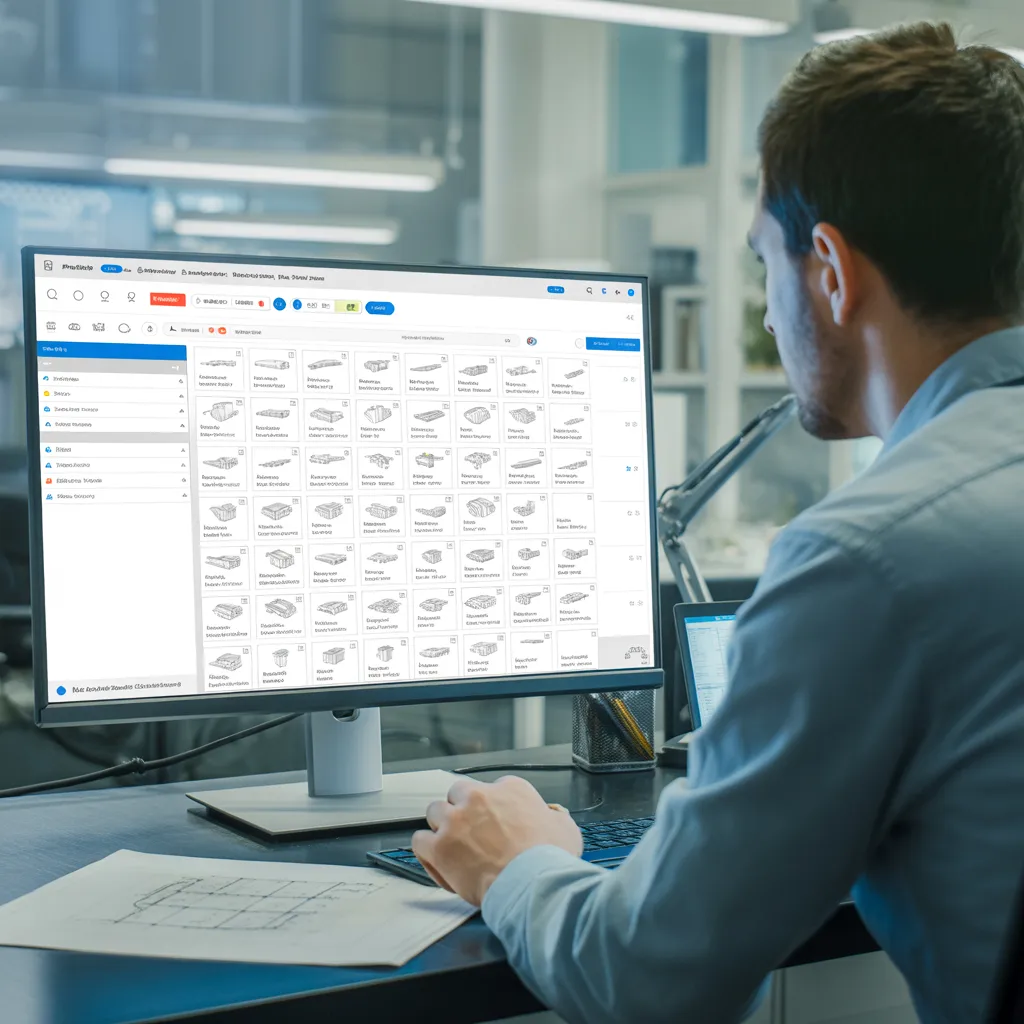
Geometric similarity search reads the actual shape of parts from SLDPRT and SLDASM files and returns matches based on how geometrically similar they are to the search input. That M8 flange nut with the specific head height can be found by showing the system a matching geometry, regardless of what the file was named or what the property card contains. Results include dimensional comparison data so engineers can see exactly how close each match is before opening anything.
Leo AI indexes SolidWorks PDM vaults by reading the native files directly - SLDPRT, SLDASM, STEP, IGES, and others. When an engineer describes what they need in plain language, Leo searches against what the parts actually are geometrically, not what they were called. The 847-result query that returned nothing useful becomes a four-result query with dimensional match data. The engineer finds the right part in under two minutes.
Beyond findability, Leo indexes the organization's full knowledge base: design reports, stress analyses, supplier qualifications, archived project documentation, meeting notes. When an engineer asks why a bracket is 316 stainless and not 304, Leo returns the original corrosion study, the material justification from the project report, and the design note from the revision that made the material change. The institutional knowledge does not disappear when engineers leave. It becomes retrievable.
Keep Reading: Best PDM Software for Mechanical Engineers · AI for Product Data Management · The Real Cost of Bad PDM Search · Engineering Knowledge Management
FAQ
STOP BUILDING PARTS YOU ALREADY HAVE.
SolidWorks PDM stores your engineering history perfectly. It just can't surface it when you need it.
Engineers spend hours searching for parts they know exist — then give up and model from scratch, making the problem worse next time. Leo reads native CAD geometry, matches parts by shape regardless of how files were named or described, and finds what's already in your vault before anyone starts from scratch. Less duplication. Faster decisions. A vault that actually works the way engineers think.
Schedule a Demo →

#1 New AI Software Globally - G2 2026

Enterprise-grade security

Trusted by world-class engineering teams