
AI for Engineering Knowledge Management
Can text-to-CAD tools hit production-grade precision? We tested dimensional accuracy, tolerance compliance, and feature fidelity across the leading tools.
·
⏱
9

Michelle Ben-David
Michelle Ben-David is a mechanical engineer and technical writer specializing in CAD workflows, manufacturing processes, and engineering AI tools.
BOTTOM LINE
Text-to-CAD tools produce shapes that look approximately correct, but dimensional accuracy, tolerance specification, and feature fidelity fall well short of production requirements. For conceptual work and prototyping, they have real value. For production engineering, the smarter move is finding existing validated parts in your PDM vault. Leo AI makes this possible with natural language search across your entire design history, delivering real parts with real tolerances instead of AI-generated approximations.
There is a growing assumption in the engineering AI space that text-to-CAD tools are almost ready for production use. The demos look impressive. You type a description, a 3D model appears, and the shape roughly matches what you asked for. For someone watching from a distance, it looks like the future is here.
But "roughly matches" is not an engineering specification. Production parts live in a world of tolerances measured in microns, GD&T callouts that define functional surfaces, and material specifications that determine whether a component survives 10,000 thermal cycles or fails at 500. The gap between "that shape looks right" and "that part meets print" is enormous, and almost nobody in the text-to-CAD conversation is addressing it honestly.
I spent the past few months testing how current text-to-CAD tools handle precision requirements. Not just whether they produce the right general shape, but whether the output is dimensionally accurate, geometrically sound, and anywhere close to what a machinist or quality engineer would accept.
When you tell a text-to-CAD tool to create a "flanged plate, 100mm x 60mm, 8mm thick, with four M6 through holes on a 80mm x 40mm bolt pattern," you are specifying exact dimensions. The question is whether the AI actually hits them.
In testing, the results are inconsistent. Some tools get the overall envelope dimensions close, within a millimeter or two. Others interpret dimensions loosely, producing geometry that looks proportionally correct but misses specific callouts. The bolt pattern might be centered but at the wrong spacing. The thickness might come out as 7mm instead of 8mm. The holes might be through holes in the prompt but blind holes in the output.
For conceptual exploration, these deviations are tolerable. For production, they are scrapped parts. A 1mm error on a bolt pattern means the assembly does not go together. A thickness deviation means stress calculations based on the nominal dimension are invalid. Dimensional accuracy is not a nice-to-have in production engineering. It is the entire point.
The root issue is that most text-to-CAD models were not trained on manufacturing drawings with explicit dimensional callouts. They were trained on 3D geometry datasets where shape similarity matters more than exact measurements. The AI understands what a flanged plate looks like, but it does not understand what "100mm +/- 0.1" means as a manufacturing requirement.
IN PRACTICE
The part search capabilities are really in a league of their own - text to text, text to CAD, and CAD to CAD. It's really something you have to try for yourself to see.
erga k., Product Engineer
Even if a text-to-CAD tool could produce dimensionally perfect geometry, the output would still be incomplete for production use. Production parts require tolerance specifications. Every dimension needs an associated tolerance band. Functional surfaces need GD&T callouts defining flatness, perpendicularity, position, and runout.
No current text-to-CAD tool generates tolerance information. The output is nominal geometry only. There are no tolerance annotations, no datum references, no surface finish specifications. An engineer receiving this output would need to manually add every single tolerance callout before the part could go to manufacturing.
This is not a minor omission. On a moderately complex machined part, tolerance specification might represent 30-40% of the total engineering effort. If you still need to do all of that work manually after the AI generates the shape, the time savings are much smaller than the marketing suggests.
GD&T is also deeply contextual. The tolerance on a bearing bore depends on what bearing you are using. The flatness callout on a sealing surface depends on the gasket material and system pressure. These decisions require engineering judgment that cannot be derived from a text prompt alone. They require knowledge of the assembly context, the manufacturing process, and the operational environment.
Beyond dimensions and tolerances, production parts contain design features that carry specific engineering intent. A counterbore has a specific depth and diameter that matches a particular fastener. A chamfer at a bore entry serves as a lead-in for press-fit assembly. A draft angle on a cast surface ensures the part releases from the mold.
Text-to-CAD tools struggle with this level of feature specificity. You can ask for "a counterbore for an M8 socket head cap screw" and get a recess that looks approximately right, but the diameter might not match the actual DIN 912 head dimension, and the depth might not provide the required flush condition.
The problem compounds with complexity. A single feature might be off by a small amount. But a part with 15 features, each slightly wrong, produces geometry that is completely unusable for production. The cumulative error makes the difference between a concept sketch and a manufacturing model.
What production engineers need is not approximate shapes. They need exact feature definitions that reference real standards, real fastener specifications, and real manufacturing processes. That level of precision currently requires parametric modeling tools with engineering libraries, not text-prompt generators.
This is not to say text-to-CAD is useless. There are genuine use cases where the current accuracy level is sufficient.
Conceptual design exploration is one. If you are in the early stages of a project and want to quickly visualize different configurations, generating rough 3D shapes from text descriptions can accelerate brainstorming. The models are not production-ready, but they do not need to be at that stage.
3D printing prototypes are another. If you are printing a form-check model on an FDM printer to verify fit and feel, dimensional accuracy within a millimeter or two is often acceptable. The prototype is going in the trash after the review meeting anyway.
Communication mockups also work well. If you need to show a concept to a non-engineering stakeholder, AI-generated geometry communicates the idea faster than a sketch on a whiteboard. Nobody is going to inspect the bolt pattern spacing on a concept review model.
The danger is when teams try to push text-to-CAD output downstream into production workflows. The gap between "looks right" and "is right" catches up fast when parts hit the machine shop.
Keep Reading: Best Text-to-CAD AI Tools in 2026: What Engineers Actually Need · Sketch-to-CAD with AI: Converting Hand Drawings to 3D Models in Minutes · DFM Analysis in 2026: The Best Tools for Getting Instant Manufacturing Feedback
For engineers who need production-grade accuracy, there is a more practical approach than trying to generate new geometry from text: finding existing parts that already meet specifications.
Most engineering organizations have years of validated designs sitting in their PDM vaults. Parts that were dimensioned, toleranced, reviewed, prototyped, and proven in production. The problem is that finding them is painful. PDM search tools rely on exact part numbers and filenames, and if you do not know those, you are stuck browsing folder trees or asking colleagues.
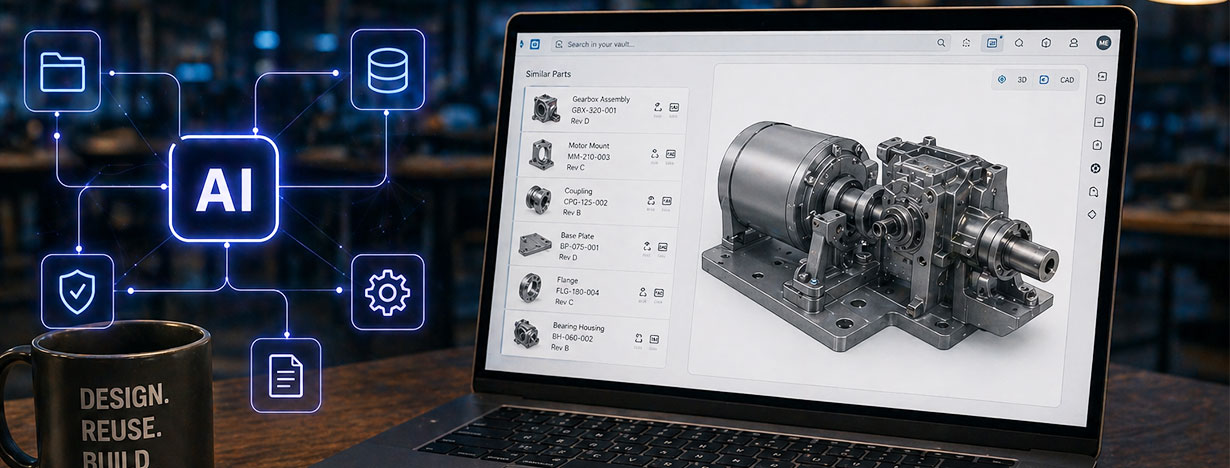
Leo AI solves this by connecting to your existing PLM and PDM systems and letting engineers search using plain language. Describe the part you need, and Leo finds matching components from your design history, complete with drawings, tolerances, revision history, and manufacturing data. Leo reads CAD geometry natively, so the search understands actual part shapes, not just metadata. It offers integrations with leading PDM and PLM platforms including SolidWorks PDM, Autodesk Vault, PTC Windchill, Siemens Teamcenter, and Arena PLM.
The result is not an AI-generated approximation. It is a real, production-validated part with every dimension, tolerance, and annotation intact. That is the kind of precision production engineers actually need.
FAQ
Production Parts, Not Approximations
Find validated designs in your vault instantly
Leo AI searches your PDM vault using natural language and CAD geometry. Find production-ready parts with full tolerances and revision history instead of starting from scratch.
Schedule a Demo →

#1 New AI Software Globally - G2 2026

Enterprise-grade security

Trusted by world-class engineering teams