Liran Silbermann, Leo AI Marketing
Feb 19, 2026
There's an old joke in mechanical engineering:
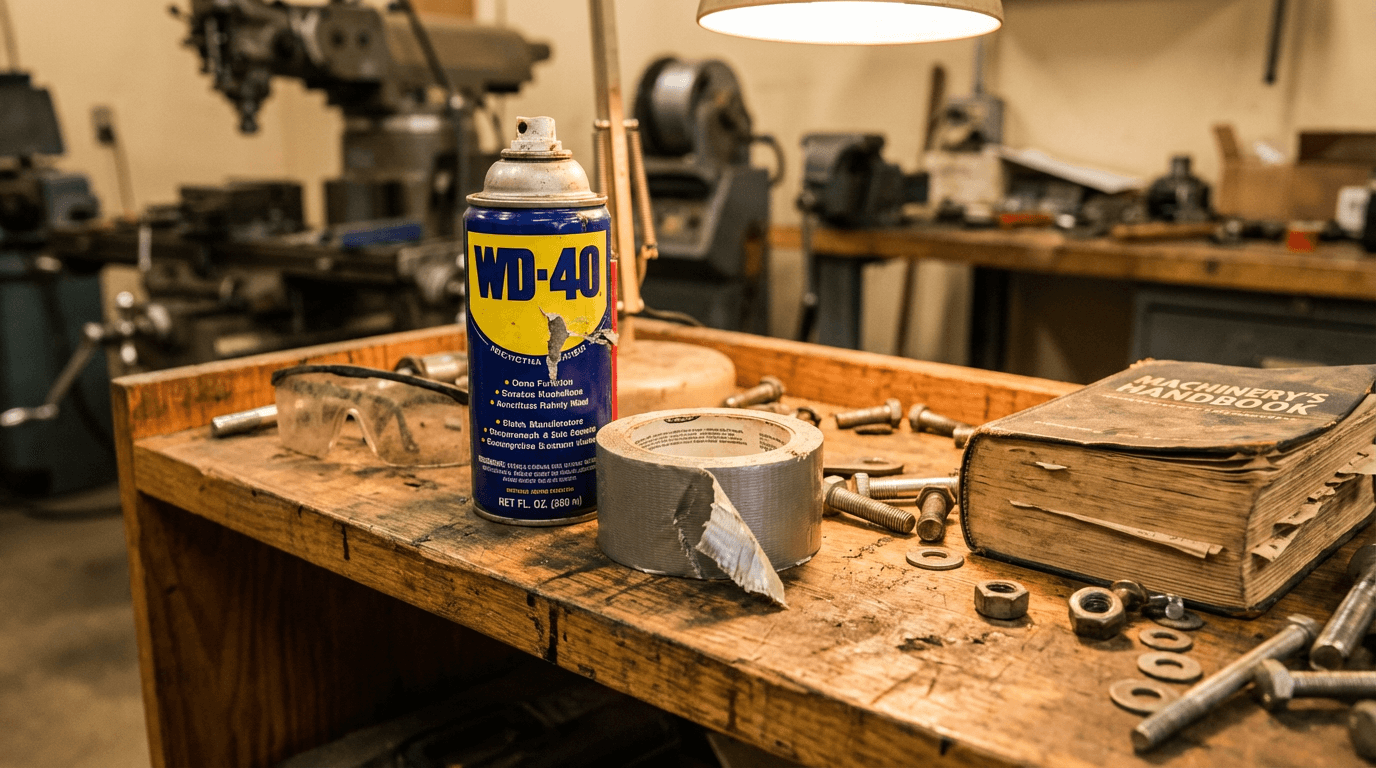
"Does it move? Should it? WD-40. Doesn't move? Should it? Duct tape."
Every engineer reading this just nodded. Because it's funny. And because it's the kind of truth that only lands when you've actually been there. Standing in front of a stubborn assembly at 4pm on a Friday. Reaching for the blue and yellow can. Knowing it's not the elegant solution but it is absolutely the right one.
WD-40 and duct tape have earned their place on the shelf because they work without ceremony. No IT ticket. No training. No six-month rollout. You grab them, you fix the problem, you move on.
But here's what the joke leaves out.
WD-40 fixes the hinge. Duct tape holds the cable. Neither one answers the question that burns more engineering hours than any stuck bolt or loose fitting ever will:
"What did we do last time?"
The Problem Behind the Punchline
You know the scenario. Design review. Someone spots something familiar. "Didn't we try this approach on the Titan project?" Room goes quiet. Someone opens Slack. Someone else checks email. The one guy who might actually know is on a call. You wait.
Forty-five minutes later you have three half-answers, two conflicting email threads, and a design decision made on gut feel because the deadline doesn't care that Bob's still in his meeting.
That's not bad engineering. That's a bad system.
According to research from the University of California, Irvine, every time an engineer gets pulled away from actual design work to chase information, it costs 23 minutes of recovery time to get back into the zone. McKinsey research puts the annual bill for a 50-person team at over $1.3M in lost productivity.
That's not a rounding error. That's headcount.
And WD-40 doesn't fix it. Duct tape doesn't fix it. Telling engineers to "document better" definitely doesn't fix it. (We've all been in that all-hands meeting. We know how it ends.)
The Three Knowledge Failures Nobody Talks About
Engineering time doesn't disappear because of hard technical problems. It disappears because of three completely preventable knowledge failures that happen every day in every design office.
Knowledge Failure 1: Diagnosing Without the History
"Does it move? Should it?"
Diagnosis should be fast when you know the history. You recognize the pattern, you pull the fix from memory, you move on. But when the history lives in the vault with no useful comments, in an email chain from 2019, or in the head of someone who left for a competitor 18 months ago, every diagnosis starts from scratch.
Research from ASME shows that 30-40% of engineering errors are repeat problems. Not new problems. Repeat problems. Problems that were already solved, already documented somewhere nobody can find, and now need to be solved again at full cost.
Engineers call this the "haven't we been here before?" moment. It happens in every design cycle. It is entirely preventable.
Knowledge Failure 2: Going Down the Rabbit Hole
The moment someone asks "what did we do last time?", design work stops and the rabbit hole begins.
Check the vault. Search Slack. Pull up email. Try SharePoint. Ask someone in the next row who thinks they remember. Get sent to someone else who might know. Wait.
This is what engineers mean when they say they spent the whole day firefighting and got nothing done. Not literal fires. Just the constant drag of chasing information through five disconnected systems, each one requiring its own search logic, its own login, its own completely different way of organizing information that was never designed to talk to the others.
The average engineer switches context 13 times per hour. Each switch costs 23 minutes. For a 50-person team that's $204,000 a year gone before a single design decision gets made.
WD-40 and duct tape are great specifically because they do not cause rabbit holes. You use them and you're done. Back to work in 30 seconds.
An AI copilot for mechanical engineers should work the same way.

Knowledge Failure 3: The "Ask Bob" Single Point of Failure
Every team has a Bob.
The guy who's been there 15 years. Knows why the XR-400 housing uses stainless instead of aluminum. Remembers the vendor situation from 2019. Knows that the assembly sequence in the drawing isn't actually the sequence that works on the production floor, and that if you follow the drawing you'll be redoing it at 7am on a Tuesday.
Bob is irreplaceable. Bob is also a single point of failure that the entire team's institutional knowledge runs through.
When Bob's in a meeting, junior engineers wait. When Bob goes on holiday, decisions get deferred. And when Bob retires, which according to Pew Research is happening to 10,000 engineers every single day across the US, twenty years of hard-won tribal knowledge walks out the door.
Not the CAD files. Those stay. Not the drawings. Those stay too.
The why leaves. Why that tolerance is tighter than standard. Why you never use that fastener type in a vibration environment. Why that particular mate configuration causes circular reference errors that take three days to untangle. Why the DFM team flagged that approach twice before and engineering ignored it both times until the production line stopped.
That's what leaves. That's what duct tape cannot fix.
Why the Tool Shelf Has Been Incomplete Until Now
The mechanical engineering toolkit has been built around physical and process problems for as long as the discipline has existed.
Calipers for measurement. SOLIDWORKS for design. The vault for version control. PLM for lifecycle. FEA for simulation. DFM tools for manufacturability. Each tool earns its place by solving a specific, well-defined problem.
Nobody built a tool for the knowledge problem because until recently, building it was technically impossible.
Not for lack of trying. Engineers have tried to solve it with SharePoint wikis that nobody updates. With "lessons learned" documents that live in a folder nobody opens. With elaborate PDM comment conventions that get ignored after week two. With dedicated knowledge managers who spend 80% of their time chasing engineers to document things and 20% of their time wondering why nobody reads the documentation.
None of it works because it all requires engineers to change how they work. And engineers, like all humans, do not change how they work just because someone created a SharePoint folder and sent an all-hands email about documentation hygiene.
What actually works is a system that captures knowledge automatically from work that's already happening. From check-in comments. From email threads. From design review notes. From the Slack conversation where someone figured out that mate error workaround at 11pm on a Wednesday and shared it with three people who are now the only four humans on earth who know it exists.
That requires AI. Specifically, it requires an AI copilot built for mechanical engineering. Not a general-purpose chatbot. Not a search engine bolted onto your PDM. A system that understands engineering context, speaks SOLIDWORKS, knows what a BOM is and why it matters, and can tell the difference between a design decision and a design discussion.
The Third Tool: What It Actually Does
Leo AI is the third tool. Here's what that looks like when the rubber meets the road.
When You Hit a "Haven't We Been Here Before?" Moment
You're deep in a housing design. Wall thickness feels familiar. Not sure if it's familiar because it worked or familiar because it was the exact approach that caused the pressure testing headache on Project Titan.
Old way: Stop working. Open Slack. Search "housing wall thickness". Get 847 results. Give up. Check email. Find a thread but it's 94 replies long. Ask around. Wait for Bob to get out of his meeting. Make decision anyway because the rev is due Friday.
With Leo AI: Ask from inside SOLIDWORKS: "Have we had issues with this wall thickness on similar housings?" Answer in 30 seconds: "Similar configuration on Project Titan (2021) failed pressure testing at 2.8mm. Recommended minimum 3.2mm based on TR-2021-047. See also: Project Atlas wall thickness decision (2020)." Back to work in under a minute.
When a Junior Engineer Is Two Days Into a Problem Bob Would Solve in Ten Minutes
Your new hire is good. Solid CAD skills. Good instincts. But he doesn't know your product line history. He doesn't know that the mate error he's been fighting for two days is caused by the same origin plane misalignment issue that caught everyone out when the new assembly template was rolled out in 2022. He doesn't know because nobody told him and it's not written down anywhere findable.
Old way: Bob answers the question. Again. Loses an hour. New engineer waits, loses two days, feels like he's always behind.
With Leo AI: New engineer asks. Gets the answer from company design history. Fixes the mate error in 20 minutes. Bob gets his hour back. New engineer gets his confidence. Productive in months, not years.
When the Design Review Hits a "Why Did We Do It This Way?" Wall
Drawing review. The bearing configuration looks wrong to someone new to the project. Nobody in the room was at the original design review. The engineer who made the call left the company. Someone suggests changing it. Someone else thinks they remember a reason not to but can't recall the specifics. Meeting stalls.
Old way: Defer the decision. Schedule a follow-up. Spend a week trying to reconstruct the original rationale. Make the change anyway because the original reason never surfaces. Find out six months later during testing that the original configuration was correct and the reason was documented in an email thread from 2019 that nobody searched for.
With Leo AI: Ask during the meeting. Answer in 30 seconds from the original design review notes and test data: "Bearing configuration selected based on thermal expansion behavior at operating temperature. Alternative configuration B rejected in design review DR-2019-023 due to dimensional instability above 85°C. See thermal test data: [link]." Meeting continues. Right decision made first time.
When a Vendor Name Rings a Bell for the Wrong Reasons
Specifying a machined component. The supplier name looks familiar. Could be good familiar. Could be NCR familiar.
Old way: Check the approved vendor list. Nothing flagged. Use them. Receive parts with 28% reject rate. Remember now why that name rang a bell.
With Leo AI: Ask before specifying: "Any history with Precision Parts Co. on tight tolerance work?" Answer: "Precision Parts Co. used on Project Atlas (2019) and Project Falcon (2020). Both generated NCRs on tolerances below 0.005 inches, reject rates 25-31%. Engineering recommendation: approved for non-critical components only or require capability study first." Problem prevented before the purchase order goes out.
The Tool Shelf Is Now Complete
WD-40 for things that should move but won't.
Duct tape for things that shouldn't move but do.
Leo AI for questions that should have answers but don't.
The joke has always been funny because it captures something true: the best tools are simple, accessible, and get out of your way. They don't require a six-month implementation or an enterprise budget or a company-wide change management program. They just work.
The engineering tool shelf has been missing the knowledge tool for decades. The tribal knowledge problem, the rabbit hole problem, the "ask Bob" single point of failure problem - these have been accepted as just part of the job because there was no tool for them.
There is now.
Next Time Someone Asks "What Did We Do Last Time?"
You have two options.
Watch the room go quiet, watch five people open Slack simultaneously, watch the rabbit hole swallow the next 90 minutes of productive design time, and make a decision based on whoever had the best memory of something that happened three years ago.
Or ask Leo AI and have the answer before the question finishes echoing around the room.
The tool is on the shelf. The only question is when you pick it up.
See Leo AI in Action
Request a demo using your actual SOLIDWORKS environment and design history.
Related Resources
How to Onboard SOLIDWORKS Engineers 60% Faster
How Context Switching Costs Engineering Teams $200K Per Year
Engineering Knowledge Retention: Stop Tribal Knowledge Walking Out the Door
Leo AI for SOLIDWORKS: Features and Integration