

AI for Engineering Knowledge Management
What Is the Best AI for Mechanical Design?
What Is the Best AI for Mechanical Design?
What Is the Best AI for Mechanical Design?
The honest answer to which AI tool wins for mechanical design, by use case and not hype. Includes a Leo AI vs. ChatGPT Enterprise comparison table.
·
⏱
6 min read

Michelle Ben-David
Product Specialist, Leo AI
Product Specialist, Leo AI
Mechanical Engineer, B.Sc. · Ex-Officer, Elite Tech Unit · Aerospace & Defence · Medical Devices
Mechanical Engineer, B.Sc. · Ex-Officer, Elite Tech Unit · Aerospace & Defence · Medical Devices
Michelle Ben-David is a mechanical engineer and Technion graduate. She served in an IDF elite technology and intelligence unit, where she developed multidisciplinary systems integrating mechanics, electronics, and advanced algorithms. Her engineering background spans robotics, medical devices, and automotive systems.
BOTTOM LINE
The right AI for CAD isn't the one with the best design generation features. It's the one that understands your constraints.
Most CAD AI today focuses on geometry generation. Useful for early-stage exploration. Not useful for the other 80% of engineering work.
Leo was built for the 80%. Finding parts. Validating designs. Retrieving knowledge from 10,000 old projects. That's where the ROI is.
The Real Answer Starts With a Better Question
"What's the best AI for mechanical design" is roughly as useful a question as "what's the best hand tool." Best for what? Best for whom? With what existing stack?
The tools that are overhyped right now are the general-purpose ones. ChatGPT, Gemini, and Copilot are useful for drafting emails, summarizing documents, and writing Python scripts. In a mechanical engineering context, where answers need to be traceable, where the source material is CAD geometry and proprietary design history rather than internet text, they're a starting point at best and actively dangerous at worst.
A materials engineer at a defense company queried ChatGPT for a material comparison for a high-strength steel substitution. ChatGPT returned a confident answer with invented property values. The engineer caught it during verification. But the cost of trusting that answer in a live production environment would have been significant.
The question worth asking is more specific: where does your team lose the most time or make the most costly mistakes? The answer to that narrows the field quickly.
The Real Answer Starts With a Better Question
"What's the best AI for mechanical design" is roughly as useful a question as "what's the best hand tool." Best for what? Best for whom? With what existing stack?
The tools that are overhyped right now are the general-purpose ones. ChatGPT, Gemini, and Copilot are useful for drafting emails, summarizing documents, and writing Python scripts. In a mechanical engineering context, where answers need to be traceable, where the source material is CAD geometry and proprietary design history rather than internet text, they're a starting point at best and actively dangerous at worst.
A materials engineer at a defense company queried ChatGPT for a material comparison for a high-strength steel substitution. ChatGPT returned a confident answer with invented property values. The engineer caught it during verification. But the cost of trusting that answer in a live production environment would have been significant.
The question worth asking is more specific: where does your team lose the most time or make the most costly mistakes? The answer to that narrows the field quickly.
The Four Categories of Mechanical Engineering AI
Category 1: Knowledge Retrieval and CAD Search
What it solves: Engineers spending hours searching for answers that exist somewhere in the org's history. New engineers taking 12–18 months to get productive. Senior engineers being the bottleneck for every technical question.
Tools in this category: Leo AI (strongest CAD-native search), CoLab (review history focused)
What to look for: Does it read your actual CAD geometry, or just text? Does it integrate with your PDM/PLM? Does it cite sources you can verify?
Category 2: Design Inspection and DFM
What it solves: Design errors caught after the drawing leaves engineering, at manufacturing, in testing, or in the field. Consistent review quality regardless of which senior engineer is available.
Tools: Leo Inspect, CoLab AutoReview
What to look for: Does it check against your org's own internal guidelines, or only generic standards? Does it explain why it flagged something?
Category 3: Generative and Topology-Optimization Design
What it solves: Lightweighting structural components, exploring geometry alternatives in early-concept stages.
Tools: Autodesk Generative Design, Siemens NX Generative Engineering, PTC Creo GDX
What to look for: What manufacturing methods does it optimize for? Does the output return as editable B-rep or mesh?
Category 4: Rapid Simulation
What it solves: Reducing design iterations before formal FEA/CFD; catching gross structural problems during modeling rather than after release.
Tools: ANSYS Discovery, SimScale AI-assisted
What to look for: Accuracy relative to your final-fidelity solver; which physics domains are covered.
The Four Categories of Mechanical Engineering AI
Category 1: Knowledge Retrieval and CAD Search
What it solves: Engineers spending hours searching for answers that exist somewhere in the org's history. New engineers taking 12–18 months to get productive. Senior engineers being the bottleneck for every technical question.
Tools in this category: Leo AI (strongest CAD-native search), CoLab (review history focused)
What to look for: Does it read your actual CAD geometry, or just text? Does it integrate with your PDM/PLM? Does it cite sources you can verify?
Category 2: Design Inspection and DFM
What it solves: Design errors caught after the drawing leaves engineering, at manufacturing, in testing, or in the field. Consistent review quality regardless of which senior engineer is available.
Tools: Leo Inspect, CoLab AutoReview
What to look for: Does it check against your org's own internal guidelines, or only generic standards? Does it explain why it flagged something?
Category 3: Generative and Topology-Optimization Design
What it solves: Lightweighting structural components, exploring geometry alternatives in early-concept stages.
Tools: Autodesk Generative Design, Siemens NX Generative Engineering, PTC Creo GDX
What to look for: What manufacturing methods does it optimize for? Does the output return as editable B-rep or mesh?
Category 4: Rapid Simulation
What it solves: Reducing design iterations before formal FEA/CFD; catching gross structural problems during modeling rather than after release.
Tools: ANSYS Discovery, SimScale AI-assisted
What to look for: Accuracy relative to your final-fidelity solver; which physics domains are covered.
IN PRACTICE
"The connection to our PDM and using that as a data source is legit the best thing ever. I found three viable bracket options fitting my exact envelope constraints — in minutes, not days."
— Eytan S., R&D Engineer
Why Leo AI Is the Strongest Fit for Most Enterprise Engineering Teams
The majority of engineering organizations dealing with product complexity, multi-year design histories, and workforce aging aren't primarily losing time on topology optimization or simulation setup. They're losing time on:
Finding information that exists but can't be located
Repeating work that was already done on a previous project
Catching design errors late in the cycle
Getting new engineers productive on a product line they don't know
Categories 1 and 2 above are Leo's primary territory, and it covers them better than any competing tool because of a fundamental technical difference: Leo's patented Large Mechanical Model reads actual B-rep CAD geometry. Every other tool in the market works with images, text descriptions, or metadata about CAD, not the geometry itself.
That matters because the most valuable questions an engineer asks are geometry-dependent: "Is there a part in our PDM that fits this envelope?" "Does this feature violate our DFM guidelines for CNC?" "What did we use in a structurally similar location on a previous program?" Answering those questions accurately requires reading the shape, not reading text about the shape.
At Rafael Advanced Defense Systems, an R&D engineer needed material validation for a high-strength steel substitution, a calculation that previously took 48 hours of manual research. Leo returned a verified comparison table with MatWeb-cited properties in under two minutes. T. Norman, R&D Mechanical Engineer: "Accurate and relevant to our question."
At Sketch Design, working on a cryogenic LH2 system design, weeks of research for material specifications, equations, and vacuum design limitations were replaced by Leo queries. Oliver Diebel, Co-Director: "Days, weeks, to minutes. It has paid off massively for us."
Why Leo AI Is the Strongest Fit for Most Enterprise Engineering Teams
The majority of engineering organizations dealing with product complexity, multi-year design histories, and workforce aging aren't primarily losing time on topology optimization or simulation setup. They're losing time on:
Finding information that exists but can't be located
Repeating work that was already done on a previous project
Catching design errors late in the cycle
Getting new engineers productive on a product line they don't know
Categories 1 and 2 above are Leo's primary territory, and it covers them better than any competing tool because of a fundamental technical difference: Leo's patented Large Mechanical Model reads actual B-rep CAD geometry. Every other tool in the market works with images, text descriptions, or metadata about CAD, not the geometry itself.
That matters because the most valuable questions an engineer asks are geometry-dependent: "Is there a part in our PDM that fits this envelope?" "Does this feature violate our DFM guidelines for CNC?" "What did we use in a structurally similar location on a previous program?" Answering those questions accurately requires reading the shape, not reading text about the shape.
At Rafael Advanced Defense Systems, an R&D engineer needed material validation for a high-strength steel substitution, a calculation that previously took 48 hours of manual research. Leo returned a verified comparison table with MatWeb-cited properties in under two minutes. T. Norman, R&D Mechanical Engineer: "Accurate and relevant to our question."
At Sketch Design, working on a cryogenic LH2 system design, weeks of research for material specifications, equations, and vacuum design limitations were replaced by Leo queries. Oliver Diebel, Co-Director: "Days, weeks, to minutes. It has paid off massively for us."
The Comparison That Actually Matters
The comparison most engineering teams eventually land on isn't Leo vs. CoLab or Leo vs. ANSYS. It's Leo vs. ChatGPT Enterprise, because that's what's already in the procurement pipeline at most organizations.
Here's what the comparison actually looks like in a mechanical engineering context:
Capability | Leo AI | ChatGPT Enterprise |
|---|---|---|
Reads native CAD geometry (B-rep) | ✅ Patented, 3 US grants | ❌ Images/text only |
Searches your PDM/PLM by geometry | ✅ | ❌ |
Answers from your org's own data | ✅ Full integration | ❌ Requires manual upload |
Source citations to original documents | ✅ Clickable, page-level | Partial |
Trained on your data | ❌ Never | ❌ Never (Enterprise policy) |
Training data includes Reddit/unverified sources | ❌ 1M+ vetted engineering sources only | Yes |
SOC 2 Type II | ✅ | ✅ |
Designed to say "I don't know" | ✅ | Partial |
Engineering calculations with shown code | ✅ | Partial |
Note: Capabilities reflect publicly available information and customer deployment data as of Q1 2026. ChatGPT Enterprise policies and features evolve; verify current terms with OpenAI. Leo AI capability details sourced from Leo AI's technical documentation and deployed customer accounts.
The Comparison That Actually Matters
The comparison most engineering teams eventually land on isn't Leo vs. CoLab or Leo vs. ANSYS. It's Leo vs. ChatGPT Enterprise, because that's what's already in the procurement pipeline at most organizations.
Here's what the comparison actually looks like in a mechanical engineering context:
Capability | Leo AI | ChatGPT Enterprise |
|---|---|---|
Reads native CAD geometry (B-rep) | ✅ Patented, 3 US grants | ❌ Images/text only |
Searches your PDM/PLM by geometry | ✅ | ❌ |
Answers from your org's own data | ✅ Full integration | ❌ Requires manual upload |
Source citations to original documents | ✅ Clickable, page-level | Partial |
Trained on your data | ❌ Never | ❌ Never (Enterprise policy) |
Training data includes Reddit/unverified sources | ❌ 1M+ vetted engineering sources only | Yes |
SOC 2 Type II | ✅ | ✅ |
Designed to say "I don't know" | ✅ | Partial |
Engineering calculations with shown code | ✅ | Partial |
Note: Capabilities reflect publicly available information and customer deployment data as of Q1 2026. ChatGPT Enterprise policies and features evolve; verify current terms with OpenAI. Leo AI capability details sourced from Leo AI's technical documentation and deployed customer accounts.
The Honest Limitations
Leo AI's value scales with your data. A team with 30 years of PDM history gets substantially more out of it than a 2-year-old startup with 200 CAD files. Leo is deployed at both types of organizations, but the ROI calculation looks different.
Leo does not replace generative design (it doesn't generate novel geometry). It doesn't replace full-fidelity FEA/CFD. It doesn't handle software engineering, civil engineering, or electrical design. It is a mechanical engineering tool, with all the specificity that implies.
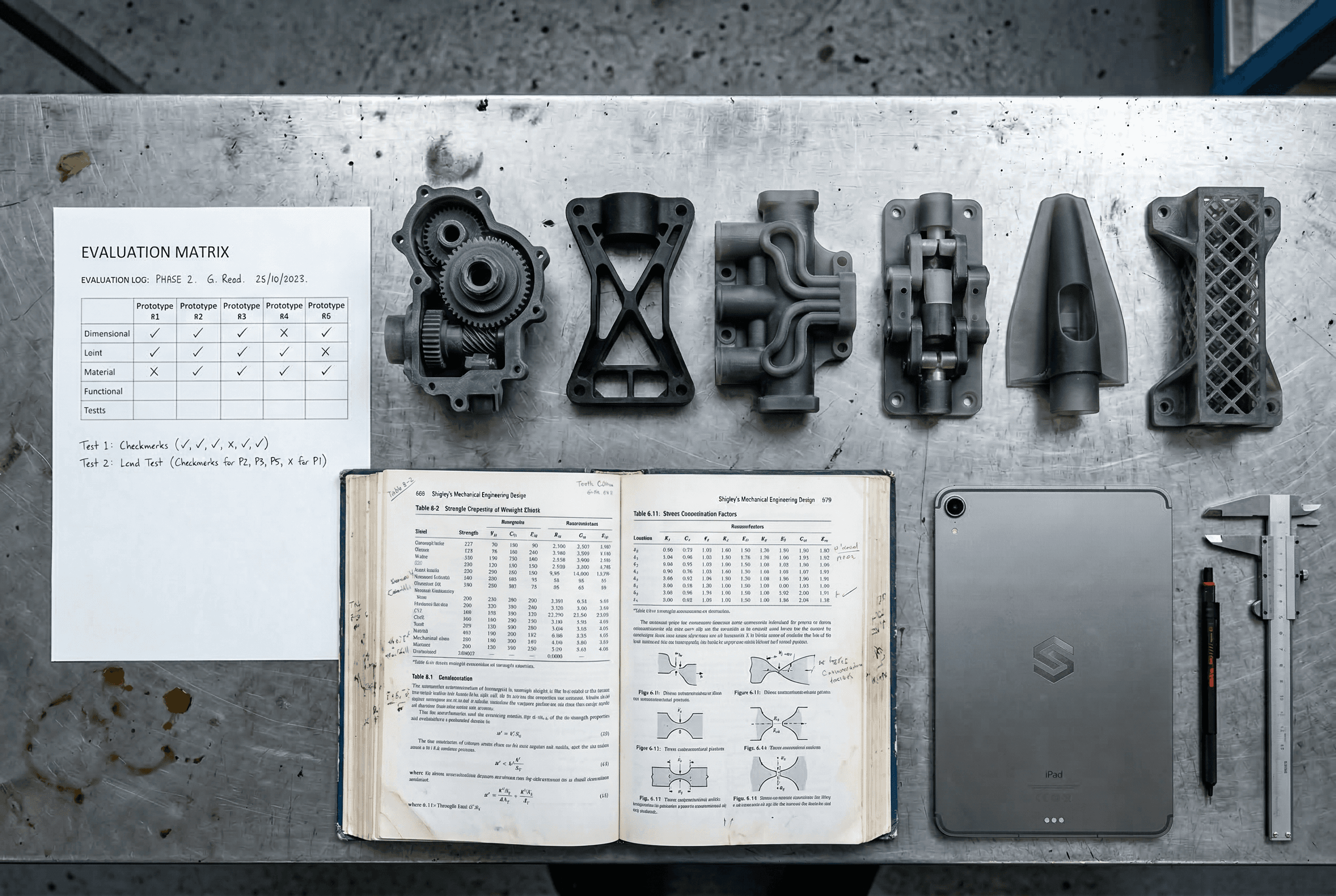
For hardware startups without a deep design archive, Leo's value is primarily in the 1M+ engineering standards library (Shigley's, Roark's, ASME, ISO, DIN, MIL-STD), the 120M+ part catalog, and the DFM inspection capability, which don't depend on org-specific data.
The Honest Limitations
Leo AI's value scales with your data. A team with 30 years of PDM history gets substantially more out of it than a 2-year-old startup with 200 CAD files. Leo is deployed at both types of organizations, but the ROI calculation looks different.
Leo does not replace generative design (it doesn't generate novel geometry). It doesn't replace full-fidelity FEA/CFD. It doesn't handle software engineering, civil engineering, or electrical design. It is a mechanical engineering tool, with all the specificity that implies.
For hardware startups without a deep design archive, Leo's value is primarily in the 1M+ engineering standards library (Shigley's, Roark's, ASME, ISO, DIN, MIL-STD), the 120M+ part catalog, and the DFM inspection capability, which don't depend on org-specific data.
FAQ
Stop Wasting Hours on Manual CAD Search
Leo AI turns your existing vault into a searchable knowledge base.
Leo AI connects to your PDM and makes every part findable by description in under 10 seconds. <a href="/onboarding">Try Leo Today</a>
Schedule a Demo →

#1 New AI Software Globally - G2 2026

Enterprise-grade security

Trusted by world-class engineering teams
Recommended

Subscribe to our engineering newsletter
Be the first to know about Leo's newest capabilities and get practical tips to boost your engineering.
Need help? Join the Leo AI Community
Connect with other engineers, get answers from our team, and request features.

#1 New Software
Globally
All Industries
#12 AI Tool
Worldwide
G2 2026


© 2026 Leo AI, Inc.
Be the first to know about Leo's newest capabilities and get practical tips to boost your engineering.
Connect with other engineers, get answers from our team, and request features.
#1 New Software
Globally
All Industries
#12 AI Tool
Worldwide
G2 2026
© 2026 Leo AI, Inc.
Subscribe to our engineering newsletter
Be the first to know about Leo's newest capabilities and get practical tips to boost your engineering.
Need help? Join the Leo AI Community
Connect with other engineers, get answers from our team, and request features.
#1 New Software
Globally
All Industries
#12 AI Tool
Worldwide
G2 2026
© 2026 Leo AI, Inc.
Subscribe to our engineering newsletter
Be the first to know about Leo's newest capabilities and get practical tips to boost your engineering.
Need help? Join the Leo AI Community
Connect with other engineers, get answers from our team, and request features.
#1 New Software
Globally
All Industries
#12 AI Tool
Worldwide
G2 2026
© 2026 Leo AI, Inc.