AI for Engineering Productivity
Learn how AI compliance checking catches manufacturing standards violations in CAD before production. See how Leo AI validates designs against ASME, ISO, and GD&T.
·
⏱
5 min read

Michelle Ben-David
Michelle Ben-David is a mechanical engineer and Technion graduate. She served in an IDF elite technology and intelligence unit, where she developed multidisciplinary systems integrating mechanics, electronics, and advanced algorithms. Her engineering background spans robotics, medical devices, and automotive systems.
BOTTOM LINE
Manufacturing compliance checking is too important and too complex to rely on manual review alone. Standards violations caught after production cost 10 to 100 times more to fix than violations caught during design. AI tools that read native CAD files, understand engineering standards, and connect to your design history can catch these issues before they leave engineering.
Leo AI closes that gap by combining native CAD reading, over one million pages of standards knowledge, and direct integration with leading PDM and PLM platforms. For teams shipping complex mechanical products under regulatory constraints, automated compliance checking is no longer optional.
Every mechanical engineer has lived this moment: a design passes internal review, gets sent to the shop floor, and comes back flagged for a tolerance that violates ASME Y14.5 or a wall thickness that fails the material supplier's minimum spec. The rework costs time, delays the schedule, and burns credibility with manufacturing partners.
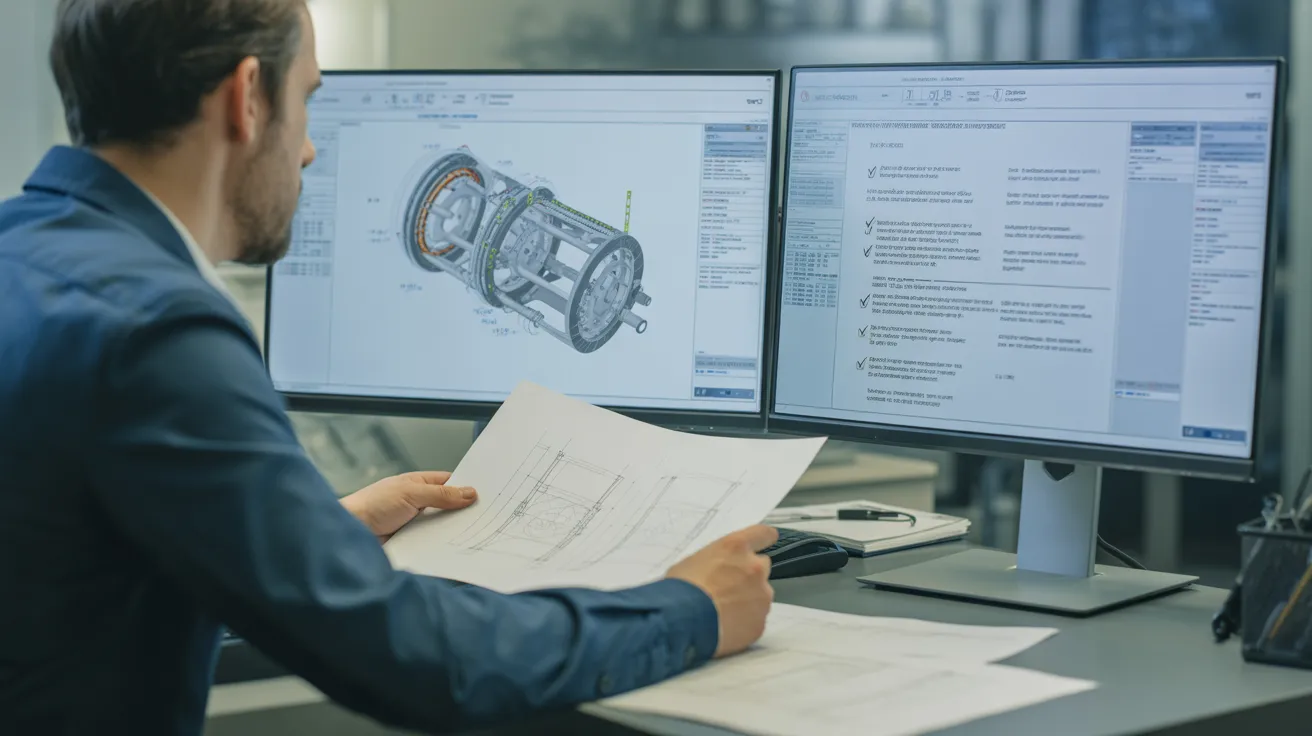
In most organizations, compliance checking is still a manual process. A senior engineer opens the drawing, cross-references the relevant standard, and marks up violations by hand. This works when you ship five parts a month. It collapses when you ship fifty, or when the senior engineer who memorized every DFM rule retires. AI compliance checking is changing this by validating designs against manufacturing standards automatically, before the file ever reaches procurement.
What Manufacturing Compliance Checking Actually Involves
Manufacturing compliance checking is the process of verifying that a CAD design meets the requirements defined by industry standards, customer specifications, and internal manufacturing guidelines before production begins.
1. Geometric Dimensioning and Tolerancing (GD&T) requires that every tolerance callout follows ASME Y14.5 or ISO 1101 syntax and that tolerances are physically achievable with the intended manufacturing process.
2. Material and process specifications dictate minimum wall thicknesses, fillet radii, draft angles, and surface finishes based on the chosen material and fabrication method.
3. Regulatory and industry standards like ISO 2768, ASME B16.5, MIL-STD specifications for defense, and FDA 21 CFR Part 820 for medical devices impose constraints that vary by industry.
4. Internal DFM guidelines capture company-specific rules: preferred fastener sizes, approved vendor lists, and assembly sequence constraints.
The problem is that these rules exist across dozens of documents, often in different formats, maintained by different teams. No single engineer holds all of them in working memory.
IN PRACTICE
What Engineers Are Saying
"With Leo, our team improves design quality, reduces mistakes, and shortens time-to-market. Instead of wasting hours on repetitive searches and calculations, we focus on making better products and leading our category."
— Uriel B., Field Warfare Specialist, Elbit Systems
Why Manual Compliance Reviews Break Down at Scale
Manual compliance review has three structural weaknesses that make it unreliable as organizations grow.
First, it depends on tribal knowledge. The engineer who knows that your casting supplier requires a 3-degree minimum draft angle for aluminum housings may not have documented that rule anywhere searchable. When that engineer is unavailable, the rule gets missed. A 2024 report from CIMdata estimated that engineering teams spend 20 to 30 percent of their time searching for technical information.
Second, manual review does not scale with design volume. Checking a single part drawing against ASME Y14.5, the relevant material spec, and internal DFM guidelines can take 30 to 90 minutes. Multiply that by 40 new parts per program, and compliance checking alone consumes weeks of senior engineering time per product launch.
Third, manual review introduces inconsistency. Two engineers checking the same drawing against the same standard may flag different issues. There is no audit trail showing which rules were checked and which were skipped.
How AI Changes Manufacturing Compliance Validation
AI-powered compliance checking addresses these gaps by automating the comparison between a CAD design and a set of defined rules. The approach works in three stages.
In the first stage, the AI system ingests the relevant standards, specifications, and internal guidelines as structured knowledge.
In the second stage, the system reads the CAD file directly. This is where most generic AI tools fail. Compliance checking requires understanding actual geometry: wall thicknesses, hole diameters, fillet radii, tolerance callouts, and material assignments.
In the third stage, the AI compares the design geometry against the ingested rules and flags violations with specific references to the standard being violated, the exact location in the model, and the recommended fix.
The result is faster design iterations, fewer late-stage rework cycles, and a consistent standard of review across every engineer on the team.
How Leo AI Validates Designs Against Manufacturing Standards
Leo AI is purpose-built for this exact workflow. Unlike generic AI assistants that treat engineering files as opaque attachments, Leo reads native CAD formats including SLDPRT, SLDASM, STEP, IGES, and CATIA files, understanding the actual geometry, feature tree, and annotations.
Leo is trained on over one million pages of engineering standards, textbooks, and technical references. When an engineer asks Leo to check a design against ASME Y14.5 or a specific material specification, Leo can identify violations and cite the exact clause being violated. This traceability is critical for regulated industries where audit documentation is mandatory.
Leo also connects to an organization's PDM and PLM systems, including SolidWorks PDM, Autodesk Vault, PTC Windchill, and Siemens Teamcenter. This means Leo can cross-reference a new design against previous designs that passed compliance review, surface relevant internal DFM guidelines, and flag tolerance deviations from approved parts.
Enterprise customers including HP, Elbit Systems, and Intel rely on Leo for design validation. Leo is SOC-2 certified and GDPR compliant, and customer IP is never used for AI training.
Keep Reading: DFM Analysis Tools with Instant Feedback · AI Design Review: Catch Errors Before Manufacturing · Engineering Knowledge Management · AI for Mechanical Engineers: The Complete Guide
What to Look for in an AI Compliance Checking Tool
Not every AI tool that claims to support compliance checking delivers meaningful results. Engineers evaluating options should focus on five criteria.
1. Native CAD file reading is non-negotiable. If the tool cannot parse geometry, feature trees, and tolerance annotations directly from your CAD format, it cannot perform compliance validation.
2. Standards coverage and traceability separates useful tools from surface-level solutions. The tool should cite specific clauses, not just report pass/fail.
3. PDM/PLM integration determines whether the tool can access your full design history for context.
4. Customizable rule sets are essential because every organization has internal standards beyond published industry documents.
5. Security and IP protection must meet enterprise requirements. SOC-2 certification at minimum, with clear data isolation policies.
FAQ
CIMdata, "The Value of Simulation Data Management," 2024
Catch Violations Before Production
Your designs deserve standards-grade validation before they ship.
Leo AI reads your CAD files, checks them against ASME, ISO, and your internal DFM rules, and flags violations with cited references. No more manual compliance reviews.

#1 New AI Software Globally - G2 2026

Enterprise-grade security

Trusted by world-class engineering teams