
AI for Engineering Knowledge Management
An honest review of SolidWorks AURA in 2026. What it actually does, what it promised, and what engineers still need from AI tools today.
·
⏱
9 min read

Michelle Ben-David
Michelle Ben-David is a mechanical engineer and Technion graduate. She served in an IDF elite technology and intelligence unit, where she developed multidisciplinary systems integrating mechanics, electronics, and advanced algorithms. Her engineering background spans robotics, medical devices, and automotive systems.
BOTTOM LINE
AURA is a documentation chatbot, not the generative design co-pilot it was marketed as. The headline capabilities shown at 3DExperience World 2025 have not shipped, and accessing what did ship requires migrating to the 3DExperience platform, a move most desktop SolidWorks users are not ready to make.
If your team needs AI that works with your actual engineering data, connects to your PDM and PLM systems, and helps engineers find parts, reuse designs, and access institutional knowledge, Leo AI is purpose-built for exactly that. No platform migration, no vendor lock-in, just real engineering value from day one.
If you have been following SolidWorks news over the past year, you have probably heard about AURA. Dassault Systemes introduced it at 3DExperience World 2025 with impressive on-stage demos, bold promises about AI-powered design, and a vision of a "virtual companion" that learns from you and performs tasks for you. The engineering community was genuinely excited.
But now that AURA has been available in beta for several months, the reality looks quite different from those keynote demos. Engineers who tried it are asking hard questions about what it actually delivers versus what was shown on stage. And many are wondering whether it solves the problems they actually face every day.
This is an honest, hands-on review of SolidWorks AURA in 2026. We will look at what it actually does today, what it does not do (despite what the marketing suggests), and where the real gaps are that engineers need filled. No hype, no vendor spin, just what you need to know before making decisions about AI tools for your engineering team.
What AURA Actually Is (and Is Not)
Let us start with the basics. AURA is built on top of the Mistral AI foundational model, a general-purpose large language model hosted on Dassault's Outscale cloud infrastructure. It was trained on SolidWorks documentation, help files, and community forum content.
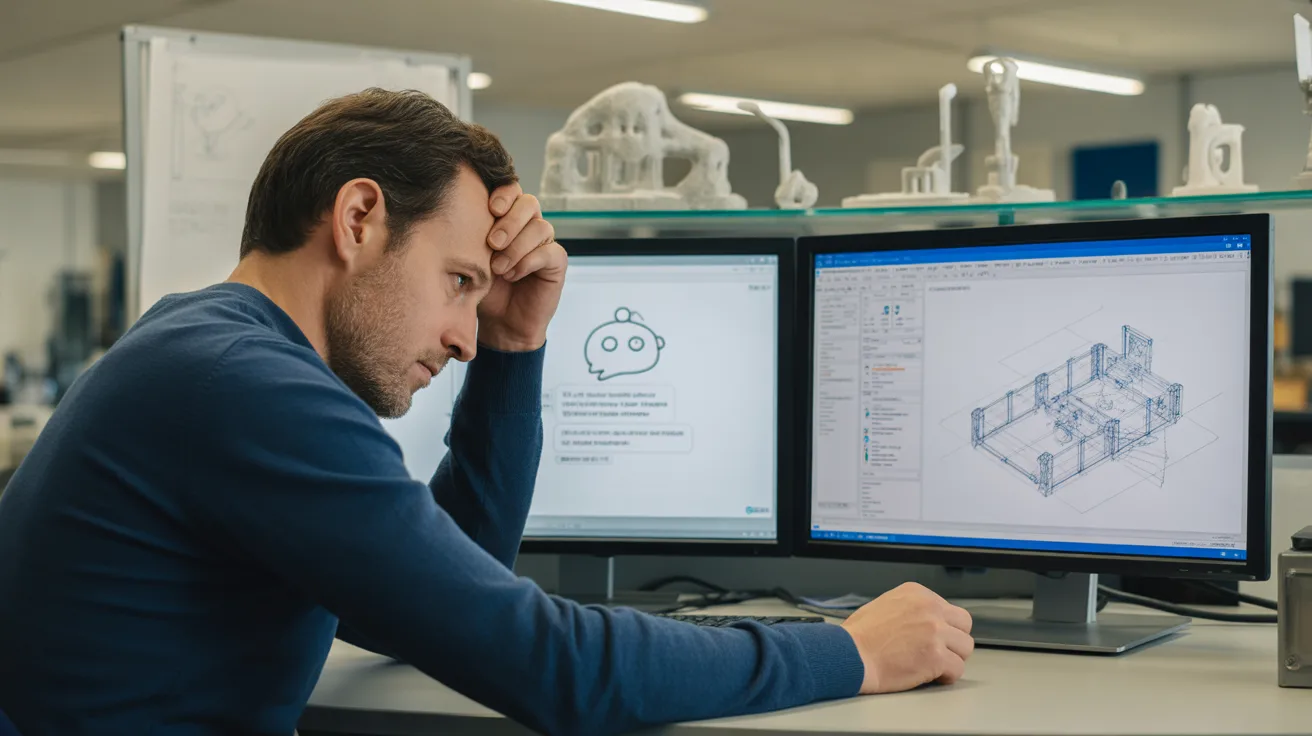
In practical terms, AURA is a documentation chatbot. It answers "how do I..." questions about SolidWorks operations, searches through SolidWorks communities and resources, retrieves results with source links, and can summarize or translate 3DSwym community content. There are also some local AI features in beta, including Fastener Recognition, Command Predictor, and Picture to Sketch.
What AURA is not, despite how it was marketed, is a generative design co-pilot. It does not do topology optimization (that is SolidWorks Simulation, a completely separate pre-existing product). It cannot generate CAD files or assembly structures from text prompts. It does not create drawings using AI. It does not access your PDM or PLM vault data, and it does not retrieve engineering knowledge from your organization's history.
The on-stage demo at 3DExperience World showed someone typing "design me an e-bike" and watching AURA generate full assembly structures with sub-assemblies and part files. That capability has not shipped. What shipped in July 2025 was the documentation chatbot functionality only.
IN PRACTICE
It's the only AI for Mechanical Engineers that actually understands CAD, PLM, and the realities of enterprise design work. With Leo, our team improves design quality, reduces mistakes, and shortens time-to-market. Instead of wasting hours on repetitive searches and calculations, we focus on making better products and leading our category.
"It's the only AI for Mechanical Engineers that actually understands CAD, PLM, and the realities of enterprise design work. With Leo, our team improves design quality, reduces mistakes, and shortens time-to-market. Instead of wasting hours on repetitive searches and calculations, we focus on making better products and leading our category."
- Uriel B., Field Warfare and Survivability Specialist
The 3DExperience Lock-In Problem
Here is something that often gets buried in the marketing materials. AURA requires 3DExperience Connected. It is not available on traditional desktop SolidWorks.
That is a massive deal. The majority of active SolidWorks users, roughly 700,000 professional licenses, run the desktop version. If you are one of them, you cannot access AURA unless you re-purchase new cloud licenses through a reseller. This is not a free update or a simple add-on. It is a platform migration.
And the 3DExperience platform itself has a track record that should give you pause. An 18-year SolidWorks veteran published "37 Things That Confuse Me About 3DEXPERIENCE," which drew over 18,000 readers and prompted the SolidWorks CEO to personally meet with the author. As of early 2026, only 5 of those 37 issues have been fixed. User reviews on Capterra describe the platform with words like "zero efficiency" and "only cloud problems."
So before you even evaluate what AURA does, you need to ask whether you are willing to migrate your entire CAD environment to a platform that many experienced users find frustrating to work with.
What Engineers Actually Need From AI
Take a step back from vendor marketing and think about where engineers actually lose the most time. The biggest pain points are not about learning SolidWorks commands, they are about finding information.
Engineers spend hours searching through PDM systems for parts they know exist but cannot locate. They interrupt senior team members to ask about past design decisions. They dig through supplier catalogs looking for components that meet specific constraints. They redo calculations because the previous work is buried in a folder somewhere. They design custom parts when a perfectly good existing one is already in the vault.
These are the problems that cost real money and slow projects down. A tool that answers "how do I create a fillet in SolidWorks" is useful for a beginner, but it does not move the needle for experienced engineering teams.
What teams need is an AI layer that connects to their actual data, their PDM, their PLM, their internal documents, their design history, and makes all of that institutional knowledge searchable and accessible in plain language. That is a fundamentally different problem from answering documentation questions.
Where Leo AI Fills the Gap AURA Leaves Open
Leo AI was built specifically for this kind of problem. Rather than wrapping a general-purpose LLM around documentation, Leo is an AI platform trained on over one million pages of engineering standards, textbooks, and technical articles. It connects directly to your existing systems, including SolidWorks PDM, Autodesk Vault, PTC Windchill, Siemens Teamcenter, Arena PLM, and others.
Leo offers integrations with leading PDM and PLM platforms, so engineers can ask questions in plain language and get answers drawn from their own organization's full knowledge base. There is no platform migration required. Leo works alongside your existing CAD and data management environment, not instead of it.
The geometry-aware search is particularly relevant for teams frustrated with traditional PDM search. Instead of needing exact part numbers or file names, you can describe a part by function or geometry and find relevant components from your own design history. For teams with years of legacy data, that means reusing parts you did not even know you had, which has direct downstream impact on procurement and BOM costs.
Leo is also SOC-2 certified and GDPR compliant. No AI is trained on your data. Your IP stays protected and is never shared.
Keep Reading: AI for Mechanical Engineers: The Complete Guide · SolidWorks vs CATIA vs Creo: AI Comparison · SolidWorks Automation Without Coding · Best PDM Software for Mechanical Engineers
Real Engineers, Real Results
The difference between marketing promises and actual engineering value shows up clearly in how teams talk about their experience after months of real use.
A team lead at ZutaCore, a company building liquid cooling systems for data centers, described how every project used to require custom pipe adjustments, with a dedicated engineer spending three days just on that task. Leo found a nature-inspired solution the team would not have considered on their own, one that used standard off-the-shelf parts instead of custom manufacturing. The savings added up to around $400 per system and eliminated the need for a dedicated engineer per project.
An R&D engineer described the PDM connection as the best feature: "I found three viable bracket options fitting my exact envelope constraints in minutes, not days." That kind of search simply is not possible with AURA, which has no access to your vault data.
At a large defense and space organization using Teamcenter with years of legacy NX data, an engineer noted that traditional search was always a weak point. "If you don't know the exact part number or file name, you're basically not finding it." Leo changed that by allowing functional and geometric descriptions to surface relevant parts from the organization's own history.
FAQ
SwYFTSOL, "SolidWorks AURA: AI-Powered Context and Design Assistant for Engineering Teams," 2025
CAD Booster, "37 Things That Confuse Me About 3DEXPERIENCE," 2025
GoEngineer, "AI in SolidWorks," 2025
Hawk Ridge Systems, "What Is Here Today: AI in SolidWorks CAD 3DExperience," 2025
Develop3D, "SolidWorks AURA Announced as New AI Virtual Companion," 2025
See What Your PDM Is Missing
Ask Leo a question about your engineering data today.
Engineers using Leo find parts, past designs, and institutional knowledge in minutes instead of hours. Try it with your own data and see the difference.

#1 New AI Software Globally - G2 2026

Enterprise-grade security

Trusted by world-class engineering teams